Introduction
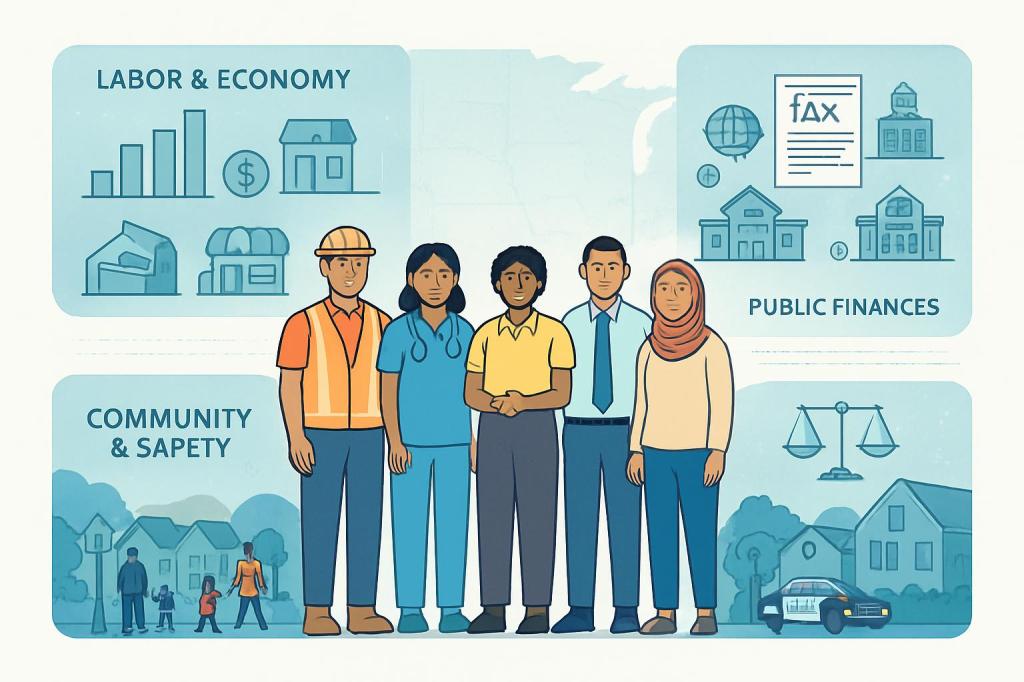
Public debate about undocumented immigration is dominated by a few powerful claims: that undocumented workers steal jobs, drain public coffers, and drive crime. This report tests those assumptions against the best available evidence from economics, demography, criminology, and public policy. It first examines undocumented immigrants’ role in labor markets and fiscal systems, then analyzes their community‑level impact on safety and local budgets, and finally scrutinizes the specific link between undocumented status and crime. Across sections, the report shows how law and policy shape these outcomes—and why empirical data consistently contradicts the most common fears.
Across economics, criminology, and public policy research, undocumented immigrants emerge not as primary drivers of crime or fiscal strain but as long‑term workers, taxpayers, and community members whose presence generally supports local economies and is associated with stable or declining crime rates.
Undocumented immigrants are deeply embedded in the U.S. labor market. Syntheses by the National Academies conclude that immigration overall has only very small effects on wages and employment of native‑born workers, with modest negative impacts, where they occur, concentrated among prior immigrants and U.S.‑born high school dropouts [1]. Newer work focused specifically on unauthorized inflows after 2020 finds that increases in undocumented workers expand total local employment roughly one‑for‑one, without evidence that native workers are crowded out [2]. This aligns with sectoral evidence that undocumented immigrants fill chronic shortages in low‑wage and “essential” jobs, especially in agriculture, construction, food services, and caregiving. Their labor supply acts as an adjustment margin that allows local and regional economies to meet demand, particularly during periods of tight labor markets.
The fiscal picture similarly runs counter to common narratives. Undocumented immigrants work at high rates, including labor‑force participation rates above 90% among working‑age men [1], and they pay into multiple layers of the tax system. They contribute through payroll taxes (often via Social Security numbers not tied to lawful permanent residence), income taxes, sales taxes, and property taxes (directly or through rent). National estimates suggest undocumented immigrants hold nearly $300 billion in annual spending power within a broader immigrant purchasing power of about $1.7 trillion [4], boosting local demand for goods and services and indirectly expanding tax bases. One comprehensive analysis finds they paid $96.7 billion in combined federal, state, and local taxes in 2022—around $8,889 per person, with $37.3 billion going directly to state and local governments [4]. Large destination states such as California, Texas, New York, Florida, Illinois, and New Jersey each receive more than $1 billion annually in tax revenue from undocumented residents alone [4]. Studies of high‑immigration states, including Florida and Arizona, indicate that undocumented immigrants tend to contribute more in state and local taxes than they receive in direct public services, even when education costs for their children are included [1], [3].
A key policy insight is that legal status and work authorization amplify these fiscal contributions. Legalization and formal work permits are consistently associated with higher wages and thus higher tax payments. Conservative estimates place the wage gain from legalization at about 10%, with higher estimates up to 12–15% [3]. Updated modeling suggests that granting work authorization to all current undocumented immigrants could increase their annual tax contributions by roughly $40.2 billion, possibly up to $136.9 billion, while also improving compliance and reducing informality [4]. These projections frame expansion of lawful status not as a net cost but as a revenue‑enhancing policy, particularly for state and local budgets dependent on income and consumption taxes.
The apparent inconsistency in fiscal impact estimates largely reflects methodological choices rather than the underlying behavior of undocumented immigrants. Earlier “static” ledger‑style studies could swing from a net positive to a net negative fiscal estimate—such as +$25 billion versus −$16 billion—simply by altering assumptions about how national defense, infrastructure, or intergenerational education costs are allocated to immigrants and their U.S.‑born children [2]. More recent general‑equilibrium approaches integrate both tax/transfer flows and labor‑market effects, showing that legal immigrants tend to reduce the tax burden on natives because their lifetime contributions exceed the transfers they receive, while undocumented immigrants’ positive effects operate more through labor‑market expansion, job creation, and consumer demand than through direct eligibility for benefits [1], [5]. Policy decisions about eligibility, enforcement, and work authorization therefore shape how these contributions are captured and measured.
Public safety is the area where popular beliefs and empirical evidence diverge most sharply. Across national and local studies, immigrants—including those without legal status—are less likely than U.S.‑born residents to commit crimes or be incarcerated, once immigration‑only offenses are excluded [2], [4], [5]. One influential analysis using institutionalization (incarceration and related confinement) as a behavioral proxy finds that undocumented immigrants are less likely to be institutionalized than natives, despite being disproportionately young, male, and low‑skilled—groups normally associated with higher offending rates [1]. At the metropolitan level, higher shares of undocumented residents are associated with lower or unchanged crime rates, not increases [1].
Temporal and geographic trends reinforce this pattern. From 1990 to 2013, the undocumented population more than tripled, while the national violent crime rate fell by 48% [1], [3]. Reviews of data across states, counties, and neighborhoods confirm that jurisdictions with higher shares of unauthorized immigrants typically do not experience higher rates of violent or property crime and often see declines in offenses such as homicide and robbery [2], [4], [5]. Several studies highlight that many immigrants processed in local jails are held for federal immigration violations instead of traditional criminal charges, underscoring how conflating civil immigration enforcement with crime statistics can inflate perceived criminality among the undocumented [2].
Criminological theory has evolved in response to this evidence. Older “social disorganization” models predicted that concentrations of disadvantaged newcomers would erode community cohesion and increase violence. More recent research instead supports an “immigrant revitalization” perspective in many contexts: low crime‑prone immigrants and their families help stabilize neighborhoods, support local businesses, and build dense social networks that can enhance informal social control [3], [6]. One national study even finds suggestive evidence that undocumented immigration contributed to the U.S. crime drop, in part by strengthening local economies and social organization [3]. Mechanisms proposed include strong deterrence (given the high personal costs of criminal justice contact for those facing deportation), positive selection of migrants on motivation and risk aversion, and the role of family and community networks in sustaining law‑abiding norms [2].
Legal status again appears pivotal. A Federal Reserve synthesis notes that when large numbers of undocumented immigrants gained legal status under the 1986 Immigration Reform and Control Act (IRCA), areas with more newly legalized residents saw larger subsequent declines in crime, especially in property offenses [3]. This suggests that, even from an already low baseline of offending among the undocumented, regularization and greater access to formal labor markets can further reduce crime risks. More broadly, nonpartisan reviews emphasize that as immigration has increased, violent crime has generally fallen, indicating that immigrant‑rich communities, including those with substantial undocumented populations, are not becoming more dangerous [1], [4], [5].
At the community level, these patterns have direct implications for perceptions of safety, belonging, and social cohesion. Over 80% of undocumented immigrants have lived in the United States for more than five years [1], and many reside in mixed‑status families with U.S.‑citizen children. They are thus long‑standing neighbors, co‑workers, parents in local schools, and participants in religious and civic institutions. Studies of local fiscal capacity stress that their tax payments support precisely the services that anchor community stability—public education, health systems, policing, and emergency response [1], [4]. Analyses of large‑scale deportation proposals warn that mass removals would not only sever social networks but also deliver a macroeconomic shock comparable to the Great Recession, with cascading impacts on employment, housing markets, and local revenues [1]. By contrast, policies that expand work authorization and legal protections are projected to strengthen public finances and, based on the IRCA evidence, likely yield additional crime reductions.
Overall, the integrated evidence from demography, labor economics, public finance, and criminology converges on a consistent narrative: undocumented immigrants are tightly woven into the U.S. economy and community life; they are substantial contributors to tax revenues and local demand; and their presence is associated with equal or lower crime, not the heightened danger portrayed in much public discourse. Policy choices around legal status, enforcement, and labor‑market access largely determine whether their contributions are fully realized and how costs and benefits are distributed across communities.
Conclusion
Across labor markets, public finances, and community safety, the evidence converges on a clear picture: undocumented immigrants are not the drain or danger they are often portrayed to be. They fill critical labor gaps, spur local employment, and contribute billions in taxes while accessing few public benefits. Crime research consistently shows undocumented residents offending and being incarcerated at lower rates than U.S.-born peers, with higher local undocumented shares often linked to stable or falling violence. Policy choices around legal status and work authorization largely determine whether these residents are treated as liabilities or recognized as long‑standing, net contributors to shared prosperity and safety.
Sources
[1] National Academies of Sciences, Engineering, and Medicine. “The Economic and Fiscal Consequences of Immigration.” https://www.nationalacademies.org/projects/DBASSE-CNSTAT-13-03
[2] Dallas Federal Reserve Bank. “Local Labor- and Housing-Market Effects of Unauthorized Immigration.” https://www.dallasfed.org/~/media/documents/research/papers/2026/wp2607.pdf
[3] American Immigration Council. “Undocumented Immigrants in the United States: An Overview.” https://www.americanimmigrationcouncil.org/about-immigration/undocumented-immigrants
[4] CUNY Institute for State & Local Governance. “Global Roots, Local Impact: Immigrants’ Contributions to U.S. Communities.” https://islg.cuny.edu/resources/global-roots-local-impact
[5] Migration Policy Institute. “Immigrants and Crime in the United States.” https://www.migrationpolicy.org/explainer/immigrants-and-crime-united-states
[6] American Immigration Council. “Debunking the Myth of Immigrants and Crime: What the Research Says.” https://www.americanimmigrationcouncil.org/fact-sheet/debunking-myth-immigrants-and-crime
[7] Martinez, Daniel Eduardo, et al. “Immigration and the Recent Violent Crime Drop in the United States: A Pooled, Cross-Sectional Time-Series Analysis of Metropolitan Areas.” https://pmc.ncbi.nlm.nih.gov/articles/PMC6241529
[8] Institute on Taxation and Economic Policy (ITEP). “Undocumented Immigrants’ State & Local Tax Contributions.” https://itep.org/undocumented-immigrants-state-local-tax-contributions-2017
[9] Institute on Taxation and Economic Policy (ITEP). “Undocumented Immigrants’ Tax Contributions, 2024 Update.” https://itep.org/undocumented-immigrants-taxes-2024
[10] American Immigration Council. “Immigrants Contribute Billions in Taxes.” https://www.americanimmigrationcouncil.org/blog/immigrants-contribute-billions-federal-state-taxes
[11] Manhattan Institute. “The Fiscal Impact of Immigration: 2025 Update.” https://manhattan.institute/article/the-fiscal-impact-of-immigration-2025-update
[12] Butcher, Kristin F., and Anne Morrison Piehl. “Why are Immigrants’ Incarceration Rates So Low? Evidence on Selective Immigration, Deterrence, and Deportation.” https://escholarship.org/content/qt2x77h3pz/qt2x77h3pz_noSplash_86d1075532d19e82a7985b6f75ab7e1b.pdf
[13] National Institute of Justice. “Undocumented Immigration and Crime in the United States.” https://www.ojp.gov/pdffiles1/nij/grants/308552.pdf
[14] Dallas Federal Reserve Bank. “Immigrants, Crime, and the U.S. Labor Market.” https://www.dallasfed.org/-/media/documents/research/papers/2019/wp1905.pdf
[15] National Academies Press. “The Economic and Fiscal Consequences of Immigration,” Chapter 12 (Fiscal Impacts). https://www.nationalacademies.org/read/23550/chapter/12
[16] “Immigration and Public Finance in the United States.” Journal of Public Economics. https://www.sciencedirect.com/science/article/abs/pii/S1094202524000279
Written by the Spirit of ’76 AI Research Assistant





Leave a Reply