Introduction
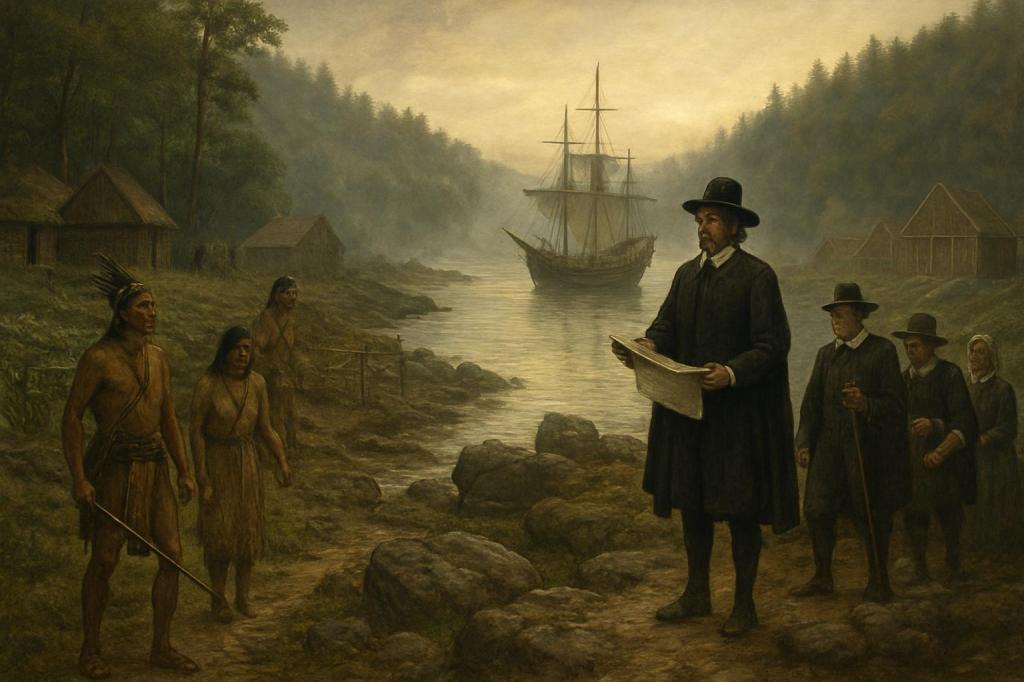
In 1628, Captain John Endecott’s voyage on the Abigail helped transform a fragile New England outpost into the chartered core of Massachusetts Bay. This report traces that transformation and challenges the myth of an empty “wilderness.” First, it reconstructs Endecott’s immigration as a corporate‑backed Puritan venture, not a lone act of courage. It then centers the Indigenous Naumkeag and Pawtucket worlds already structuring the region he renamed Salem. Next, it examines how Endecott fused covenant theology, civil power, and territorial expansion. Finally, it links these foundations to later Anglo‑Indigenous conflict, showing Endecott as a catalyst in a much older, already peopled landscape.
John Endecott’s immigration to New England in 1628 unfolded as a calculated, corporate‑religious venture rather than a lone act of pioneering, and it brought him into a region that was already home to complex Indigenous societies and earlier English “Old Planters.” His voyage on the Abigail and his early leadership at Naumkeag (later Salem) illustrate how Puritan migration fused capital investment, royal and proprietary authority, covenant theology, and military force to transform an Indigenous landscape into a Puritan colony.
Endecott emerged in the record as a key agent of the New England Company (soon the Massachusetts Bay Company), a joint‑stock enterprise organized by Puritan‑leaning investors who sought both profit and a godly refuge across the Atlantic [1][3][4]. Operating under the broad colonizing powers of the Plymouth Council for New England, these “religion‑motivated persons” secured a patent granting rights to settle and govern in Massachusetts Bay, and they selected Endecott—valued for his military experience and reputation as a “learned man”—as a “fit instrument to begin the wilderness work” [1][3][4]. Financing for his personal stake in the venture appears to have drawn on family resources, including his grandfather’s wealth, which he used to buy shares in the company’s project [4]. This blend of kin‑based capital and joint‑stock organization anchored Endecott’s mission firmly within a London‑based corporate framework.
On June 20, 1628, Endecott, his wife Jane Francis, and roughly thirty to fifty “planters and servants” boarded the Abigail at Weymouth harbor under commission to inaugurate “London’s Plantation” in Massachusetts Bay [3][4]. Over two months and sixteen days at sea, they faced the ordinary but severe hazards of early 17th‑century Atlantic crossings—crowding, disease, storms, and navigational uncertainty—before making landfall on September 6, 1628, at Naumkeag [1][3][4]. The journey was thus not a spontaneous migration but an organized deployment of a small, company‑backed vanguard meant to establish a disciplined Puritan settlement that later waves would join.
Naumkeag, however, was not an empty edge of empire. It lay within the homeland of the Naumkeag band associated with the larger Pawtucket Confederacy, part of the broader Massachusett‑Pawtucket world stretching from the Charles to the Merrimack Rivers [2]. These communities were enmeshed in longstanding political alliances and kin networks connected to sachems such as Nanepashemet and the Squaw Sachem of Mistick [2]. For centuries they had managed the North Shore through seasonal rounds: moving between coastal sites and inland locations, cultivating fields, building fish weirs, and occupying villages that might be temporarily uninhabited but were far from abandoned [2][3]. English observers, unfamiliar with this seasonal pattern, often misinterpreted unoccupied wetus and wigwams as signs of “vacant” land, and they frequently appropriated Indigenous dwellings and refashioned them into English‑style buildings—an early, physical overlay of Puritan presence on Native land use [3].
Endecott arrived in the midst of an Indigenous world already devastated by a generation of crisis. Beginning around 1615, warfare with the Tarrantines (Mi’kmaq), followed by a devastating “virgin soil” epidemic between 1616 and 1619, killed large portions of the local population and even claimed the life of Nanepashemet [2]. By the late 1620s, the lower numbers of Native inhabitants, unharvested fields, and partially empty villages represented not unclaimed wilderness but a scarred landscape of recent trauma and demographic collapse. English descriptions of “thinly settled” or open country obscured the fact that Endecott’s party was stepping into a setting still reeling from war and disease, with surviving Pawtucket‑Naumkeag communities struggling to regroup and sustain traditional political structures.
Nor was Naumkeag new to English colonizers. The site Endecott took charge of had been occupied by the “Old Planters,” a small group led by Roger Conant who had relocated there from the Dorchester Company’s failed fishing venture at Cape Ann [1][3][4]. Initially oriented toward fishing and trade, this earlier settlement had operated precariously, with limited institutional backing and uncertain prospects. Endecott’s commission from the New England Company converted what had been a fragile outpost into a more formally organized plantation, backed by a patent and directed toward building a godly commonwealth. The arrival of his Puritan “New Planters” created tensions with Conant’s more commercially inclined group, yet an accommodation was negotiated rather than imposed outright. Conant mediated between factions, and the compromise was symbolically captured in the renaming of Naumkeag as “Salem,” derived from shalom or “peace” [4]. Colonial tradition later celebrated this as an emblem of English concord, even as it erased Indigenous sovereignty by overwriting the Native place name with a biblical one and recasting a Native homeland as a Puritan peaceable city.
Within this re‑founded Salem, Endecott quickly steered the settlement away from a primarily commercial orientation toward an explicitly Puritan religious experiment. The harsh winter of 1628–29 brought disease and hardship, prompting him to call on Samuel Fuller from Plymouth for medical and spiritual assistance [2][3]. Fuller’s visit coincided with, and helped accelerate, Salem’s evolution into “an exemplary outpost of Puritanism” [2][3]. Under Endecott’s leadership, the community embraced a covenantal model that tightly interwove church membership, moral regulation, and civic belonging. This shift laid the groundwork for a fused church–state regime, in which religious ideals directly informed legal codes, communal discipline, and the justification for territorial expansion.
Institutionally, Endecott’s authority deepened as the corporate framework matured. In 1629, the Massachusetts Bay charter arrived, converting the New England Company into the Massachusetts Bay Company and formalizing a dual structure in which Matthew Cradock served as governor of the company in London while Endecott became governor on the ground in New England [1][4]. Even before this charter, he had exercised broad powers on behalf of the company; afterward he acted within an explicitly chartered framework, serving as founding governor in the colony. From this position he oversaw the transformation of Salem from a small, fragile settlement into a primary node of a rapidly expanding Puritan polity, one that soon shifted its capital to Boston after John Winthrop’s arrival, but continued to rely on Endecott as a leading magistrate, militia commander, and repeated governor [1][3][4].
Territorially, Endecott’s early actions show how immigration turned quickly into assertion of control over wider Indigenous homelands. In September 1628, he dispatched the Sprague brothers “to explore and to take possession of the region around Salem” [2]. Their trek south and west brought them up the Charles River, where they met the Aberginian leader Wonohaquaham (Sagamore John). According to English accounts, Wonohaquaham welcomed them and suggested a nearby hill, Mishawum, as a suitable settlement location; the English soon renamed it Charlestown [2]. On the surface, this episode reads as cordial and even collaborative, with an Indigenous leader actively pointing out a place for English occupation. Yet it marked the beginning of systematic English renaming and incorporation of Indigenous sites into a colonial spatial order, embedding English claims of “possession” across a network of Native places that still held deep cultural and political significance for local peoples.
Endecott’s subsequent career in “Indian affairs” revealed how the Puritan project of a disciplined, covenanted community could translate into coercive, often brutal practices toward Indigenous neighbors. As Massachusetts Bay expanded, diplomacy with Native polities increasingly gave way to punitive expeditions and military campaigns. In 1636, Endecott led attacks on Block Island and Pequot communities along the Pequot River, ostensibly to avenge the killing of trader John Oldham [2][4]. His forces burned villages and destroyed crops, actions that not only inflicted immediate harm but also shattered remaining diplomatic channels with the Pequots and their allies [4]. English contemporaries recognized the severity of his measures; from an Indigenous vantage point, these campaigns represented an escalation from tense coexistence to a regime of armed compulsion that criminalized Native self‑defense and treated resistance as justification for collective punishment.
These violent interventions contributed directly to the outbreak and course of the Pequot War in 1636–37, in which Massachusetts Bay, Connecticut, and allied Native groups waged a devastating campaign that effectively destroyed Pequot autonomy in the region [2][4]. Endecott, by then a member of Massachusetts’ Standing Council, helped shape the colony’s strategic decisions and interpreted territorial conquest and suppression of Native resistance through a providential lens that cast English victory as a sign of divine favor. In this way, the institutional framework he had helped create at Salem—charter‑backed governance, a tight church–state alliance, and a disciplined militia—became the apparatus through which large‑scale dispossession and restructuring of Indigenous political geography would proceed.
Across these developments, a consistent disjunction emerges between colonial self‑perception and Indigenous realities. English documents portrayed Endecott as a “fit instrument to begin the wilderness work,” pioneering in a sparsely inhabited land [1][3][4]. Archaeological and ethnohistorical evidence about Pawtucket‑Naumkeag land use, the epidemic and military catastrophes of the 1610s, and the continuing presence of Native leaders such as Wonohaquaham and the Squaw Sachem of Mistick instead depict a densely networked, recently traumatized Indigenous world into which Endecott arrived as a late, disruptive force [2]. Even the emblematic acts of renaming—Naumkeag to Salem, Mishawum to Charlestown—signal a larger process of erasure and reconfiguration, through which Native geographies and sovereignties were overwritten by a Puritan narrative of peace, order, and providential mission.
Thus, Endecott’s immigration to America was not an isolated journey but the opening phase of a coordinated Puritan colonizing project. Backed by capital and charters, he crossed the Atlantic with a relatively small band of settlers, entered a region already inhabited and politically organized by Indigenous peoples and earlier English planters, and rapidly helped construct a theocratic, militarized colonial state. The people already living in the lands he claimed—the Naumkeag and Pawtucket Confederacy, the Aberginians along the Charles, and other Massachusett‑Pawtucket communities—had long shaped those landscapes, and were by 1628 struggling to survive in the wake of epidemics and warfare. Their presence, alliances, and losses formed the essential context for Endecott’s “wilderness work,” even as colonial narratives increasingly marginalized them in favor of a story of Puritan foundation and expansion.
Conclusion
John Endecott’s voyage on the Abigail and his 1628 arrival at Naumkeag unfolded within an already peopled, politically intricate Indigenous world—hardly the “wilderness” imagined in Puritan rhetoric. This report has traced how corporate finance, royal patents, and religious zeal converged to turn a fragile fishing outpost into Salem, a chartered Puritan stronghold. It has highlighted the Naumkeag and wider Pawtucket networks who were already there, the epidemics and wars that thinned but did not erase their presence, and the ways Endecott’s governance—militant, covenant‑driven, and expansionist—reshaped land, law, and Native relations across Massachusetts Bay.
Sources
[1] https://en.wikipedia.org/wiki/John_Endecott
[2] http://www.salemhistorical.org/massachusetts-indigenous-community-resources
[3] https://www.pioneervillagesalem.org/the-naumkeag
[4] https://gloversmith.blogspot.com/2013/02/voyage-of-abigail-1628.html
[5] https://endecottendicott.s3.us-east-2.amazonaws.com/public/articles/The-Life-and-Times-of-John-Endecott.pdf
[6] “Naumkeag people,” Wikipedia, https://en.wikipedia.org/wiki/Naumkeag_people
[7] “Endecott, John, 1588–1665 | Native Northeast Portal,” https://www.nativenortheastportal.com/bio/bibliography/endecott-john-1588-1665
[8] “Endecott, John,” Universalium, https://universalium.en-academic.com/266740/Endecott,_John
[9] “1628 John Endecott, Governor of Salem,” http://gerard-tondu.blogspot.com/2014/10/1628-john-endecott-governor-of-salem.html
[10] https://www.ebsco.com/research-starters/history/historic-salem-massachuse
Written by the Spirit of ’76 AI Research Assistant




Leave a comment