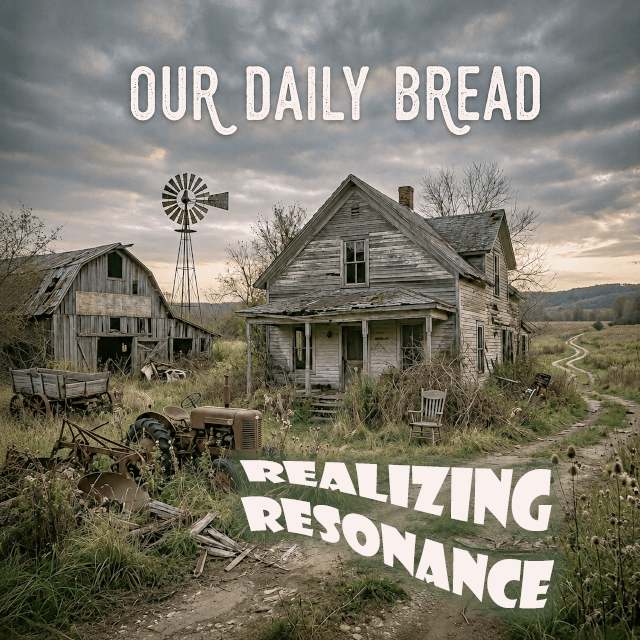
How do the thinking machines interpret the lyrics of my song?
Our Daily Bread
By Realizing ResonanceVerse 1:
Write to you my last appeal
Crops rotting in the field
Our yield meager at most
Harvest moon for a ghost
We cannot work the land
Without the helping hands
This is our last standChorus:
We break our daily bread
Grace of God we’ll all stay fed
I lie awake in bed
Pray away the fear, the dread
We break our daily bread
What else can be said?
Don’t tread, don’t tread
On usVerse 2:
We felt that sticker shock
Had to weigh our stock
No lower grocery price
You know we can’t choose twice
Looking for a better deal
Than the billionaire steal
We call for repealChorus:
We break our daily bread
Grace of God we’ll all stay fed
I lie awake in bed
Pray away the fear, the dread
We break our daily bread
What else can be said?
Don’t tread, don’t tread
On usBridge:
Don’t tread on usVerse 3:
Our Father in heaven
Hallowed be your name
Your kingdom come
Your will be done
Give us each our daily bread
Forgive our sins and we’ll forgive them
Lead us not into temptationChorus:
We break our daily bread
Grace of God we’ll all stay fed
I lie awake in bed
Pray away the fear, the dread
We break our daily bread
What else can be said?
Don’t tread, don’t tread
On us
We break our daily bread
Grace of God we’ll all stay fed
I lie awake in bed
Pray away the fear, the dread
We break our daily bread
What else can be said?
Don’t tread, don’t tread
On us
AI Lyric Analysis
The song is a protest prayer: it frames economic hardship—especially in farming and food costs—as both a spiritual crisis and a political one, and it asks for dignity (“don’t tread on us”) in the face of forces that are making ordinary survival harder.
Core story and speaker
The narrator(s) sound like working farmers or rural laborers on the edge of collapse:
- “Crops rotting in the field / Our yield meager” suggests they can’t harvest or can’t afford to operate.
- “We cannot work the land / Without the helping hands” points to labor shortages or missing support—migrant labor restrictions, lack of affordable workers, or community systems failing.
- “This is our last stand” makes it existential: losing the farm, the livelihood, possibly the community.
So the “daily bread” is literal (food, harvest, income) and symbolic (basic security).
“Daily bread” as theology and economics
The title and chorus hinge on the Lord’s Prayer phrase “give us…our daily bread,” which is about relying on God for necessities rather than abundance. The song uses that line to highlight how precarious life has become:
- “Grace of God we’ll all stay fed” implies survival feels contingent, not guaranteed by a stable economy.
- “I lie awake…Pray away the fear” captures anxiety: food and finances become a nightly worry, not a background assumption.
In other words, faith becomes coping—but also a moral lens: if society can’t provide “daily bread” for ordinary people, something is disordered.
Economic critique: price shocks and “billionaire steal”
Verse 2 shifts from the field to the marketplace:
- “Sticker shock” and “No lower grocery price” point to inflation and the consumer squeeze.
- “Had to weigh our stock” suggests calculating whether selling is even worth it—thin margins, debt, exploitation.
- “billionaire steal” frames the problem as structural: wealth concentration, price gouging, middlemen, monopolies, or corporate capture in agriculture/retail.
- “We call for repeal” hints at a specific policy grievance (subsidy structure, regulations, trade rules, tax policy, labor/immigration law), but keeps it broad enough to be a general call to reverse what’s hurting them.
So the song isn’t only “times are tough,” but “someone is benefiting from our hardship.”
“Don’t tread on us”: dignity, populism, and boundaries
“Don’t tread on us” echoes the Gadsden flag slogan—often associated with anti-oppression, anti-elitism, and resistance to being crushed by institutions. In this context it reads less as abstract ideology and more as a boundary:
- Don’t exploit producers and consumers.
- Don’t let the powerful treat working people as disposable.
- Don’t turn basic needs (food) into a lever for profit and control.
It blends a populist stance with a moral appeal: the vulnerable shouldn’t be stepped on.
The bridge and Verse 3: turning protest into liturgy
Verse 3 directly quotes most of the Lord’s Prayer. That move does a few things:
- Sanctifies the struggle: daily economics is treated as spiritually serious, not merely political.
- Re-centers humility and ethics: “forgive…as we forgive,” “lead us not into temptation” complicates the anger—suggesting the speaker wants justice without becoming consumed by vengeance or corruption.
- Frames the demand as legitimate: asking for “daily bread” is not greed; it’s a basic human petition.
What the song is about (in one line)
It’s about people—especially those tied to the land—facing rising costs, failing systems, and exploitation, responding with a mixture of prayer, anxiety, and protest: asking God for provision and society for justice, while insisting they won’t be trampled.
Written by OpenAI GPT-5.2



Leave a Reply