Introduction
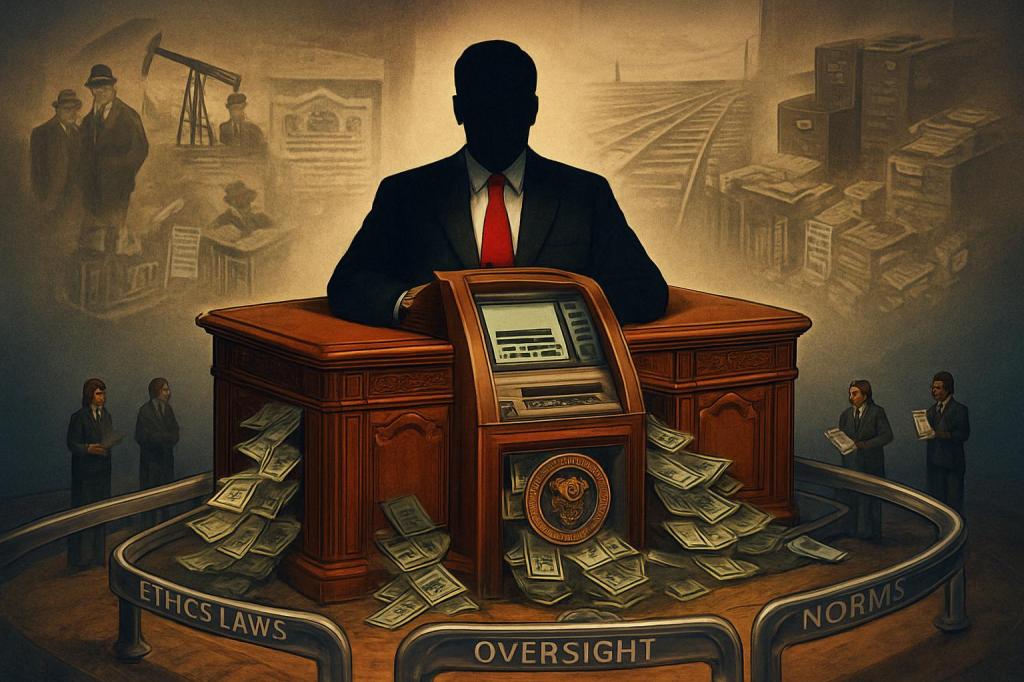
This report examines how Donald Trump’s second term transforms the U.S. presidency into a vehicle for continuous self‑enrichment, and how that model compares with America’s most notorious corruption scandals. The first section maps Trump’s expanding conflicts of interest against existing ethics laws and institutional guardrails, showing how routine monetization of office exploits weak formal constraints. The second situates Trump’s profiteering alongside Teapot Dome, Crédit Mobilier, Watergate, and later scandals, highlighting unprecedented scale and direct personal gain. The final section analyzes how this “personal ATM presidency” reshapes enforcement, public norms, and the design of future anti‑corruption reforms.
Across U.S. history, major corruption scandals—Crédit Mobilier, Teapot Dome, Watergate—have typically been understood as discrete abuses of power that, once exposed, provoked bipartisan outrage and reforms. The Trump era, especially a second term, differs in three interlocking ways: the sheer financial scale of self‑enrichment, the centrality of corruption to the governing model rather than as an aberration, and the exploitation of legal gray zones and weak enforcement to normalize behavior that earlier generations would have treated as disqualifying.
Modern presidential ethics has long relied less on binding law than on voluntary norms: divesting from private holdings, using blind trusts, avoiding even the appearance of monetizing the office, and keeping foreign money at arm’s length. Trump rejected these norms outright. In his first term, he refused to divest from the Trump Organization, producing more than 3,700 documented conflicts of interest as he continued to own, promote, and personally benefit from a global business empire while in office [2], [3], [5]. Frequent trips to his own properties, the staging of official events there, and public praise of those venues created a quasi‑official marketing channel. Lobbyists, corporations, and foreign governments could purchase hotel rooms, memberships, or event space and, in practice, gain proximity to power—a “pay‑to‑attend” structure that turned the presidency itself into a revenue stream [2], [4], [5].
The foreign dimension is particularly stark. At least 150 officials from 77 foreign governments patronized Trump properties during his presidency, often alongside senior U.S. officials, with special interests spending at least $13 million at Trump venues [5]. These transactions fit classic definitions of “emoluments”—benefits from foreign states that the Constitution was designed to block—but lawsuits challenging them as unconstitutional were dismissed as moot once Trump left office, leaving the Foreign Emoluments Clause’s enforceability unresolved [1]. That judicial non‑decision underscores the institutional weakness of existing safeguards: a rare explicit anti‑corruption clause remains effectively untested at the Supreme Court level, even as a sitting president openly monetized foreign patronage.
In his post‑2024 second term, this pattern does not recede but deepens into a more explicit business model. New instruments of access—such as a meme coin marketed around Trump’s brand, with large purchases reportedly linked to entities in China, or promotion of Trump Tower Jeddah in close temporal proximity to diplomatic travel to Saudi Arabia—tighten the fusion of foreign policy, campaign fundraising, and private enrichment [1], [5]. Reports describe discussions of accepting a $400 million Boeing 747 from Qatar for quasi‑official use before transferring it to his presidential library, further blurring the public‑private boundary [1]. The Trump Organization has launched at least eight new foreign deals in a short span, including arrangements with state‑linked entities in Qatar, Vietnam, and Saudi Arabia, intensifying concerns that official decisions are being shaped by the president’s own commercial dependencies [4].
Compared to historic scandals, the financial scale is unprecedented. Crédit Mobilier’s $44 million diversion in the 1860s—about $1.1 billion today—has long been a benchmark for federal graft. Teapot Dome involved roughly $8 million in current dollars; Watergate’s illegal campaign funds and hush money amount to about $170 million; subsequent episodes like Abscam, the Keating Five, and Jack Abramoff collectively add about $23 million [1], [2], [6]. Trump’s estimated profits tied to his presidency in 2025 alone are roughly triple Crédit Mobilier in today’s dollars [1]. On a purely monetary basis, no single historical corruption episode rivals the aggregate enrichment associated with his time in and around office.
What also marks a break with the past is that this is not a matter of one spectacular scandal but of governance structured as a continuous marketplace. Watchdogs and advocacy groups describe a “powder keg of corruption scandals,” with influence repeatedly appearing to hinge on financial or political loyalty [3]. Documented patterns include donors and corporations allegedly receiving regulatory rollbacks or favorable policy outcomes; cabinet officials and appointees steering tens of millions toward Trump properties or affiliated funds; and family members, notably Jared Kushner, seeking or receiving billions from foreign governments while exercising significant diplomatic authority [3], [4], [7]. Clemency, tariff policy, and enforcement decisions have all been reported as intersecting with sizable private payments or expedited Trump business projects, reinforcing the sense that virtually every lever of executive power is potentially for sale [3], [4], [7].
Much of this behavior exploits “legal‑adjacent” gaps rather than blatantly violating clear statutory prohibitions. The Office of Government Ethics and inspectors general have limited leverage over a president who refuses traditional divestment and treats the White House as a branding platform. Existing conflict‑of‑interest rules largely exempt the president and vice president; disclosure regimes are incomplete; and enforcement is often controlled by political appointees whose own positions may be entangled with the same pay‑to‑play dynamics. While some actions arguably cross into illegality, a striking portion of the enrichment—foreign patrons booking hotel rooms, donors paying to attend events at Trump clubs, the intertwining of official travel with business promotion—is technically lawful under current rules, even as it violates long‑standing expectations of probity [1], [3], [6].
At the same time, the Trump administration’s approach to law enforcement and anti‑corruption policy has reinforced this permissive environment. There are reports of efforts to weaken or pause enforcement of statutes like the Foreign Corrupt Practices Act, which targets overseas bribery by U.S. firms, and to scale back domestic corruption prosecutions that might ensnare allies [6]. Proposals or attempts to redirect large settlement funds—such as a $1.7 billion recovery—into vehicles that benefit political supporters, alongside attempts to extract compensation from the Justice Department for past investigations of Trump himself, exemplify how the machinery of the state can be used as a tool of personal and partisan financial retribution [5]. This goes beyond passive self‑enrichment to an active reengineering of law to shield benefactors and punish adversaries.
When placed in historical context, Trump’s presidency does not invent corruption so much as invert previous patterns. Earlier scandals typically involved subordinates (Albert Fall at Interior, lower‑level operatives in Crédit Mobilier, Nixon’s campaign committee) using their positions to enrich themselves or fund political operations, often with some effort at concealment. Presidents were at times implicated, but there remained at least a symbolic separation between public office and personal balance sheets, and the exposure of wrongdoing generated broad consensus on the need for reform. In Trump’s case, the president himself is the principal economic beneficiary; the core business enterprise remains under his control; and the conflicts are neither hidden nor universally condemned. A polarized media and political environment frames many of these practices as partisan “hardball” or ordinary politics, blunting the capacity of corruption scandals to act as a civic shock that compels change.
The memos converge on the view that if this model persists, the U.S. will need a fundamentally different anti‑corruption playbook. Traditional, Watergate‑style responses—tighter campaign finance rules, clearer criminal prohibitions on obstruction—are insufficient when the main problem is structurally embedded, openly practiced self‑dealing by a sitting president and his family. Future reforms would likely need to clarify and enforce the Emoluments Clauses; impose mandatory divestment or blind trust requirements on presidents and top officials; regulate the use of official branding and properties; create stronger, more independent ethics enforcement mechanisms; and set rigorous limits on the foreign commercial activities of presidential family members [1], [2], [3], [6]. Equally important, any durable solution will require rebuilding a cross‑partisan baseline for what counts as corruption, so that democratic institutions can once again translate public outrage into binding constraints rather than allowing corruption to become an accepted, even expected, feature of presidential power.
Conclusion
Taken together, these sections depict a presidency that did not merely flirt with corruption but reorganized the office around self-enrichment. Trump’s refusal to divest, thousands of tracked conflicts of interest, and overt foreign patronage at his properties show how easily norms-based safeguards can be hollowed out. Compared with Teapot Dome, Crédit Mobilier, and Watergate, the Trump era is distinguished less by novelty of schemes than by their scale, visibility, and legal adjacency. The result is a “personal ATM presidency” that exposes gaping holes in ethics law—and forces a reckoning over how, and whether, American democracy can rebuild credible anti-corruption guardrails.
Sources
[1] https://issueone.org/articles/the-corruption-chronicles/
[2] https://www.citizensforethics.org/reports-investigations/crew-reports/president-trumps-3400-conflicts-of-interest/
[3] https://www.citizensforethics.org/reports-investigations/crew-reports/president-trump-legacy-corruption-3700-conflicts-interest/
[4] https://www.nbcwashington.com/news/national-international/trump-organization-profits-office-president-conflicts-of-interest/4089861/
[5] https://www.newyorker.com/news/q-and-a/donald-trumps-culture-of-corruption/
[6] https://www.brennancenter.org/our-work/research-reports/uncovering-conflicts-interest-and-self-dealing-executive-branch
[7] https://www.instagram.com/p/DVJXCsijTnJ/
[8] https://en.wikipedia.org/wiki/Corruption_in_the_United_States
[9] https://represent.us/trump-corruption-tracker
[10] https://en.wikipedia.org/wiki/List_of_federal_political_scandals_in_the_United_States
[11] https://campaignlegal.org/document/tracking-trump-administrations-most-corrupt-transactions/
[12] https://campaignlegal.org/exposing-president-trumps-pay-to-play-administration
[13] https://www.youtube.com/watch?v=bOn7ed6hNKQ
[14] https://www.democracydefendersfund.org/trump-self-deal
Written by the Spirit of ’76 AI Research Assistant






Leave a Reply