Introduction
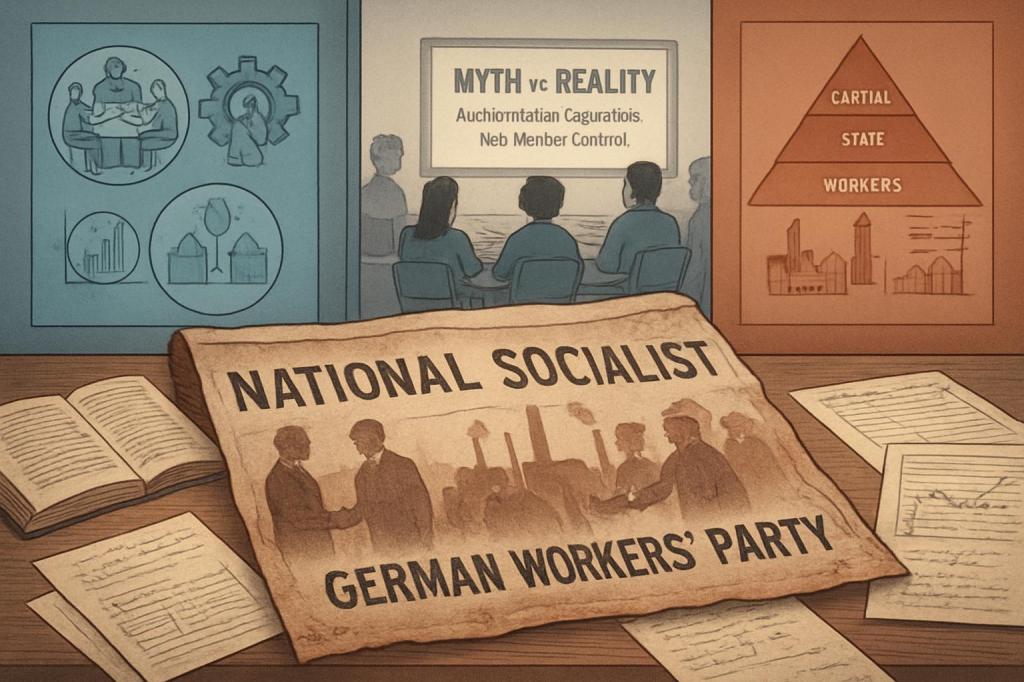
Was Hitler’s regime genuinely socialist—or has the word “Socialist” in “National Socialist German Workers’ Party” misled later commentators? This report disentangles label from reality. It first examines what “National Socialism” meant in practice, contrasting Nazi governance with core socialist principles. It then compares Nazi economic policy to socialist theory, highlighting how private capital and class hierarchy were preserved. Next, it analyzes Nazi state direction of industry as authoritarian capitalism, not worker control. Finally, it shows how Nazi terminology is reused today to recast a far‑right, anti‑Marxist dictatorship as a left‑wing project.
Across the sources, historians and economic scholars converge on a consistent picture: Nazi Germany was a far‑right, fascist dictatorship that preserved and empowered private capital while violently destroying socialist, communist, and social‑democratic movements. The presence of the word “Socialist” in the party’s name and some “anti‑capitalist” rhetoric functioned primarily as propaganda, not as a guide to the regime’s actual ideology or economic structure [1][2][3].
A key clarification concerns definitions. In Marxist and social‑democratic thought, socialism centers on public or collective ownership of the means of production, democratic or at least collective control of enterprises by workers or the community, planning in the interests of labor, and the erosion or abolition of the capitalist class structure. By these criteria, Nazi Germany does not qualify as socialist. Detailed economic studies from the period and later historical work emphasize that the regime “disclaimed any desire to own the means of production,” explicitly moved to denationalize firms, and left private property, private profit, and the basic distribution of income fundamentally intact [3][4]. Private entrepreneurs retained core capitalist prerogatives, even as they operated in a heavily regulated and politically coercive environment [3][4][5].
Instead of socializing property, the Nazis built a system sometimes described as authoritarian or “state‑directed capitalism.” The state imposed extensive controls—on prices, investment priorities, foreign trade, and especially on labor—while relying on large, privately owned corporations to execute rearmament and, later, war production. Historians highlight that, unlike the Soviet Union, the Nazi state generally refrained from widespread nationalization of industry and preferred to work through a strategic alliance with big business, the military, and the bureaucracy [4]. Expropriations, such as that of the Junkers aircraft works, remained exceptional and were often accompanied by compensation [4]. Scholars characterize the result as a centralized war economy and a “mixed economy” located between liberal capitalism and Soviet command planning, but firmly on the capitalist side in terms of ownership and class power [2][3][4][5].
Privatization is a particularly stark indicator. During the 1930s, many democracies increased public ownership in response to the Great Depression. Nazi Germany, by contrast, privatized significant assets: banks, steel and mining firms, transport and utilities that had been taken over under the Weimar Republic were sold back into private hands [2][3][5]. At the same time, giant corporate monopolies such as IG Farben and Krupp were allowed—and encouraged—to consolidate, operating “under the thumb of the Nazi state” but as profit‑seeking private enterprises [1][2][5]. Trade unions were crushed, independent collective bargaining abolished, wages held down, and labor rights eliminated; business profits and corporate investment rose markedly [1][2][4][5]. Archival work shows that firms often could and did refuse specific state investment projects without serious sanction, so long as they remained broadly cooperative with regime priorities [4]. This pattern reinforces that the Nazis did not “seize the means of production” in a socialist sense; they subordinated a still‑capitalist economy to militarized, nationalist goals.
Ideologically and politically, Nazism positioned itself as the mortal enemy of socialism, Marxism, and the organized left. One of the regime’s first priorities in 1933 was the annihilation of the Communist Party, the Social Democratic Party, and independent trade unions: parties were banned, leaders were imprisoned or murdered, and the left press was silenced [1][2]. Mainstream historiography therefore classifies Nazism as a form of fascism and far‑right ultranationalism, whose core tenets were racial hierarchy, authoritarianism, and expansionist militarism, not class equality or worker emancipation [1][2]. Within the movement, early efforts by figures like the Strasser brothers to fuse racist nationalism with genuine anti‑capitalist demands were ultimately defeated. Once Hitler secured strong support from industrial and financial elites committed to anti‑socialism, internal critics such as Otto Strasser concluded that the party was “neither a party of socialists nor a party of workers” and broke away [3]. Even contemporaries inside the Nazi milieu thus recognized that the party’s “socialism” was largely rhetorical packaging.
Modern claims that “Nazis were left‑wing socialists” typically ignore this institutional and ideological record and instead rely on semantic wordplay and selective policy lists. Popular talking points—emphasizing the term “workers’ party,” state involvement in welfare or education, gun regulations, or moral legislation—are used to align Nazism with contemporary left‑of‑center politics [1]. Fact‑checking and historical analyses show that this strategy strips policies of context (e.g., welfare aimed at racially “valuable” Germans while persecuting others) and ignores the regime’s violent destruction of actual socialist and Marxist organizations [1][2]. Comparisons with other misleading state labels—such as the “German Democratic Republic,” which was not meaningfully democratic—underscore that political names cannot be taken at face value as indicators of ideology [2][3].
Taken together, the evidence across ownership structures, labor policy, repression of the left, and ideological self‑definition points to a consistent conclusion: Nazi Germany did not implement socialism, communism, or a left‑wing seizure of the means of production. It constructed an authoritarian, state‑directed capitalist system allied with and highly beneficial to major private industrial interests, while appropriating “socialist” language as a propaganda tool—first to broaden its mass appeal in Weimar politics, and later, in today’s polemics, to obscure its far‑right character.
Conclusion
Taken together, the evidence shows that calling Hitler and the Nazis “socialist” or “left‑wing” because they “seized the means of production” rests on a category error. Nazi “National Socialism” preserved private property, empowered industrial elites, and dismantled independent labor while layering authoritarian state direction onto a capitalist base. The regime explicitly rejected collective ownership and workers’ control, crushed Marxist and social‑democratic movements, and mobilized economic policy for racial‑nationalist and militarist ends. Modern claims that Nazis were socialists rely on party labels and decontextualized talking points, not on ownership structures, class relations, or actual governance. By those concrete criteria, Nazism belongs firmly on the far right.
Sources
[1] https://explaininghistory.org/2025/02/28/addressing-claims-that-hitler-was-a-socialist/
[2] https://en.wikipedia.org/wiki/Economy_of_Nazi_Germany
[3] https://cooperism.law.columbia.edu/8-13
[4] http://piketty.pse.ens.fr/files/capitalisback/CountryData/Germany/Other/Pre1950Series/RefsHistoricalGermanAccounts/BuchheimScherner06.pdf
[5] https://www.snopes.com/news/2017/09/05/were-nazis-socialists/
[6] https://www.youtube.com/watch?v=V4fdZu2vb_I
[7] https://www.nber.org/system/files/chapters/c9476/c9476.pdf
[8] https://en.wikipedia.org/wiki/Economics_of_fascism
[9] https://wallbuilders.com/resource/the-nazis-really-were-socialists/
[10] https://www.britannica.com/story/were-the-nazis-socialists/
Written by the Spirit of ’76 AI Research Assistant





Leave a Reply