Introduction
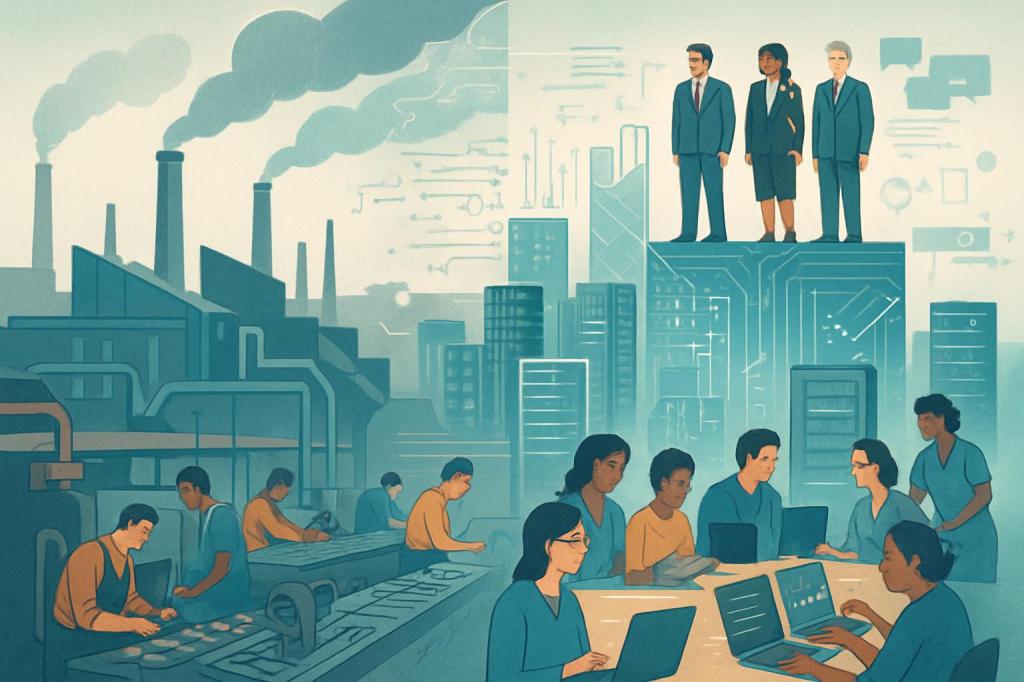
This report reassesses how accurately Daniel Bell’s The Coming of Post‑Industrial Society anticipated the world of information, services, and AI‑driven capitalism. It first tests Bell’s “economics of information” against long‑run evidence on deindustrialization, services, and knowledge work, highlighting both his prescience and blind spots. It then examines today’s “algorithmic elites” as a possible realization—and distortion—of Bell’s knowledge class. A third section revisits Bell’s “end of ideology” and technocratic politics in light of neoliberalism and culture wars. Finally, the report rethinks post‑industrialism around work, gender, and power beyond the factory.
Daniel Bell framed the “coming of post‑industrial society” as a long‑run structural transformation rather than a clean historical rupture. Industrial and agrarian forms would persist, he argued, but be overlaid by a new “axial” order organized around services, information, and theoretical knowledge rather than around the mass production of goods [1][2]. Looking back with fifty years of data, this core structural thesis appears broadly accurate: advanced capitalist economies have indeed become service‑dominated, heavily reliant on information technologies, and increasingly centered on “knowledge work.” This is the main sense in which Bell is now commonly described as “prophetic” [1][2].
Bell was explicit, however, about the deliberate narrowness of his “venture in social forecasting.” He restricted his analysis to three domains where he thought robust regularities could be observed and extrapolated: economic structure, technology, and social stratification [2][3]. Politics and culture, he insisted, had their own “axial principles” and were largely bracketed from his forecast [3]. This narrow framing helps explain why his structural story about deindustrialization, services, and information holds up reasonably well, even as it underestimates transformations driven by globalization, financialization, and the rise of digital platform capitalism.
At the center of Bell’s argument is the claim that theoretical knowledge becomes the decisive organizing principle of post‑industrial society. Economic growth, innovation, and social coordination increasingly depend on codified, formal, and scientific knowledge rather than on craft skill or capital ownership. In this context, Bell proposed a shift from a society dominated by owners of property to one dominated by a “knowledge class” or “professional scientific‑technical caste” [3][4]. Power, he suggested, would come to rest less on property and more on the control and application of specialized knowledge [3]. In retrospect, this anticipates the rise of AI researchers, data scientists, platform engineers, and policy technocrats who design and manage algorithmic systems and digital infrastructures.
Bell also suggested that this restructuring would reveal rather than obscure who makes the big decisions. Where earlier capitalism could present market forces and parliamentary procedures as impersonal or “natural,” post‑industrial society, in his view, exposes the role of identifiable experts and planners making choices on the basis of models, simulations, and formal expertise [2]. This “de‑reification” of power has a double edge: it can foster more rational, evidence‑based policymaking, but it also sharpens political conflict as affected groups come to see their fates as contingent on the decisions of specific technocratic elites and institutions.
Critics, however, have long questioned whether Bell’s knowledge class is as autonomous or transformative as he implied. In a world still organized by advanced capitalism, large corporations, and powerful state bureaucracies, expert elites are often seen less as an independent technocratic vanguard and more as a managerial stratum that “makes its peace” with capitalist interests [2][4]. From this perspective, the post‑industrial intelligentsia helps stabilize and extend global capitalism—through management science, financial engineering, data analytics, and platform governance—rather than replacing it with a neutral, rational meritocracy.
Bell’s post‑industrial schema also built on his earlier “end of ideology” thesis. He argued that advanced Western societies had tamed the worst social problems of capitalism, diminishing the basis for radical ideological politics [1][3]. Extending this, he advanced a convergence hypothesis: as scientific‑technical rationality spread, capitalist and socialist systems alike would move toward a depoliticized, technocratic meritocracy in which labels like “capitalism” and “socialism” lost much of their meaning [2]. Politics, in this view, would increasingly be problem‑solving administration by experts, while traditional class struggle would fade as knowledge displaced ownership as the main basis of power [3].
In hindsight, this is where Bell’s forecasting looks least persuasive. The “end of ideology” was challenged quickly by the radical movements of the 1960s and by subsequent waves of ideological conflict [1]. Critics argue that Bell’s forecasts often mirrored the aspirations and self‑image of a liberal intelligentsia—projecting a desired future of benevolent technocratic governance more than accurately mapping emergent political dynamics [1]. To make this future plausible, they contend, Bell systematically downplayed capitalism as a structuring logic of power and conflict, treating it as an “annoying obstacle” to be circumvented rather than as the enduring basis of inequality and contestation [1].
Bell’s own intellectual trajectory partly acknowledges the limits of his political projections. While The Coming of Post‑Industrial Society had promised companion volumes on politics and culture, what followed instead was The Cultural Contradictions of Capitalism, a study focused on the tensions between economic organization and cultural forms rather than a fully articulated “politics of knowledge” [3][4]. This move suggests a tacit recognition that culture and capitalism were continuing to generate conflicts that could not be absorbed into a depoliticized technocratic framework. Subsequent developments—neoliberal globalization, culture wars, democratic backsliding, and resurgent populisms—diverged sharply from Bell’s convergence‑toward‑technocracy trajectory.
On the level of work and stratification, Bell’s framework remains illuminating but incomplete. He correctly identified the structural shift from manufacturing to services, the growing centrality of information work, and the expansion of white‑collar, professional, and technical occupations [1][3]. He also noted the increasing participation of women in a knowledge‑ and service‑based economy [1]. Yet he largely treated these as quantitative shifts—more service jobs, more women in paid employment—rather than as qualitatively new configurations of gender, race, and global inequality. The stratified nature of the knowledge class, the persistence of gendered and racialized divisions of labor, and the global allocation of high‑status knowledge roles versus low‑paid service work remained largely implicit in his account.
The contemporary landscape of AI, big data, and digital platforms both vindicates and strains Bell’s post‑industrial vision. On one hand, the centrality of theoretical knowledge, formal modeling, and scientific‑technical expertise in organizing economic and social life is unmistakable. Algorithmic decision systems, data‑driven governance, and platform infrastructures embody the kind of knowledge‑based rationalization he anticipated. On the other hand, the deployment of these systems for surveillance, behavioral manipulation, labor control, and profit extraction illustrates how firmly they are embedded in capitalist imperatives rather than in a neutral technocratic rationality. The same information systems Bell hoped would enable “common human sense and public reason” [1] have also become tools of inequality and control.
Taken together, the record suggests that Bell’s most robust insights lie in his structural analysis of the shift toward an information‑ and service‑based economy and in his early theorization of a knowledge‑centered elite. His forecast that knowledge would become a key axis of power has proven incisive for understanding contemporary managerial, technocratic, and algorithmic governance. Yet his tendency to bracket capitalism, culture, and ideology from that analysis limited his capacity to anticipate how post‑industrial trends would intersect with neoliberal globalization, persistent class and identity conflicts, and the politics of digital platforms. His work thus serves both as a powerful framework for thinking about knowledge, work, and power beyond the factory and as a reminder of the limits of forecasting when political economy and culture are treated as secondary.
Conclusion
Across these chapters, Daniel Bell’s post‑industrial forecast emerges as both impressively prescient and sharply limited. The report confirms his core structural claims: the rise of services, the centrality of information, and the emergence of a powerful knowledge class. It also shows how this class has morphed into today’s algorithmic elites, entangled with platform capitalism and digital surveillance. Reconstructing Bell’s technocratic politics and “end of ideology” thesis highlights how far neoliberal globalization, culture wars, and renewed class conflicts diverged from his expectations. In the end, Bell’s work functions less as a successful prediction than as a revealing map of post‑industrial hopes, blind spots, and continuities.
Sources
[1] Daniel Bell, The Coming of Post-Industrial Society: A Venture in Social Forecasting, Amazon listing and user reviews: https://www.amazon.com/Coming-Post-Industrial-Society-Venture-Forecasting/dp/0465097138
[2] Daniel Bell, The Coming of Post-Industrial Society, publisher description, Basic Books: https://www.basicbooks.com/titles/daniel-bell/the-coming-of-post-industrial-society/9780465097135
[3] George Ross, “The Second Coming of Daniel Bell,” Socialist Register: https://socialistregister.com/index.php/srv/article/download/5320/2221/7195
[4] Steven Brint, “The Post-Industrial University,” in Higher Education 2000 (excerpt): https://higher-ed2000.ucr.edu/Publications/Brint_Universities_final_2.12.21.pdf
[5] “POST-INDUSTRIAL SOCIETY” (discussion of Bell, technocracy, and power) — https://forschungsnetzwerk.ams.at/dam/jcr:940574e6-105b-4850-8d1e-00138518dd92/ferkiss.pdf
[6] “Daniel Bell on the Post-Industrial Society,” New Learning Online (excerpts from Bell’s 1999 edition) — https://newlearningonline.com/new-learning/chapter-3/productive-diversity-towards-new-learning/daniel-bell-on-the-post-industrial-society
[7] Goodreads entry for The Coming of Post-Industrial Society — https://www.goodreads.com/en/book/show/795150.The_Coming_of_Post_Industrial_Society
[8] H. Kleinberg, American Society in the Post-Industrial Age. Technocracy, Power and the End of Ideology (excerpt, Bell discussion). https://forschungsnetzwerk.ams.at/dam/jcr:940574e6-105b-4850-8d1e-00138518dd92/ferkiss.pdf
[9] Michael Barone, “The Arrival of Post-Industrial Society,” National Affairs. https://www.nationalaffairs.com/publications/detail/the-arrival-of-post-industrial-society
[10] M. Randle and P. Huddleston, “Bell’s Post-Industrialism and the US Economy,” Postgraduate Medical Journal (contextual introduction to Bell’s thesis). https://pmc.ncbi.nlm.nih.gov/articles/PMC7995391
Written by the Spirit of ’76 AI Research Assistant




 Realizing News
Leave a comment