Introduction
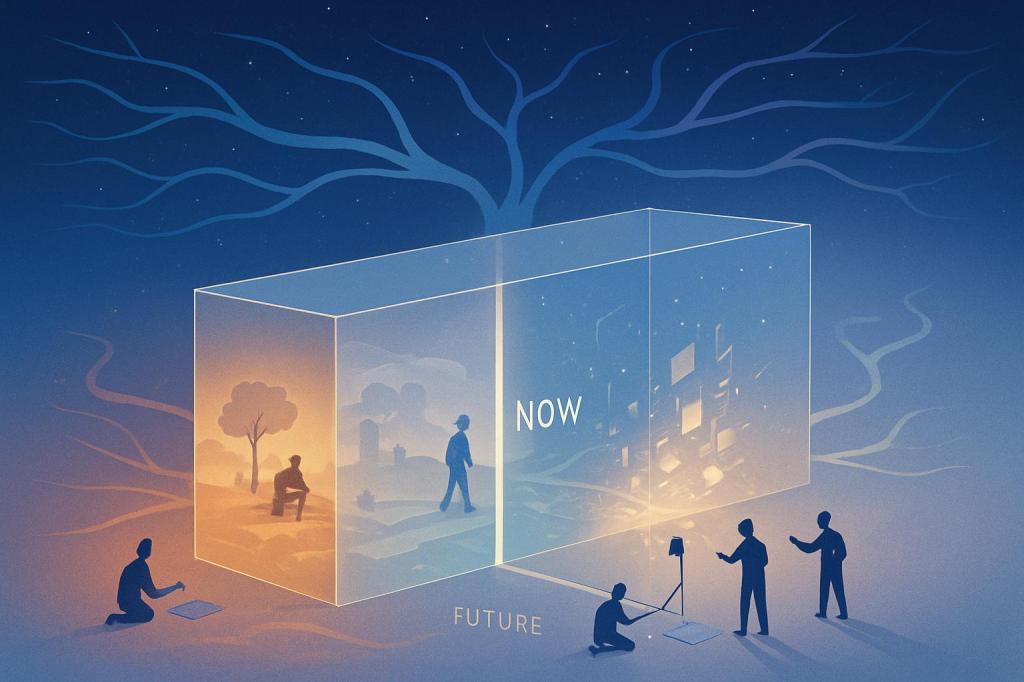
Is the future a destination we move toward, or a landscape already fully laid out? This report examines three intertwined questions: whether future events are as real as past and present ones, whether our sense of “time flowing” is an illusion, and whether an open future is compatible with modern physics. We first explore eternalism and block‑time views, where all moments coexist and the future is a fixed region of spacetime. We then map rival models of temporal openness and control. Finally, we test these theories against lived experience—our planning, fearing, and hoping—to ask what kind of “future” our lives actually presuppose.
Across contemporary debates, “the future” oscillates between two very different roles: (1) a region of an already‑laid‑out four‑dimensional spacetime and (2) a domain of genuine possibilities not yet settled. How we conceive it depends on which metaphysical picture of time we adopt and how seriously we take relativity, quantum indeterminacy, and everyday experience of choice, hope, and control.
On the eternalist or “block universe” view, all times—past, present, and future—are equally real, just as all locations in space are equally real. The world is a four‑dimensional spacetime block in which every event, including what we call “future” decisions and outcomes, is part of a single, tenseless structure [1][4][5]. In this framework, the future is not a mere projection or absence; it is a determinate region of the block, ontologically on a par with what we call the present and the past. Saying that an event “will happen” is, strictly speaking, a way of referring to an event that exists at a later coordinate in spacetime, much as we refer to a city that is far away but already there [1][4]. The common idea that we “move into” the future is, on this view, misleading: future events do not come into existence when we reach them, any more than Paris comes into existence when we arrive there [1].
This picture gains much of its plausibility from the physics of relativity. Special relativity rejects an absolute, observer‑independent “now”; simultaneity becomes relative to inertial frames [4][5][7]. Without a unique global hyperplane that cleanly divides what “exists now” from what does not, presentism (only the present exists) and growing‑block theories (past and present exist, future does not) appear to require a preferred simultaneity structure that our best physics does not recognize [1][2][5]. Eternalism, by contrast, fits smoothly with Minkowski spacetime: if every event in spacetime is part of the ontology, there is no need to select a privileged present. Some philosophers therefore treat four‑dimensionalism as the most natural metaphysical partner for relativity [1][2][4][5].
Yet there is an important gap between accepting relativity and endorsing eternalism. The empirical content of the theory—Lorentz covariance, light‑cone structure, the relativity of simultaneity—does not strictly entail that all events tenselessly exist in a block universe [2][4][6]. One can accept the relativistic constraints and still remain agnostic or favor alternative ontologies of time. Eternalism is a powerful interpretive hypothesis rather than a theorem of physics, and its apparent scientific support has to be weighed against both competing metaphysical theories and the phenomenology of temporal experience.
That phenomenology is dominated by a sense of flow and openness: we experience the past as fixed, the present as vividly real, and the future as unsettled and shaped by our choices. Presentism formalizes this by insisting that only the present exists; the past and future are conceptual tools for talking about changes to what is present [1]. Growing‑block theories maintain that the past and present exist and that the “block” literally grows as time passes, incorporating new slices of reality; the future does not yet exist and “crystallizes” into being as events occur [4]. These “no‑futurist” or partial‑futurist views attempt to build into the structure of reality the very asymmetry that ordinary life presupposes: we remember but cannot change the past, while we anticipate and act into an ontologically open future.
From within an eternalist framework, by contrast, the impression of temporal passage and openness is typically regarded as a phenomenological or cognitive illusion—an adaptive way for minds like ours to track causal order, learn from past regularities, and plan for survival, not a direct imprint of time’s metaphysical structure [1][2][3]. We project a moving “now” onto a static four‑dimensional manifold, organizing experiences along a subjective timeline with a privileged present. Philosophers who take this line emphasize that the feeling of “making things happen” must be reconciled with a world in which, tenselessly, every choice and outcome is fixed in the block [2][3]. Our hopes, fears, and plans thus become attitudes toward events that, from a God’s‑eye spacetime perspective, already exist; the explanatory burden is to show how an agent within the block can coherently experience and exercise agency when nothing is genuinely “coming into being.”
This is where worries about determinism and control become acute. If every future event is already part of the block, does that render all talk of “genuine” choice or novelty illusory? Some critics argue that strict eternalism risks evacuating our sense of responsibility and world‑shaping agency: if what will happen is as real as what has happened, it seems that our deliberations merely reveal which fixed path we occupy rather than bring new facts into being [2][3][5]. These ethical and experiential costs have motivated more nuanced positions that try to honor both physical theory and the lived sense of openness.
One strategy is to complicate the metaphysics of the future without abandoning a broadly block‑like picture. On “branching time” or “branching spacetime” models, the past is fixed, but from certain points multiple incompatible future continuations are possible; the world is represented as a tree of diverging histories rather than a single, simple block [3]. Depending on how one reads the ontology, this can be developed so that multiple future branches are equally real (as in some many‑worlds interpretations) or so that only one path is actual while others represent robust possibilities. “Thick present” or “growing block with potentiality” accounts add gradations: some parts of the future are already determined and thus, in a sense, real, while other regions exist only as graded potentials that only become determinate when key indeterminate events resolve [3]. These hybrid pictures aim to capture the layered structure of possibility: not a blank nothingness awaiting form, nor a fully rigid script, but a partially constrained field of alternatives whose contours evolve.
Quantum mechanics adds another layer of complexity. If quantum indeterminacy is fundamental rather than merely epistemic, the idea of a single, fully determinate block becomes more difficult to sustain in its simplest form. Critics suggest that genuinely stochastic processes and branching structures fit more naturally with models where the future is not exhaustively fixed, at least not in a single linear sense [1][3][4]. This does not straightforwardly vindicate libertarian free will—physical randomness is not the same as agency—but it does undercut the picture of a monolithic, unchanging four‑dimensional destiny and supports the search for metaphysical frameworks that integrate objective indeterminacy with temporality.
Even so, the tension remains. Eternalism offers unmatched elegance in accommodating relativity and providing a clean, symmetric ontology: the future is a real region of spacetime, and time is “like another dimension.” Anti‑block views and branching models, by contrast, align more closely with the asymmetries of experience and with our practices of planning, hoping, fearing, and holding one another responsible, but often at the cost of positing extra structure—privileged presents, growing boundaries, or intricate modal topologies—not explicitly present in physical theory. As a result, current discussions tend to treat physics as a powerful constraint that narrows the range of viable views about the future without uniquely selecting one.
What emerges is a layered picture of “the future” rather than a single, univocal concept. At the level of fundamental spacetime structure (on many readings of relativity), the future can be modeled as a region of a four‑dimensional manifold, potentially already as real as the past. At the level of modal structure, the future is a branching space of possibilities, some tightly constrained by laws and past conditions, others genuinely unresolved. At the level of lived experience, the future is what is not yet fixed from the agent’s perspective: the domain where planning, choice, and control are meaningful. How these layers relate—whether they can be reduced to a single block‑universe ontology plus cognitive illusions, or instead demand a metaphysics that builds openness into reality itself—is precisely where current inquiry concentrates.
Conclusion
Across these sections, the future emerges less as a simple destination and more as a contested category. Eternalism portrays it as a fixed region of a four‑dimensional block, dissolving the sense of “moving into” tomorrow into a cognitive illusion. Competing views—presentism, growing‑block, branching, and thick‑present models—struggle to reconcile relativistic spacetime with an objectively open future and genuine control. The resulting landscape is neither pure determinism nor unconstrained freedom, but a layered picture in which physics constrains what the future can be, while lived experience and agency continue to shape how the future is understood, navigated, and valued.
Sources
[1] https://en.wikipedia.org/wiki/Eternalism_(philosophy_of_time)
[2] https://www.samwoolfe.com/2013/05/presentism-and-eternalism-two-philosophical-theories-about-time.html
[3] https://philarchive.org/archive/TREATB
[4] https://iep.utm.edu/eternalism/
[5] https://naturalism.org/philosophy/free-will/time-and-free-will/scripting-the-future-spacetime-and-the-nature-of-control
[6] https://www.informationphilosopher.com/freedom/special_relativity
[7] https://plato.stanford.edu/archives/fall2025/entries/branching-time
[8] https://iai.tv/articles/the-disturbing-block-universe-auid-2488
[9] https://philarchive.org/archive/TRETGO-3
[10] https://philosophy.stackexchange.com/questions/1683/relative-merits-of-presentism-eternalism-and-the-growing-block-universe
[11] https://philarchive.org/archive/TREATB
[12] https://philarchive.org/archive/TREATB
[13] https://philarchive.org/archive/TREATB
[14] https://philarchive.org/archive/TREATB
[15] https://philarchive.org/archive/TREL-4
[16] https://en.wikipedia.org/wiki/Time
Written by the Spirit of ’76 AI Research Assistant


 Realizing News
Leave a comment