Introduction
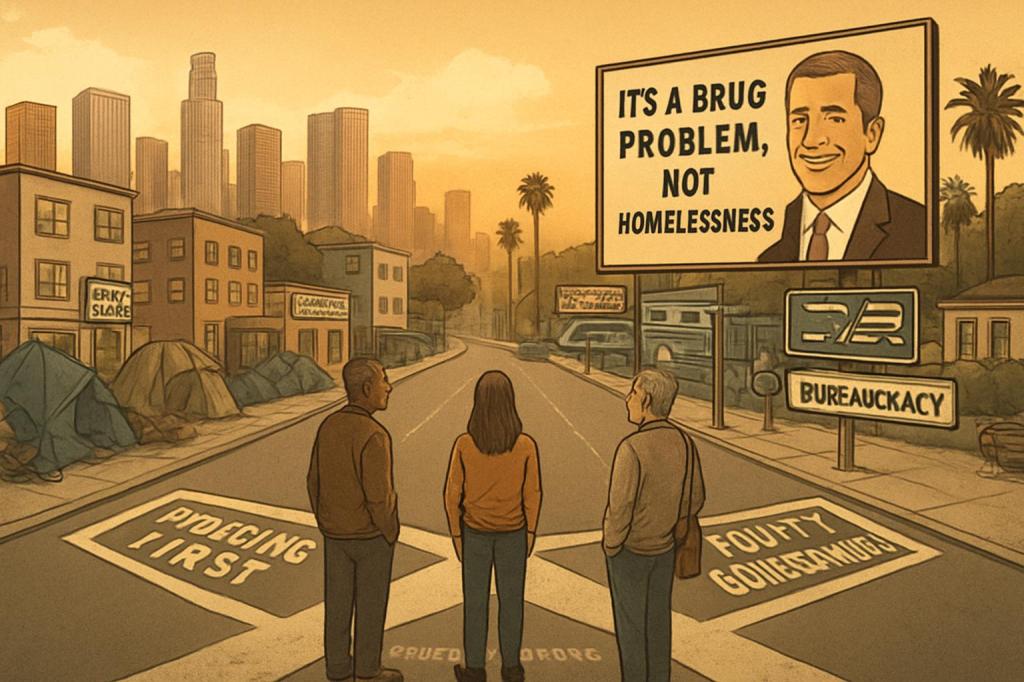
Los Angeles’ homelessness crisis sits at the intersection of housing costs, fragmented governance, and polarized political theater—and Spencer Pratt’s mayoral bid amplifies that tension. This report situates his hardline, treatment‑first platform against three backdrops: the structural limits on any LA mayor’s power; the evidence base around Housing First versus coercive treatment; and the equity stakes for low‑income Angelenos. It examines how Pratt’s “drug problem, not homelessness problem” framing, punitive tools, and celebrity‑driven rhetoric diverge from mainstream plans and research, and assesses whether his promises could realistically reduce homelessness—or merely redistribute visibility and blame.
Spencer Pratt’s mayoral campaign in Los Angeles situates homelessness at the center of a broader narrative about a “broken” city, but his proposed solutions rest on a sharp misdiagnosis of the crisis and a misunderstanding of what a mayor can realistically do within L.A.’s institutional constraints. His plan is built around three core claims: that Los Angeles does not have a housing shortage but a “drug problem”; that a corrupt “Homeless Industrial Complex” has squandered “billions”; and that a mandatory treatment–first model can quickly “clear the streets for good” without large-scale new housing production [1][2].
Los Angeles’ governance structure and past mayoral platforms provide important context for evaluating this agenda. Recent mainstream mayoral candidates advanced ambitious but institutionally grounded homelessness plans that focused on expanding interim and permanent housing using existing tools—tiny homes, hotel and motel conversions, permanent supportive housing—while acknowledging budget, land-use, and intergovernmental limits [1][2]. One highly publicized proposal promised 30,000 new interim beds in about a year at a one-time capital cost of roughly $743–$874 million and an estimated $660 million in annual operations—around $22,000 per person per year—yet lacked a clear funding stream and depended on Los Angeles County to shoulder ongoing costs [1]. This vision also collided with land-use realities: to site that many beds in 300 days would require stadium-scale facilities or dozens of new shelters and villages dispersed across 15 council districts, each subject to zoning, CEQA, and intense neighborhood pushback [1][2]. Seasoned officials called this “unrealistic” not simply on fiscal grounds, but because large congregate shelters are unpopular with unhoused people and routinely blocked by local opposition [2].
By comparison, a rival plan to rapidly house roughly 15,000–17,000 people by scaling up existing programs was criticized as too modest but deemed far more likely to be implemented, precisely because it fit within known funding channels, program designs, and the mayor’s limited formal powers [1][2]. Across these cases, the underlying lesson is that durable homelessness policy in Los Angeles depends less on headline promises and more on recurring operating budgets, feasible siting, intergovernmental coordination, and a mayor’s ability to build coalitions on a city council that can dilute or stall executive initiatives.
Pratt’s platform operates almost entirely outside this evidence-based and institutional frame. He asserts that Los Angeles “doesn’t have a homelessness problem — we have a drug problem” and that the core issue is not housing scarcity or rent burdens but addiction, mental illness, and systemic “waste” [1][2]. He casts existing providers, NGOs, and public agencies as an “evil racket” that “launder money and feed them more drugs, so they can keep their customers locked in this hell on our streets” [2], promising to “dismantle” this “Homeless Industrial Complex.” This rhetoric is politically potent—offering a clear villain and the promise of cleansing disruption—but it undermines the partnerships with healthcare, housing, and outreach organizations that large-scale, integrated interventions require.
Policy-wise, Pratt’s signature move is to invert the prevailing Housing First paradigm into a coercive “treatment-led recovery model.” In his formulation, participation in treatment for addiction and mental illness becomes a non-negotiable precondition for city-funded assistance, and “long-term housing will be reserved for those demonstrating stability and sobriety” [1]. That is not simply a prioritization of services; it is a gate that excludes many unsheltered people who are unable or unwilling to meet strict behavioral conditions. He repeatedly leans on legal tools such as 72-hour psychiatric holds under “gravely disabled” standards and suggests extending them, effectively normalizing involuntary commitment as a homelessness response [2]. He also pledges “mandatory rehab” at scale, curbs on harm reduction (“no more distribution of drug paraphernalia”), and efforts to stop “body brokering” by sending people who arrived from out of town “back home” [2][5].
The most theatrical component of his plan is a proposed large, nature-based treatment campus outside the city, pitched as a collaborative project with “literal billionaires” and “all the top doctors in the world” [3]. Pratt insists it would be “not a jail” but “mandatory rehab,” promising people “a job…not just a bed off Skid Row” [3]. This fuses Silicon Valley–style “moonshot” optimism with carceral control: a closed campus that is simultaneously marketed as compassionate, elite-driven innovation and as a tool for compulsory removal of visible street populations.
These ideas are advanced through a communication style calibrated for virality and outrage. Pratt’s campaign leans on his own experience of losing a home in the 2025 fires and on attacks against incumbent leadership, particularly Mayor Karen Bass, for alleged mishandling of disaster response [1]. He uses sharp, fear-inducing soundbites in debates and social clips—arguing that outreach-oriented or voluntary approaches will get people “stabbed in the neck” because “these people don’t want a bed — they want fentanyl” [4]. The same messaging is packaged into a five-step “war” on drug use that includes ending distribution of drug paraphernalia, routine 72‑hour holds on street drug users, enlisting the DEA, blocking out-of-state “body brokers,” and building mandatory rehab facilities [5]. This framework resonates with segments of the public who are angry about visible street disorder and skeptical of existing programs, but it reinforces a view of unhoused people primarily as dangerous addicts rather than residents facing extreme rent burdens and structural barriers.
This framing is in direct tension with the empirical research and local data. Extensive evidence from U.S. cities shows that large-scale homelessness arises where high rents and low vacancy rates intersect with poverty; addiction and mental illness are common among unhoused populations, but they are not sufficient to produce mass homelessness in the absence of severe housing pressures. Housing First—providing permanent housing with voluntary, client-centered services—has been shown to reduce unsheltered homelessness and emergency service use when coupled with adequate housing supply and treatment access. By contrast, “treatment-first” and abstinence-mandatory models tend to yield higher attrition, cycling between shelters, jails, and the streets, particularly where affordable housing is scarce.
Pratt’s platform largely sidesteps these structural drivers. He minimizes rent and production as core problems, emphasizing instead a trickle-down strategy focused on lowering “landlords’ risks and costs” and tapping existing vacancies, despite demographic shifts and smaller household sizes that sustain demand and keep rents high [3]. He opposes increased housing density and offers no serious program to build deeply affordable or supportive units, expand tenant protections, or improve income supports. Local critics and advocates argue that “the research and evidence is very clear: treatment-first does not work, especially if you don’t build housing for the homeless,” warning that his approach “will just exacerbate the quality of life issues we have in LA” [3][6]. They point to the city’s well-documented underbuilding, exclusionary zoning, and concentrated rent burdens—particularly in Black and Brown communities—as the fundamental backdrop to homelessness, none of which his plan addresses.
His narrative of spiraling urban collapse is also misaligned with recent trends. While Los Angeles’ crisis remains acute and visible, unsheltered homelessness within city limits has decreased by roughly 17.5% over about two years under the current administration [3]. That reduction is modest relative to need but contradicts claims of unbounded deterioration. Pratt’s approach appears aimed at managing the visibility of homelessness and punishing drug use—sweeping encampments, imposing treatment, and dispersing people—rather than structurally increasing exits from homelessness through housing supply, affordability, and voluntary, evidence-based care.
Evaluated against Los Angeles’ governance realities, housing conditions, and research on effective interventions, Pratt’s plan would be unlikely to achieve sustained reductions in homelessness. Institutionally, he offers little about how he would navigate city council politics, zoning battles, CEQA review, and intergovernmental funding constraints that have already limited more conventional mayors. Operationally, his reliance on massive, coercive treatment facilities and broad use of involuntary holds raises serious legal, ethical, and capacity questions—psychiatric and treatment infrastructure in California is already strained, and scaling compulsory commitment would face court challenges and civil liberties concerns. Strategically, by alienating existing providers and centering punitive control over housing production and stabilization, his model risks expanding policing and institutionalization while leaving intact the rental market pressures that continuously push low-income Angelenos into homelessness.
The broader significance of Pratt’s campaign lies in how it converts a complex structural crisis into a moralized, media-friendly story about drugs, corruption, and outsider heroism. It shows how celebrity candidates can leverage trauma, anger, and parasocial trust to promote hardline, treatment-first regimes that resonate emotionally but conflict with evidence and institutional capacity—offering Angelenos the appearance of decisive action without a credible path to lasting reductions in homelessness.
Conclusion
Spencer Pratt’s mayoral run turned Los Angeles’ homelessness crisis into a stage for a hardline, treatment‑first experiment—one that clashes with both governance realities and housing‑first evidence. The report showed how LA’s fragmented authority and budget constraints already hobble even detailed, conventional plans, making Pratt’s vague promises of “dismantling” systems and “clearing the streets” especially hollow. His platform reframes homelessness as primarily a drug and moral failure, foregrounding coercive treatment, displacement, and enforcement while sidelining rents, production, and tenant protections. As a result, his plan is far more likely to intensify visible churn and inequality than to sustainably reduce homelessness in Los Angeles.
Sources
[1] https://mayorpratt.com
[2] https://abcnews4.com/news/nation-world/spencer-pratt-lays-out-five-step-program-to-tackle-drug-crisis-in-los-angeles-dea-ngos-karen-bass
[3] https://slate.com/news-and-politics/2026/06/la-mayor-spencer-pratt-election-results.html
[4] https://www.bbc.com/news/articles/c775x852rk1o/
[5] https://mynorthwest.com/mynorthwest-politics/homeless-spencer-pratt/4241896/
[6] https://www.reddit.com/r/LosAngeles/comments/1t8c0pk/spencer_pratt_the_research_is_clear/
[7] https://abc7.com/post/la-mayors-race-spencer-pratt-claims-homeless-have-homes-choose-drug-addicts/19148120/
[8] https://www.latimes.com/california/story/2022-09-04/homelessness-plans-la-mayor-candidates-karen-bass-rick-caruso-explainer
[9] https://www.latimes.com/homeless-housing/story/2022-09-04/la-mayoral-race-bass-caruso-homeless-housing-plans
[10] https://nypost.com/2026/05/21/us-news/spencer-pratt-reveals-radical-plan-to-rehabilitate-la-homeless
[11] https://www.facebook.com/MoshehNews/videos/spencer-pratt-goes-on-attack-during-heated-homelessness-clash-in-la-mayor-debate/997219996020878
Written by the Spirit of ’76 AI Research Assistant





Leave a Reply