Introduction
Is the United States still a representative democracy, or has it drifted toward oligarchy? This report traces how, since roughly 1976, rising inequality and shifting legal rules have allowed concentrated wealth to translate into concentrated political power. It begins with the Gilens–Page research showing that policy outcomes track affluent and business preferences while ordinary citizens’ views are “near‑zero” in effect. It then examines how campaign finance doctrine—from Buckley to Citizens United—constitutionalized this imbalance, enabling billionaires and corporations to dominate elections. Finally, it assesses whether today’s “soft oligarchy” is reversible, outlining institutional reforms that could restore more equal political influence.
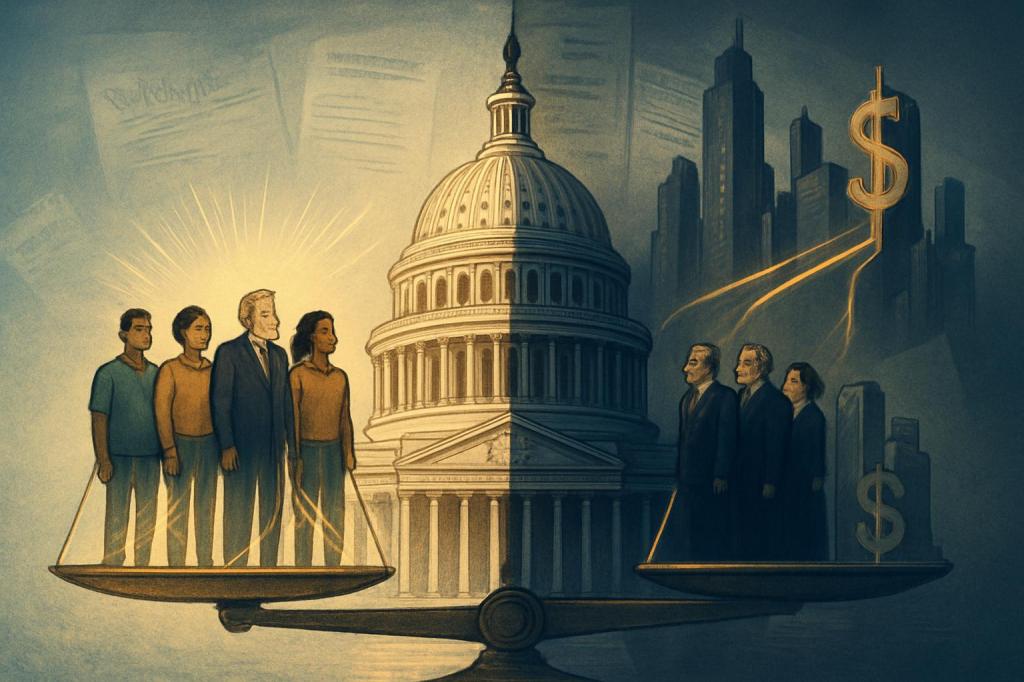
Across the past half‑century, the United States has retained the formal trappings of democracy—elections, parties, constitutional rights—while its core institutions have drifted toward a system in which political influence is concentrated in the hands of the affluent and organized business interests. Multiple lines of research converge on the view that the U.S. now functions less as a majoritarian democracy and more as a “soft oligarchy” or “plutocracy,” in which ordinary citizens matter politically mainly when their preferences coincide with those of economic elites [1][2][3][4].
The empirical centerpiece of this assessment is the research program launched by Martin Gilens and Benjamin Page. Using data on roughly 1,800 policy proposals debated over three decades, they compared what different groups wanted—average citizens, affluent Americans, and organized interest groups—with what Congress actually did. They operationalized “political influence” as the extent to which support or opposition from a given group changes the odds that a policy is adopted. Their findings show a nearly flat line between mass public support and policy enactment: when average citizens favor a policy and wealthier Americans do not, the policy is unlikely to pass; when affluent citizens and business groups support a policy, it usually succeeds regardless of mass opinion [1][3].
Statistically, the independent impact of ordinary citizens’ preferences on national policy outcomes is at a “non‑significant, near‑zero level” [1][2][4]. By contrast, policy is highly responsive to the views of the top of the income distribution and to organized business interests. One striking result is that if just 25% of affluent Americans oppose a policy, its prospects drop to roughly 4%, whereas comparable opposition by the middle class still leaves something like a 40% chance of passage [3]. This asymmetry suggests that economic elites wield not only disproportionate agenda‑setting power but also a de facto veto over unwanted policies.
Scholars describe the resulting regime as a “democracy of coincidence”: it appears responsive to the public only in cases where middle‑ and lower‑income preferences happen to align with those of the affluent. Where they diverge, public policy tracks elite preferences [2][3]. Subsequent methodological critiques of the Gilens–Page work have not substantially dislodged this core conclusion; replication and extended analyses continue to show systematic bias toward the affluent and business constituencies [2][4].
This pattern of policy responsiveness is tightly intertwined with a legal and institutional evolution that has made it easier to translate private wealth into political power. A defining turning point was Buckley v. Valeo (1976), where the Supreme Court equated independent political spending with protected speech under the First Amendment. The Court struck down limits on independent expenditures by individuals while upholding contribution caps, effectively establishing a constitutional entitlement for those with substantial disposable income to spend almost without limit to influence elections [5]. This doctrinal move did more than add money to politics: it redefined efforts to equalize political influence or limit the role of wealth as constitutionally suspect, making it difficult for legislatures to constrain the conversion of economic advantage into electoral power [5][6].
Over ensuing decades, rising income and wealth inequality in the U.S.—surpassing even Gilded Age levels at the very top—interacted with this campaign finance regime in a self‑reinforcing loop. Legislative and regulatory choices that favored deregulation, weakened labor, and tax changes skewed toward high earners reflected and reinforced elite preferences. At the same time, the law increasingly shielded political spending by wealthy individuals and corporations from robust regulation, ensuring that those who benefited most from policy shifts could invest more heavily in the political process that sustained them [5][6][8].
Citizens United v. FEC (2010) marked the clearest inflection point in this legal trajectory. The Court invalidated bans on independent expenditures by corporations and unions, narrowed the definition of “corruption” to outright quid pro quo exchanges, and further entrenched the idea that virtually all political spending is protected speech [6][7]. This paved the way for Super PACs and other vehicles for unlimited independent spending, largely financed by a small cadre of ultra‑rich donors. McCutcheon v. FEC (2014) extended this approach by striking down aggregate contribution limits, again emphasizing the primacy of donors’ speech rights over egalitarian concerns [6].
Empirically, the post–Citizens United landscape reflects a dramatic escalation in elite electoral spending. Outside spending has exploded; Super PACs are overwhelmingly bankrolled by a tiny fraction of the population. Analyses show that just twenty‑five individuals account for nearly half of all individual Super PAC contributions—about $1.4 billion out of approximately $3 billion since 2010 [7]. Other research documents a 160‑fold increase in billionaire election spending since Citizens United, with the top 1% of donors providing 96% of Super PAC funds and, in at least one recent cycle, a single billionaire contributing as much as three million small donors combined [7][8]. These patterns underscore that effective agenda‑setting power—determining which candidates can compete and which issues get serious consideration—is increasingly gated by access to large sums of private money.
Parallel to these campaign finance changes, broader economic trends have deepened the structural capacity of the wealthy to shape politics. Oxfam’s analysis highlights that the richest U.S. billionaires control a share of national wealth greater than during the early‑twentieth‑century Gilded Age, with the ten wealthiest gaining nearly $700 billion in a single year [8]. This extreme concentration facilitates not only direct campaign and lobbying expenditures but also control over media, think tanks, and policy networks, enabling elites to shape public narratives and the range of “serious” policy options. As mid‑20th‑century jurists warned about “industrial oligarchy,” contemporary observers see a similar pattern: economic oligarchs tightening control over both markets and government [8].
Taken together, these developments illustrate a coherent transformation. First, economic inequality has risen sharply since the mid‑1970s. Second, the legal environment—especially campaign finance jurisprudence beginning with Buckley and culminating in Citizens United and its progeny—has systematically protected and amplified the political voice that comes with wealth. Third, large‑N empirical studies of policy responsiveness show that, in this environment, public policy overwhelmingly tracks the preferences of the affluent and business groups, while the independent influence of ordinary citizens is virtually nil [1][2][3][4][5][6].
The result is a system that formally rests on “one person, one vote” but in practice functions as a “soft oligarchy,” where a small economic elite can lawfully dominate the political agenda and exercise a powerful veto over disfavored policies. Elections remain competitive and outcomes are not predetermined, but viable candidacies, issue agendas, and legislative priorities are heavily filtered through donor and business interests.
Amid this grim diagnosis, researchers and reform advocates highlight institutional levers that could partially reverse the drift toward oligarchy. Gilens emphasizes “meaningful campaign finance reform” as the most direct route to curbing oligarchic influence—through public financing, stricter disclosure requirements, and new regulatory frameworks that survive constitutional scrutiny [1][3][4]. Complementary reforms such as ranked‑choice voting and open primaries aim to weaken the two‑party duopoly and donor bottlenecks, broadening electoral competition and reducing the dependence of candidates on small circles of wealthy backers [1][3][4]. These proposals do not deny the depth of current inequalities; rather, they posit an ongoing but narrowing window in which institutional redesign could re‑align U.S. politics with more egalitarian democratic principles.
Conclusion
Taken together, the evidence surveyed here points to a profound institutional drift: from a formal one‑person‑one‑vote democracy toward a “soft oligarchy” in which policy reliably tracks the preferences of the affluent. Gilens and Page’s landmark findings show ordinary citizens exert “near‑zero” independent influence on national policy, a pattern reinforced by post‑1976 campaign‑finance jurisprudence that constitutionally protects the conversion of wealth into political power. The rise of billionaire‑dominated spending, extreme wealth concentration, and a narrow donor class has deepened this feedback loop. Yet the same analysis clarifies the path forward: robust campaign‑finance reform, electoral system redesign, and broader participation can still re‑tilt U.S. institutions toward genuine democratic responsiveness.
Sources
[1] https://act.represent.us/sign/usa-oligarchy-research-explained
[2] https://www.hks.harvard.edu/faculty-research/policycast/oligarchy-open-what-happens-now-us-forced-confront-its-plutocracy
[3] https://bclawreview.bc.edu/articles/567/files/63ad77233ee5b.pdf
[4] https://uknowledge.uky.edu/cgi/viewcontent.cgi?article=5550&context=klj
[5] https://en.wikipedia.org/wiki/Citizens_United_v._FEC
[6] https://academicworks.cuny.edu/cgi/viewcontent.cgi?article=1218&context=bb_etds
[7] https://rooseveltinstitute.org/publications/citizens-united-15-years-later/
[8] https://www.oxfamamerica.org/explore/issues/economic-justice/is-the-us-witnessing-the-rise-of-oligarchy
[9] https://rooseveltinstitute.org/publications/15-years-after-citizens-united-fact-sheet
[10] https://luskin.ucla.edu/gilens-on-the-disproportionate-influence-of-the-wealthy
Written by the Spirit of ’76 AI Research Assistant


 Realizing News
Leave a comment