Introduction
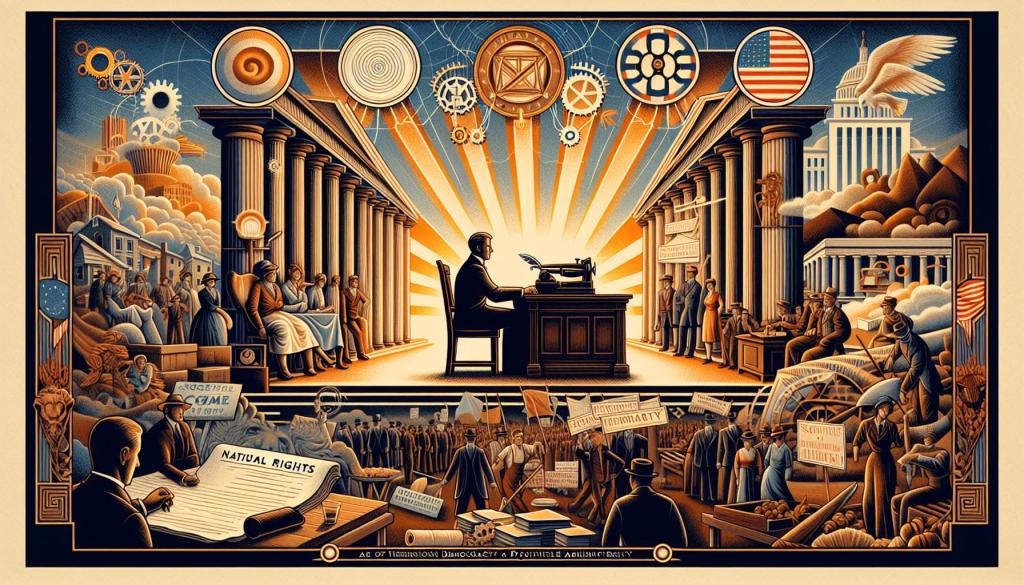
Modern American liberalism did not emerge fully formed; it evolved through overlapping philosophical arguments and political struggles stretching from the Enlightenment to the Great Society. This report traces that evolution in three stages. First, it follows the shift from classical natural-rights liberalism to New Deal commitments to social welfare and positive liberty. Second, it examines how progressive thought and German historicism legitimated the rise of the administrative state and a presidency‑centered liberal order. Third, it analyzes how popular movements—from Jacksonian democracy to civil rights—repeatedly forced liberalism to confront its exclusions and expand its promises.
Modern liberalism in the United States grows out of Enlightenment natural‑rights thought but is repeatedly reworked by structural economic change, intellectual innovation, institutional transformation, and popular struggle. Its core language—individual rights, liberty, and limited government—originates in early modern debates against monarchy and aristocracy, yet this same vocabulary later underwrites an expanded, interventionist state and a more substantive, egalitarian understanding of citizenship.
The earliest phase centers on a natural‑rights constitutionalism shaped by figures such as Locke, Montesquieu, Hume, and Mill, whose arguments stress pre‑political rights to life, liberty, and property and envision the state primarily as a guardian against arbitrary power rather than a shaper of citizens’ ends [1][2]. Early American thinkers like Jefferson, Paine, and Madison adapt this framework, constructing a republic oriented around “freedom from” interference—freedom of thought, expression, religion, and contract—while minimizing state involvement in social and economic life [1][2]. This classical liberalism helps dismantle inherited hierarchies of crown and clergy and legitimates market exchange and private property as expressions of individual autonomy.
Yet as the U.S. industrializes in the late 19th century, the social meaning of this classical liberal language shifts. The same appeals to self‑reliance and free contract that once challenged aristocratic privilege are now deployed to defend large corporations, trusts, and factory regimes that dramatically circict workers’ real options [1][3]. Formal negative liberty—legal freedom of contract, mobility, and speech—proves compatible with material dependency, coercive labor conditions, and stark inequality. This tension fuels critiques from workers’ movements, Populists, and Progressives, who draw on liberal ideals to argue that unregulated markets can generate new forms of domination.
Intellectuals associated with Progressivism respond by reinterpreting the philosophical foundations of American liberalism. Influenced by German historicism and Hegelian thought, they reject the Founders’ notion of fixed, timeless natural rights and a permanently limited constitutional framework, instead treating rights, institutions, and the Constitution itself as historically contingent and subject to reconstruction in light of modern conditions [1][3]. John Dewey exemplifies this move: he does not abandon Enlightenment commitments to rational agency and self‑direction but insists that these require new institutional forms under industrial capitalism [1]. When prevailing economic structures systematically undermine individuals’ effective freedom, government non‑interference ceases to secure genuine autonomy. In this view, the shift from a purely negative conception of liberty toward a more “positive” one—state‑provided education, social insurance, and regulation that enable self‑rule—is presented as a development of, not a departure from, liberalism’s original aspirations.
Progressive thought provides the philosophical justification for the rise of the modern administrative state. Reformers argue that the 18th‑century constitutional design, centered on legislatures and courts, is ill‑suited to the complexities of industrial society and mass democracy [1]. They promote specialized agencies staffed by policy experts and a stronger presidency as the engines of social and economic regulation. The state is reconceived as an instrument for managing markets, addressing externalities, and securing social welfare, rather than simply an umpire that enforces contracts. Legal scholars trace how new federal powers and new individual rights develop together, showing that law functions not only as a constraint but as a constitutive tool of modern state‑building [4][5]. The very expansion of rights claims—around labor, speech, and equality—both enables and legitimates broader administrative capacities.
The Great Depression and Franklin D. Roosevelt’s New Deal crystallize this evolution into what is typically called modern American liberalism. Facing economic collapse, the federal government intervenes massively to stabilize markets, manage aggregate demand, regulate finance and industry, and construct a basic social safety net through programs such as Social Security and labor protections [2][3]. New Deal liberalism couples an activist national state with a continuing, if reinterpreted, language of individual rights and constitutionalism. It aims not to replace capitalism but to save it from its own instabilities by curbing its excesses and spreading its benefits more widely [2].
Politically, these reforms are anchored in a durable New Deal coalition: labor unions, urban machines, racial and ethnic minorities, Southern whites, and intellectuals, organized primarily within the Democratic Party [2]. This coalition helps entrench an expanded federal and administrative apparatus even as a conservative congressional bloc limits further innovation after 1938. Over time, the initial social‑democratic thrust—collective bargaining, public works, social insurance—gives way to a more “rights‑based” and “compensatory” liberalism that focuses increasingly on individual legal claims rather than robust collective institutions like unions [5]. These feedback loops between electoral alignments, administrative practices, and legal developments yield a distinctively American liberal order: presidency‑centered, court‑entangled, and administratively dense, yet still rhetorically committed to individual liberty and constitutional constraints.
Beneath these institutional and intellectual shifts lies a continuous process of popular struggle that repeatedly reshapes who is recognized as a bearer of liberal rights. Jacksonian democracy in the early 19th century expands political participation for white men and mobilizes class‑inflected rhetoric against concentrated economic power—banks and Eastern capitalists—while simultaneously entrenching slavery and driving Indigenous dispossession [3][4][5]. In Arthur Schlesinger Jr.’s interpretation, Jacksonian politics poses the “specific problem” of restraining capitalist elites in the name of non‑capitalist farmers and workers, prefiguring later liberal projects such as Populism, Progressivism, the New and Fair Deals, the New Frontier, and the Great Society [4][5]. This populist idiom—protecting “the people” from entrenched economic interests—feeds into 20th‑century liberal narratives about using state power to counter private concentrations of power.
The 20th century’s mass movements make even more explicit use of liberal ideals to challenge exclusion. The Black freedom struggle illustrates how marginalized groups seize the universalizing language of the Declaration and the Constitution to expose the gap between professed liberal commitments and lived realities. Civil rights activism—from local organizing and litigation to the March on Washington and the Selma to Montgomery marches—forces issues of racial segregation, disfranchisement, and violence to the center of the national agenda [1][5]. The resulting Civil Rights Act of 1964 and Voting Rights Act of 1965, with strong federal enforcement particularly in the South, mark a decisive moment when the national state, once primarily a protector of property and contract, is reoriented toward protecting Black citizenship, political participation, and formal equality under the law [1][5]. In the Great Society era, this rights‑protecting and anti‑poverty activism extends to education, health, and welfare policy, reflecting an increasingly expansive understanding of what government must do to secure equal opportunity.
At the same time, critics argue that liberalism functions as a pervasive modern ideology that dissolves pre‑modern religious and social hierarchies only to clear space for markets and centralized state power [3]. On this critical account, liberalism’s highly individualist focus tends to fragment collective solidarities and can erode the very communal foundations on which democratic self‑government depends. The evolution from a social‑democratic New Deal liberalism rooted in class organization and labor power to a more individualized, rights‑centric liberalism can, in this perspective, undermine unions and other collective vehicles for countervailing power [3][5]. Yet even these critiques typically operate within the grammar of liberalism—rights, conscience, equality—testifying to the breadth of its conceptual dominance in American political discourse.
These trajectories converge on a persistent ambiguity at the heart of U.S. liberalism. One storyline emphasizes continuity: modern liberalism, including the New Deal and rights‑based regimes that follow, is portrayed as a faithful adaptation of Enlightenment principles to new socio‑economic realities. On this reading, the commitment to rational self‑direction and equal liberty logically leads to endorsing positive state action whenever private power or structural disadvantage thwarts effective freedom [1][3]. Another storyline stresses rupture: classical liberalism’s devotion to limited government, strong property rights, and negative liberty, some argue, survives more clearly in contemporary American conservatism and libertarianism than in modern liberalism’s administrative and redistributive practices [3]. The perceived break turns on whether natural rights and constitutional limits are seen as fixed constraints or as historically revisable tools for pursuing an evolving ideal of freedom and equality.
In practice, American liberalism develops as a hybrid formation. It fuses Enlightenment natural‑rights theory, Protestant moral individualism, German historicist and Hegelian ideas about the state, Progressive faith in expertise and administration, and the egalitarian demands of labor, civil rights, feminist, and other popular movements. Its political and philosophical origins thus cannot be pinned to a single moment or doctrine. Instead, modern U.S. liberalism emerges from recurring struggles over who counts as an individual rights‑bearer, how far state power may legitimately go in restructuring society and the economy, and which conception of liberty—negative, positive, or some synthesis—should guide American governance.
Conclusion
Modern American liberalism emerged from a long, contested reworking of Enlightenment ideas about rights, authority, and the state. The classical liberalism of natural rights and negative liberty supplied a powerful language of individual freedom, but industrial capitalism exposed how formal rights could coexist with stark material dependency. Progressive theorists and reformers responded by justifying an activist administrative state, while the New Deal translated these ideas into institutions and party coalitions that fused national power with a rights-focused constitutionalism. Across this evolution, popular struggles over race, class, and democracy repeatedly forced liberalism to renegotiate who counts as fully free—and what government must do to make that freedom real.
Sources
[1] https://www.americanprogress.org/article/think-again-how-classical-liberalism-morphed-into-new-deal-liberalism/
[2] https://www.ebsco.com/research-starters/history/liberalism
[3] https://en.wikipedia.org/wiki/Classical_liberalism
[4] https://www.britannica.com/topic/classical-liberalism
[5] Thomas G. West, “Progressivism and the Transformation of American Government,” in The Progressive Revolution in Politics and Political Science: Transforming the American Regime (Claremont Institute / Rowman & Littlefield), https://www.hillsdale.edu/wp-content/uploads/2017/07/2005-Progressivism_and_the_Transformation_of_Amer_Govt.pdf
[6] “New Deal,” Wikipedia, https://en.wikipedia.org/wiki/New_Deal
[7] William J. Novak, “The Legal Origins of the Modern American State,” NBER Conference Paper, https://users.nber.org/~confer/2002/crs02/novak.pdf
[8] Kate Andrias, “The New Labor Law,” Yale Law Journal 128 (2019): 616, https://repository.law.umich.edu/cgi/viewcontent.cgi?article=3030&context=facarticles
[9] Erin L. (dissertation), “The History of Ideas and Public Administration” (Cleveland State University), https://engagedscholarship.csuohio.edu/cgi/viewcontent.cgi?article=1290&context=etdarchive
[10] https://en.wikipedia.org/wiki/Modern_liberalism_in_the_United_States
[11] https://newuniversityinexileconsortium.org/wp-content/uploads/2022/08/Why-Liberalism-Failed-1.pdf
[12] https://en.wikipedia.org/wiki/Jacksonian_democracy
[13] https://fhsu.pressbooks.pub/orientationpolisci/chapter/chapter-2/
[14] https://www.commentary.org/articles/edward-saveth/the-age-of-jackson-by-arthur-m-schlesinger-jr/
Written by the Spirit of ’76 AI Research Assistant





Leave a Reply