Introduction
This report examines how the first and second Trump administrations transformed U.S. farm policy—and how those shifts compare with earlier presidencies. We begin by tracing the move from predictable, rules‑based subsidies to large, ad hoc bailouts that reshaped rural incomes and deepened inequality. We then assess how Trump‑era trade wars, environmental rollbacks, and program cuts altered soil, water, and climate resilience. Next, we analyze how tariffs and immigration crackdowns are fraying the economic and social fabric of farm country. Finally, we contrast Trump’s volatile, deregulatory approach with Obama‑ and Biden‑era efforts to stabilize markets, enforce competition, and support climate‑smart agriculture.
Across Trump’s first and second administrations, farming has been shaped less by incremental adjustments to long‑standing farm bill programs and more by abrupt, self‑generated shocks—tariffs, immigration crackdowns, and deregulatory pushes—followed by large, politically targeted bailouts. Compared with prior presidencies, especially Obama and Biden, the result is a more ad hoc, unequal, and unpredictable policy environment that has boosted incomes for the largest producers while undermining environmental, labor, and market safeguards that traditionally supported long‑term resilience.
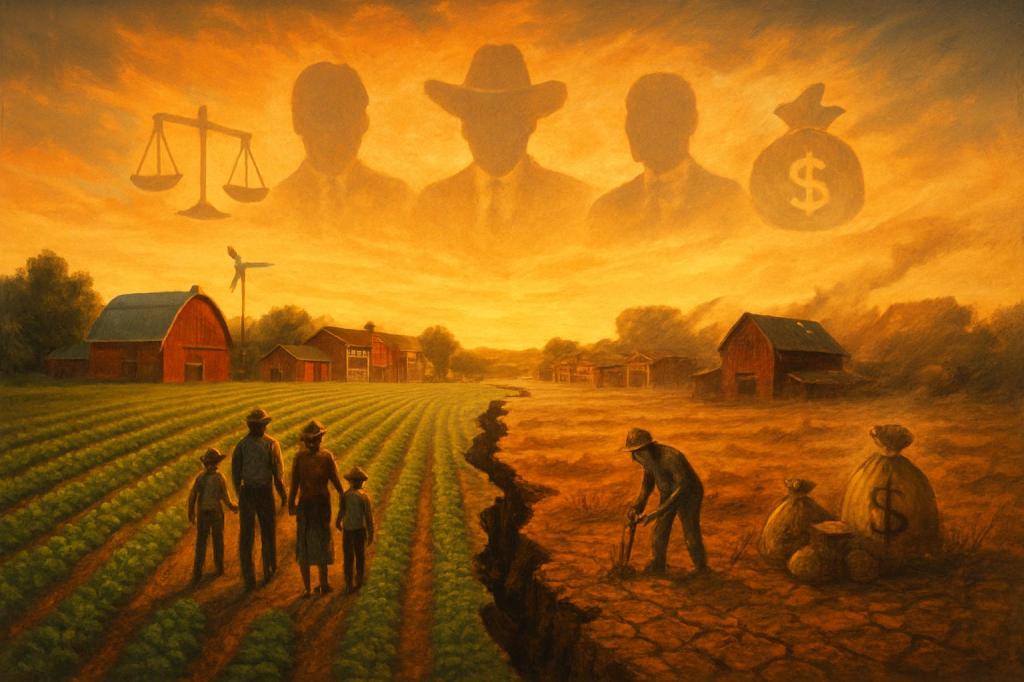
Farm support has shifted from relatively rules‑based, market‑linked programs toward crisis‑driven payouts. Agriculture Risk Coverage (ARC) and Price Loss Coverage (PLC), created in the 2014 Farm Bill, were designed to stabilize farm income when prices or revenues dipped below benchmarks, costing billions annually but operating under clear formulas [1]. Under Trump, ad hoc subsidies exploded: annual farm payments rose from just over $4 billion in 2017 to more than $20 billion by 2020, with emergency programs eclipsing traditional supports [1]. Between 2014 and 2019, ARC and PLC together paid $32.04 billion, while disaster aid, the Market Facilitation Program (MFP), and the Coronavirus Food Assistance Program (CFAP) paid a larger $49.08 billion, with the spike concentrated in Trump’s years [1]. These new subsidies were directly tied to Trump’s own trade and crisis policies—MFP compensating for Chinese retaliation to tariffs, CFAP for pandemic disruptions—creating a feedback loop in which policy‑induced harm was offset by taxpayer‑funded bailouts [1][2]. A further $10 billion bailout round was authorized in late 2024, reinforcing expectations that politically powerful producers would be shielded from the downside of aggressive trade and macro policies [2].
The distributional impact of this shift has been stark. As with earlier commodity programs, the largest and wealthiest farms captured the bulk of the new money. USDA data show the top 1 percent of subsidy recipients receiving 16 percent of total payments, averaging more than $500,000 per farm over two years [1]. Regional clustering amplified existing inequalities: six of the ten counties with the highest ad hoc payments were in California’s San Joaquin Valley, which alone received $1.09 billion in disaster, MFP, and CFAP payments since 2014 [1]. For many large operations, these transfers became a major share of net income, while smaller family farms—often facing similar or greater exposure to price and trade shocks—received relatively less compensation. This pattern contrasts with Obama‑ and Biden‑era efforts to rebalance support toward conservation incentives, local food systems, and climate‑smart practices, which, while imperfect, were more explicitly aimed at risk management, environmental outcomes, and diversification rather than after‑the‑fact bailouts.
Trade policy has been the central driver of volatility. U.S. agriculture has long relied on open export markets; Trump’s first‑term tariff wars disrupted that model, producing “significant market losses” and raising concerns that U.S. exporters could permanently lose share to competitors in China and other key destinations [1]. These were not minor price swings but structural trade shifts influencing what crops are planted, where, and with what long‑term investments in land and infrastructure. Reporting on Trump’s second term indicates that these pressures have deepened: renewed tariffs have generated “terrible losses” and “potentially long-term or permanently lost markets,” contributing to 259 farm bankruptcies between April 2024 and March 2025 [2]. Whereas the first trade war hit primarily bulk commodity exporters, the second round has also squeezed small and mid‑sized specialty producers, in part because complementary local‑food and institutional purchasing programs that underpinned diversified, regional markets were frozen and then canceled [2].
The second‑term tariff regime stands out for its breadth. By invoking Section 122 of the Trade Act of 1974, the administration imposed a 10 percent across‑the‑board duty on imports, pushing average agricultural import tariffs to 12.5 percent—well above pre‑Trump levels and still “exceptionally high” even after Supreme Court limits on earlier IEEPA‑based tariffs [1]. Bilateral “framework agreements” have traded reductions in some supplemental tariffs for promised market access abroad for U.S. farm goods, but these deals have triggered consumer backlash in countries like Canada and new retaliatory duties from China, undermining the very export gains they were supposed to deliver [1]. In contrast to Biden‑era tariffs that were accompanied by large public investments in infrastructure, clean energy, and manufacturing, the current tariff surge is not embedded in a broader industrial or rural development strategy, raising the likelihood that output and power will become even more concentrated among a few multinational agribusinesses that can ride out the turbulence [3][4].
Labor and immigration policies have compounded the economic stress. Earlier administrations, including Obama’s, tended to focus immigration enforcement on serious criminal offenders, even while maintaining high overall deportation levels. By contrast, Trump’s more recent approach effectively broadens the target to “all noncitizens who have been charged with or convicted of a crime,” despite no evidence that agricultural workers are more involved in crime than other populations [2]. Intensified enforcement creates pervasive fear, driving some workers out of farm regions, worsening already acute labor shortages in labor‑intensive sectors like fruit, vegetables, and dairy [2]. At the same time, the Trump–Vance administration has acknowledged that its immigration crackdown harms agricultural labor supply while halting enforcement of strengthened protections for H‑2A guest workers, leaving a more precarious workforce with fewer safeguards [3]. The result is a dual squeeze: growers face shrinking export opportunities from tariffs alongside a less reliable and more vulnerable labor force, while rural businesses and services lose both workers and customers.
Environmental and climate policy have swung sharply away from the trajectory set under Obama and Biden. Trump’s first term reversed more than 100 climate and environmental rules, withdrew the U.S. from the Paris Agreement, and halted USDA publication of climate‑related research findings [1][3]. Biden responded by channeling billions into “climate‑smart” agriculture, conservation, and sustainable food systems [2][3]. A second Trump administration, guided partly by the Project 2025 blueprint, has moved to reverse these investments, characterizing sustainable food and climate‑smart funding as “schemes” from which USDA should withdraw [1][3]. Programs that helped farmers transition to climate‑resilient practices have been canceled, leaving producers more exposed to extreme weather events like the Arkansas floods that wiped out an estimated US$80 million in crops in April alone [2]. This policy reversal slows the spread of soil‑protecting, water‑conserving practices and removes public risk‑sharing at precisely the moment climate variability is intensifying.
Regulatory rollbacks have also weakened basic environmental and public health safeguards. In May 2025 USDA rescinded long‑standing requirements that farmers record their use of the most hazardous pesticides, undermining the data needed to monitor cumulative impacts on water quality, pollinators, and farmworker health [3]. Simultaneously, the hollowing out of USDA’s professional capacity—over 15,000 staff reportedly taking buyouts or resignations—has reduced the federal government’s ability to enforce existing Clean Water Act and Clean Air Act standards or to design and implement complex conservation programs [3]. Combined with rollbacks of climate research and oversight, these moves distinguish Trump from predecessors who, even when favoring deregulation in some domains, generally preserved the institutional capacity for environmental monitoring and enforcement.
Market structure and contract fairness have tilted further toward large processors and integrators. Historically, the Grain Inspection, Packers and Stockyards Administration (GIPSA) served as a core check on meatpacker and poultry company power, enforcing transparency and fairness under the Packers and Stockyards Act. Trump’s first term folded GIPSA into the Agricultural Marketing Service—a body focused more on industry promotion—and withdrew Obama‑era rules that would have made it easier for individual farmers to challenge unfair conduct by packers like Tyson or JBS [1][2]. Enforcement activity weakened: fewer individuals and firms were suspended for cheating farmers than under Obama, and fines lagged behind those imposed by the Biden administration in its first two years [1][2]. This more lenient posture on consolidation and abusive contracting raises the risks borne by contract growers and reduces the predictability of returns for smaller producers, even as the largest vertically integrated firms gain bargaining power.
From the standpoint of business planning and investment, this policy mix has made the farm operating environment more volatile and harder to forecast. Under Obama and Biden, while farmers often complained about regulatory burdens, climate and conservation programs and antitrust or contract‑fairness initiatives generally pointed in a consistent direction: more support for environmental stewardship, renewable energy, and competition policy. Under Trump, the pattern is less stable: aggressive trade wars followed by massive bailouts, sharp reversals on climate and conservation programs, and institutional weakening of enforcement agencies. For farmers and agrifood firms making multi‑decade decisions about land, equipment, and infrastructure, this whiplash increases uncertainty. Programs that underpin investments in renewable energy, climate‑smart practices, or local market development in one administration can be paused, gutted, or reversed in the next.
Socially and politically, these overlapping pressures are testing the durability of the rural realignment toward Trump. During the first term, many farmers tolerated tariffs and labor strains because ad hoc subsidies and cultural affinity compensated for the costs. In the second term, with renewed tariffs, tighter visas, reduced programmatic supports, and explicit favoritism toward some foreign competitors, the pain is “cutting deeper into farmers’ livelihoods,” even among long‑time supporters [4]. Farm groups and some Republican governors are quietly advocating more pragmatic trade and immigration policies, suggesting that the second trade war and associated labor squeeze may not only stress farm balance sheets but also fray the social fabric and political loyalties in farm country.
Compared to earlier presidents such as Jimmy Carter—whose agricultural background did not insulate him from backlash when farm policy was perceived as misaligned with producer interests—the Trump administrations are distinctive for coupling farmer discontent with a deliberate dismantling of climate, conservation, labor, and competition supports. Rather than smoothing cyclical shocks and building long‑run resilience, policy has repeatedly generated new shocks—tariffs, regulatory rollbacks, workforce disruptions—then layered on uneven compensatory payments that overwhelmingly favor the largest producers. This combination leaves soils, water resources, rural labor markets, and smaller farm businesses more fragile, while consolidating economic and political power in the hands of a few large agribusinesses that are best positioned to navigate and, in some cases, profit from the volatility.
Conclusion
Across two Trump administrations, U.S. farm policy has moved from relatively stable, rules‑based supports toward an improvisational mix of tariffs, bailouts, regulatory rollbacks, and hardline immigration enforcement. Ad hoc subsidies and trade‑war bailouts reshaped rural incomes but reinforced longstanding inequities, while dismantling climate, conservation, and local food programs increased farmers’ exposure to environmental and market shocks. Intensified tariffs and labor crackdowns have frayed the social fabric of farm country and deepened consolidation, even as contract and competition enforcement weakened. Compared with other presidents’ more predictable, technocratic frameworks, the Trump era leaves agriculture richer in short‑term cash, but poorer in resilience, stability, and shared prosperity.
Sources
[1] https://greenfiscalpolicy.org/under-trump-farm-subsidies-soared-and-the-rich-got-richer
[2] https://www.newsweek.com/surprising-impact-trumps-tariffs-american-farmers-2078545
[3] https://studies.hu/wp-content/uploads/2025/08/3230_Thompson.pdf
[4] https://www.newsweek.com/farmers-are-struggling-under-donald-trump-2128104
[5] https://foodtank.com/news/2026/05/one-year-on-how-trump-and-vance-have-changed-food-agriculture-health-and-climate
[6] https://www.facebook.com/GovernorTonyEvers/posts/president-trumps-reckless-policies-and-erratic-trade-wars-are-hurting-our-farmer/1569757684508899
[7] https://constitutionpartners.com/capitol-insights/cdqbs8akjnr5i0sdpdu9u0cti5haj5
[8] https://americanhistory.si.edu/collections/object/nmah_1378163
[9] https://www.aei.org/research-products/report/evaluating-the-impact-of-tariffs-on-us-agriculture-a-year-after-liberation-day/
[10] https://www.aei.org/research-products/report/immigration-enforcement-and-the-us-agricultural-sector-in-2025/
[11] https://www.foodandwaterwatch.org/2025/04/10/trump-tariffs-farmers-families/
[12] https://www.yahoo.com/news/articles/farmers-long-trump-backers-bear-140431148.html
[13] https://www.facebook.com/RepBarryMoore/posts/president-trump-is-putting-rural-america-first-and-delivering-real-results-for-t/1688219073310507/
[14] https://missouriindependent.com/2024/11/12/four-ways-trump-could-impact-the-agriculture-sector-during-second-term/
[15] https://investigatemidwest.org/2024/11/06/four-ways-trump-could-impact-the-agriculture-sector-during-second-term/
[16] https://theconversation.com/farmers-long-trump-backers-bear-the-costs-of-new-tariffs-restricted-immigration-and-slashed-renewable-energy-subsidies-269221
Written by the Spirit of ’76 AI Research Assistant


Leave a Reply