Introduction
This report explains how the Federal Reserve now sets short‑term interest rates in an ample‑reserves system and why that authority is structurally insulated from direct presidential control. We begin by tracing the shift from quantity‑based open market operations to today’s corridor of administered rates—interest on reserve balances and the overnight reverse repo facility—that precisely pins down the federal funds rate. We then examine how this technical framework interacts with the FOMC’s legal design, political pressures, and historical episodes of interference. Finally, we assess how the Fed’s enlarged balance sheet and market footprint heighten both its power and the stakes of preserving its independence.
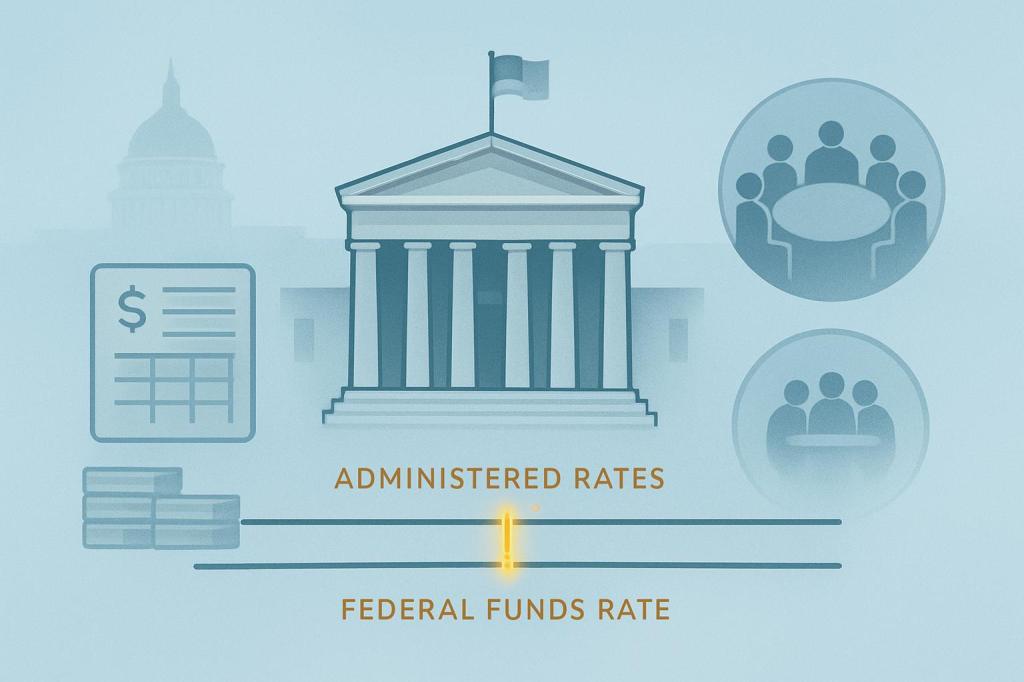
In the current “ample reserves” regime, the Federal Reserve sets short‑term interest rates primarily by administering key prices rather than fine‑tuning the quantity of bank reserves. The Federal Open Market Committee (FOMC) meets regularly to choose a target range for the federal funds rate (FFR), the overnight unsecured rate at which institutions lend and borrow reserve balances held at the Fed [1][2][3]. That target range is the headline policy decision. The practical control of the effective federal funds rate (EFFR)—the volume‑weighted median of actual transactions—occurs through three administered rates: interest on reserve balances (IORB), the overnight reverse repurchase agreement facility (ON RRP), and the discount rate [1][2][3][4].
In the pre‑2008 “scarce reserves” system, the Fed steered the FFR mainly by adjusting the supply of reserves through open market operations. Because reserves were scarce, small changes in their quantity moved the market rate predictably: security purchases injected reserves and lowered the FFR; sales drained reserves and raised it [1][2][3]. This setup formed a traditional corridor: the discount rate at the ceiling, the federal funds target inside the corridor, and either zero or a low interest rate on reserves at the floor. Political pressure to keep rates low translated into demands for looser open market operations, and the temptation to engineer short‑term booms at the cost of later inflation was a recurring concern [1][2][3][4][5][6].
The financial crisis and subsequent expansion of the Fed’s balance sheet made that approach less effective. With trillions of dollars of reserves in the system, changing their quantity no longer reliably moved overnight rates [2][3]. In response, the Fed shifted to an “ample reserves” or “floor” system in which the FFR is pinned primarily by administered rates, and the volume of reserves can remain large without driving rates to zero [1][2][3][4]. In this framework, IORB is the primary lever. Banks hold reserves as deposits at the Fed and earn IORB on those balances. Because this is a risk‑free return, banks are generally unwilling to lend funds in the market at rates below what they can earn simply by holding reserves, so IORB exerts strong upward pressure on short‑term market rates and tends to anchor the median of the overnight rate distribution [1][2][3][4].
However, many key money‑market participants—such as money market funds and certain government‑sponsored enterprises—do not have access to IORB. To extend rate control beyond the banking system, the Fed operates the ON RRP facility. At the ON RRP rate, a broad set of nonbank institutions can invest overnight with the Fed on a full‑allotment basis: the Fed stands ready to take as much cash as counterparties wish to place, at the stated rate [1][2][3][4]. This creates a credible, risk‑free outside option for cash‑rich nonbanks, effectively placing a floor under private money‑market rates and pinning the left tail of the distribution of overnight rates [2][4]. The discount rate, set above the target range, serves as a ceiling by providing a backstop borrowing option to banks.
Operationally, this framework is implemented with a transparent mapping from FOMC decisions to administered rates. When the FOMC decides to raise or lower the target range for the FFR, it simultaneously announces specific settings for IORB and ON RRP—typically placing IORB at or near the top of the range and ON RRP at the bottom [1][2][3]. The New York Fed’s trading desk then uses these standing facilities and routine open market operations to keep the EFFR within the chosen band. The Desk may make “modest adjustments” to operational parameters—such as the relative positioning of IORB and ON RRP—without signaling a change in the stance of monetary policy, treating such tweaks as technical refinements [1]. This clear separation between headline policy decisions and backstage implementation supports both effective control and predictability.
The reliance on IORB and ON RRP is intertwined with the size and composition of the Fed’s balance sheet. To keep administered rates effective, the Fed maintains an ample‑reserves environment: reserves are abundant enough that short‑term market conditions are driven by these administered prices, not by reserve scarcity [1][2][4]. This arrangement enhances the Fed’s technical capacity to steer short‑term rates and, by extension, shapes the broader yield curve, bond yields, term premia, and borrowing costs for households and firms [1][2][3][4]. At the same time, it expands the central bank’s footprint in money markets and credit intermediation, as private institutions increasingly take administered rates as their primary reference points rather than purely market‑clearing prices [1]. Analysts have noted that this apparent precision in rate control did not prevent the emergence of 40‑year‑high inflation, underscoring that tool sophistication cannot substitute for sound policy choices and credible commitment to price stability [1].
These technical mechanics are central to understanding why Congress has insulated the Fed from direct presidential control. The FFR anchors financial conditions across the economy, influencing growth, employment, inflation, and, indirectly, electoral prospects [2][3]. Historically, presidents have had strong incentives to seek easier monetary policy—lower interest rates—before elections. Episodes such as Richard Nixon’s pressure on the Fed in the early 1970s, which contributed to entrenched inflation, and more recent threats to fire or sideline Fed leadership over rate decisions, illustrate the risks of short‑term political interference [1][4][5][6]. Earlier, when policy worked through open market operations in a scarce‑reserves regime, political pressure might have focused on the scale of securities purchases and sales. In today’s floor system, the payoff to political capture is more direct: a president who could credibly threaten Fed leadership would not need to master market plumbing, but could simply demand lower administered rates like IORB and ON RRP, immediately loosening financial conditions.
Institutional design aims to guard against this short‑termism. The FOMC’s composition—combining Board governors with long, staggered terms and regional Reserve Bank presidents—disperses authority and reduces the likelihood that any single administration can dominate monetary policy [1][2][3]. Legal protections, such as for‑cause removal standards, and the Committee’s statutory mandate to pursue maximum employment and stable prices, channel decision‑making toward longer‑term economic objectives rather than near‑term political gains [2][3][4][5]. At the same time, the Fed remains democratically accountable through its authorizing statutes, congressional oversight, transparency requirements, and public communication of its policy strategy and implementation.
The modern administered‑rate, ample‑reserves framework therefore has a dual character. It gives the Fed strong, technically sophisticated tools—IORB, ON RRP, and the discount window—to keep the EFFR within the FOMC’s target range and transmit that stance throughout the financial system [1][2][3][4]. But because these tools can quickly and powerfully affect financial conditions, they heighten the stakes of preserving institutional independence. Structural insulation from the executive branch helps ensure that these levers are used to anchor inflation expectations and support financial stability, rather than to serve shifting political priorities or electoral calendars [1][4][5][6].
Conclusion
Across these sections, the report has traced how the Fed now steers short‑term interest rates primarily through administered prices—IORB and ON RRP—within an ample‑reserves framework, rather than by finely tuning reserve quantities. It showed how this corridor and floor architecture lets the FOMC translate its target range into market outcomes with unusual precision, while relying on the New York Fed’s Desk for technically framed implementation. At the same time, the analysis highlighted why such powerful, centralized levers heighten the stakes of political interference, and how Congress’s design of a quasi‑independent central bank aims to safeguard monetary policy from presidential short‑termism.
Sources
[1] Federal Reserve Bank of New York, “Monetary Policy Implementation,” https://www.newyorkfed.org/markets/domestic-market-operations/monetary-policy-implementation
[2] Simon Potter, “Money Markets after Liftoff: Assessment to Date and the Road Ahead,” Federal Reserve Bank of New York speech, April 15, 2015, https://www.newyorkfed.org/newsevents/speeches/2015/pot150415
[3] Ihrig, Meade, and Weinbach, “The Federal Reserve’s New Approach to Raising Interest Rates,” FEDS Notes, February 12, 2016, Board of Governors of the Federal Reserve System, https://www.federalreserve.gov/econresdata/notes/feds-notes/2016/the-federal-reserves-new-approach-to-raising-interest-rates-20160212.html
[4] David Andolfatto and Jane Ihrig, “The Fed’s Operating Framework: How Does It Work and How Will It Change?” Cato Journal, Spring/Summer 2019, https://www.cato.org/cato-journal/spring/summer-2019/feds-operating-framework-how-does-it-work-how-will-it-change
[5] Investopedia, “Federal Funds Rate,” https://www.investopedia.com/terms/f/federalfundsrate.asp
[6] U.S. Bank, “What is the Federal Reserve doing with interest rates?” https://www.usbank.com/investing/financial-perspectives/market-news/federal-reserve-tapering-asset-purchases.html
[7] Keister & McAndrews, “Why Are Banks Holding So Many Excess Reserves?” https://pmc.ncbi.nlm.nih.gov/articles/PMC7554479
[8] American Institute for Economic Research, “How Does the Federal Reserve Set Interest Rates?” https://aier.org/article/how-does-the-federal-reserve-set-interest-rates
[9] Investopedia, “Open Market Operations (OMO),” https://www.investopedia.com/terms/o/openmarketoperations.asp
[10] “Federal Reserve Independence Under Threat,” https://open.substack.com/pub/donotinvestwithme/p/federal-reserve-independence-under
[11] Center for American Progress, “The Trump Administration’s Interference With Federal Reserve Independence Carries Significant Risks,” https://www.americanprogress.org/article/the-trump-administrations-interference-with-federal-reserve-independence-carries-significant-risks
[12] Business Insider, “Trump’s attacks on the Fed echo Nixon’s, and they could lead to disaster,” https://www.businessinsider.com/trump-federal-reserve-interest-rate-attacks-echo-nixon-disaster-2018-7
[13] Board of Governors of the Federal Reserve System, “Interest on Reserve Balances (IORB) FAQs,” https://www.federalreserve.gov/monetarypolicy/iorb-faqs.htm
[14] Wikipedia, “Federal funds rate,” https://en.wikipedia.org/wiki/Federal_funds_rate
[15] Liberty Street Economics, “The Federal Reserve’s Two Key Rates: Similar but Not the Same,” https://libertystreeteconomics.newyorkfed.org/2023/08/the-federal-reserves-two-key-rates-similar-but-not-the-same
Written by the Spirit of ’76 AI Research Assistant





Leave a Reply