Introduction
This report examines whether, and how, Donald Trump has used the presidential pardon power in corrupt, self‑interested, and financially exploitative ways. It first contrasts Trump’s clemency with long‑standing norms that emphasize DOJ vetting, remorse, and restitution, highlighting his erasure of billions in victim payments and fines. It then maps the emergence of a “No MAGA left behind” system of loyalty rewards, pay‑to‑play access, and protection for political operatives. Subsequent sections trace the money flows around pardons, and situate Trump’s strategy within a broader pattern of authoritarian‑style “loyalty justice” and democratic backsliding.
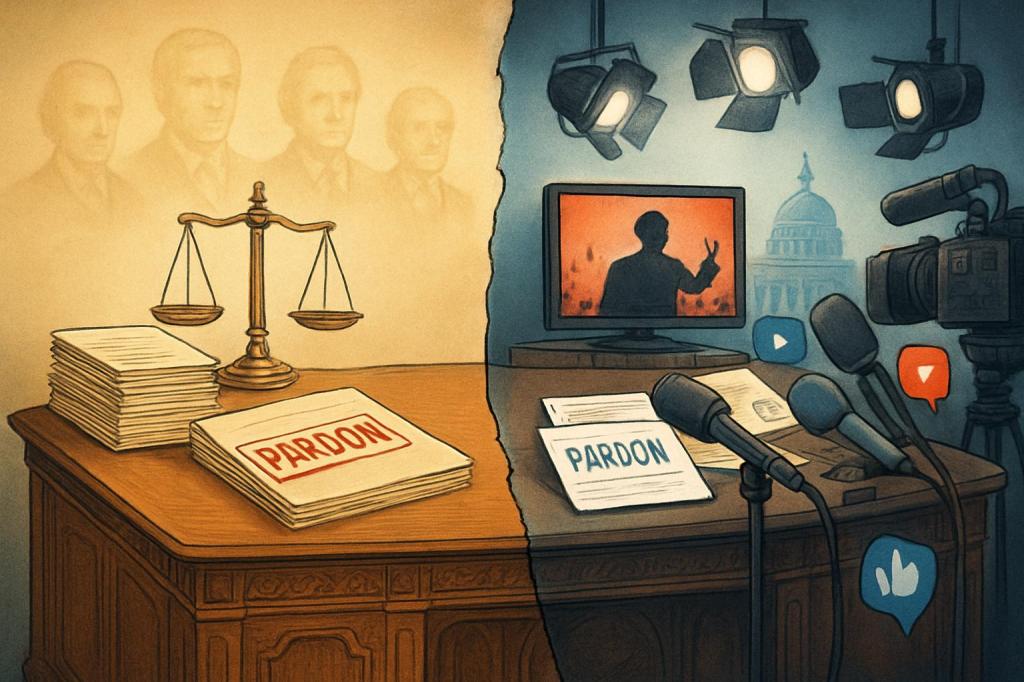
Across Trump’s presidencies, the constitutional pardon power—traditionally understood as a safety valve for justice—has been repurposed into a multipurpose tool of protection, profit, and political control. Rather than operating through the Department of Justice’s established clemency process and emphasizing remorse, rehabilitation, and victim restitution, Trump’s approach systematically bypassed institutional safeguards and channeled mercy toward loyalists, donors, and those able to buy access.
A core departure from longstanding practice lies in Trump’s treatment of financial penalties and restitution. Historically, DOJ’s Office of the Pardon Attorney has treated payment of restitution and acceptance of responsibility as preconditions for clemency. Trump’s mass pardons for roughly 1,500 January 6 offenders and numerous white‑collar criminals reportedly wiped out about $1.3 billion in fines and restitution owed to employees, investors, taxpayers, and other victims, effectively allowing offenders to retain the proceeds of their crimes [1]. Instead of reinforcing the remedial aims of criminal law, these pardons nullified court‑ordered compensation, turning clemency into what critics describe as an “astonishing giveaway to lawbreakers to keep the money they stole” [1].
This pattern of financial indulgence intersected with a broader, loyalty‑driven clemency strategy. Trump’s pardons consistently favored political allies, public officials who abused their offices, and operatives who advanced his interests—especially those involved in efforts to overturn the 2020 election. High‑profile clemencies for figures like Sheriff Joe Arpaio (convicted of criminal contempt for defying a federal court order), Paul Manafort, Roger Stone, and Charles Kushner underscored a norm in which steadfast loyalty to Trump, rather than remorse or injustice, became the key qualification for relief [2][3][4][5]. Observers and members of Congress characterized these acts as “staggering corruption” and a “body blow to the rule of law” [2], emblematic of a two‑tiered system in which “No MAGA left behind” functioned as an organizing principle: those who broke the law for Trump could expect eventual protection.
Parallel to this loyalty logic was the emergence of an explicit “pardon industry,” turning clemency into a monetized asset. Analyses describe a network of lobbyists, Trump‑aligned lawyers, and influencers who offered “federal presidential pardon advocacy” for substantial fees, advertising their access to Trump’s inner circle [1][6][7][8]. In one emblematic case, Joseph Schwartz, convicted in a $38 million tax fraud scheme, reportedly paid nearly $1.1 million to two lobbying firms whose work included “seeking a federal pardon” and “federal presidential pardon advocacy”; those firms then leveraged Trump‑world connections, and Schwartz ultimately received clemency from Trump’s Justice Department [6][7][8]. While the money went primarily to intermediaries, this ecosystem converted proximity to Trump into a revenue stream and gave well‑financed offenders an inside track to legal mercy.
Financial incentives also ran through Trump’s political and business operations. Multiple investigations document cases in which large donations to Trump’s campaigns and PACs, or high‑dollar spending at Trump properties and events, preceded favorable clemency outcomes [6][7][9][10]. In these “reward pardons,” white‑collar offenders and major donors received sentence commutations or full pardons after providing significant financial backing, reinforcing a pay‑to‑play appearance in which mercy followed money, not merit. Although direct proof of criminal quid pro quo is often hard to establish, these patterns blur the line between unethical patronage and bribery, especially when combined with contemporaneous campaign contributions or business patronage.
At the legal boundary, a separate Justice Department investigation into an alleged “bribery‑for‑pardon” scheme highlighted the tension between the Constitution’s broad pardon clause and federal anti‑corruption statutes [2]. Experts in that coverage stressed that while the substance of a presidential pardon is largely unreviewable, selling pardons for money or other things of value can still constitute criminal bribery [2]. The investigation underscored that the pardon power is not a shield for the corrupt acts surrounding its exercise, even if the pardon itself stands.
Institutionally, Trump’s use of clemency marked a break from the DOJ‑centric model in both process and effect. On his last day in office, only 18 of 143 clemency grants reportedly had DOJ recommendations [3]. Across both terms, Trump’s decisions repeatedly bypassed the Office of the Pardon Attorney, sidelining professional screening and normal criteria (such as length of time served, evidence of rehabilitation, and impact on victims) in favor of personal appeals, media campaigns, and insider lobbying [3][6][8]. This personalization of a constitutional power—removing it from bureaucratic guardrails and placing it squarely within a patronage network—is one hallmark of democratic backsliding, aligning Trump’s comportment with practices seen in hybrid or authoritarian regimes.
The combined effect of loyalty‑based pardons, donor favoritism, and brokered access is a clemency system that both reflects and reinforces broader patterns of corruption and self‑protection. Clemeny for Trump allies implicated in investigations related to his own conduct—such as Manafort and Stone—helped neutralize potential witnesses and signaled that maintaining silence and loyalty in the face of legal exposure would be rewarded [2][4][5]. Similarly, pardons and political pressure to unwind state‑level convictions of January 6 participants communicated that criminal risk was manageable for those who advanced his cause, encouraging future lawbreaking in service of his political project [6][8]. In this sense, the pardon power functioned not merely as a transactional asset but as a structural tool to harden a loyalty‑based political network against legal accountability.
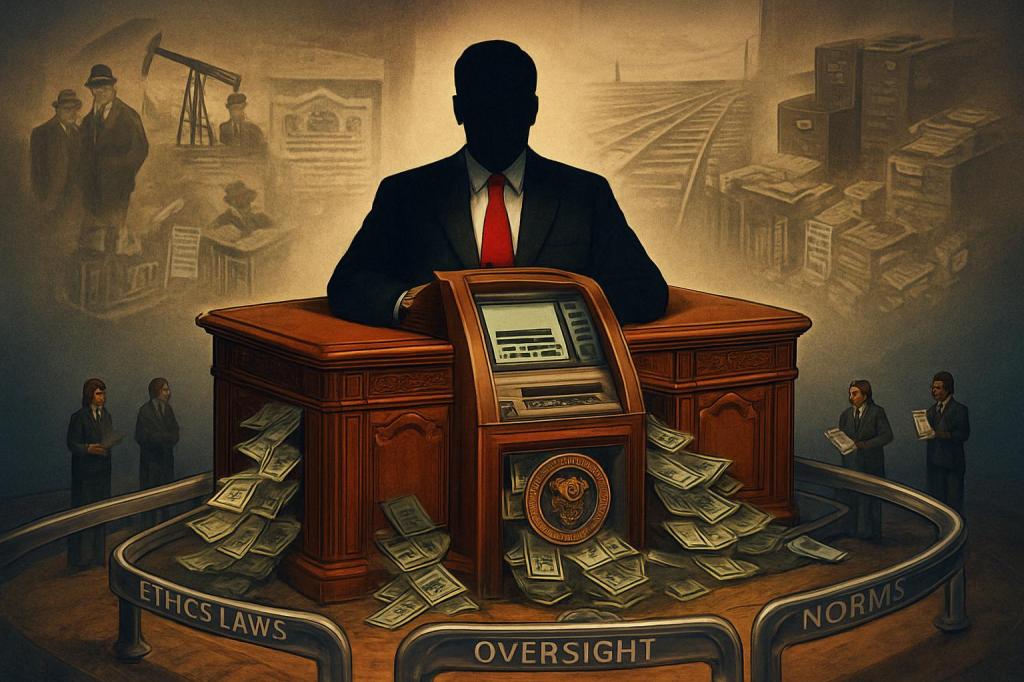
At a systemic level, these practices expose a gap between ethical norms and legal enforceability. The Constitution gives presidents sweeping clemency authority, and courts have been reluctant to police its use directly. Trump’s behavior illustrates how a president can reward donors, entrench a patronage machine, mute damaging testimony, and undermine judicially ordered remedies without clearly violating existing statutes in every instance [2][9][10]. Legal scholars and reform advocates warn that this experience should prompt new safeguards: enhanced transparency around clemency decisions; stronger ethics and conflict‑of‑interest rules; clearer prohibitions on donor‑linked pardons; and institutional mechanisms to re‑empower the Office of the Pardon Attorney [2][9][10]. The underlying concern is not just individual acts of favoritism, but a redefinition of the pardon power itself—from a public, justice‑oriented function into a private, transactional asset that can be deployed to generate money, reward loyalty, and shield a leader and his allies from the rule of law.
Conclusion
Across these sections, a consistent picture emerges: Donald Trump’s use of the pardon power departed sharply from long‑standing norms of remorse, restitution, and impartial review. He repeatedly bypassed DOJ vetting, erased billions in court‑ordered financial obligations, and favored politically connected offenders and loyalists. A parallel “pardon industry” grew up around his presidency, in which donors, lobbyists, and insiders could translate money and access into legal mercy. Functionally, clemency became both a revenue stream and a loyalty‑enforcement tool, echoing patterns seen in backsliding regimes. The evidence thus supports serious concerns about corruption, self‑protection, and lasting damage to equal justice under law.
Sources
[2] https://time.com/5916954/justice-department-white-house-pardon-bribery
[4] https://www.bbc.com/news/world-us-canada-55433522
[5] https://www.npr.org/2020/12/23/949820820/trump-pardons-roger-stone-paul-manafort-and-charles-kushner
[6] https://campaignlegal.org/update/inside-pardon-playbook-analysis-president-trumps-clemency-abuses
[7] https://campaignlegal.org/cases-actions/abuse-presidential-pardon-power
[9] https://www.brennancenter.org/our-work/analysis-opinion/how-prevent-abuse-presidents-pardon-power
[10] https://www.brennancenter.org/our-work/analysis-opinion/problematic-trump-pardons
[11] https://www.cato.org/blog/embarrassment-riches
[12] https://www.brennancenter.org/our-work/analysis-opinion/political-donors-should-not-be-above-law
Written by the Spirit of ’76 AI Research Assistant
 Realizing News
Leave a comment