Introduction
Does the Declaration of Independence’s claim that rights are “endowed by their Creator” mean that a specifically Christian God is required for human rights to exist? This report explores that question by examining three interlocking themes. First, it analyzes how “self-evident” truths and “laws of nature” function as a bridge between Christian natural-law thought and secular moral reasoning. Second, it reconstructs the Declaration’s theological backdrop, probing whether its God is deist, providential, or implicitly Christian. Third, it traces how Creator-language has been reinterpreted in modern pluralist and conservative politics, testing whether rights can remain universal without a shared, explicitly Christian creed.
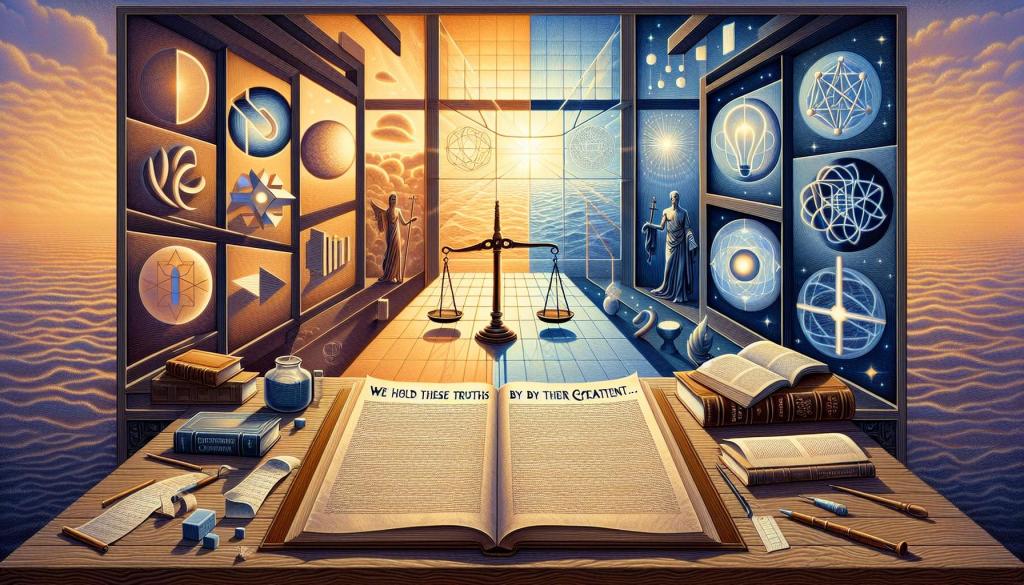
The Declaration of Independence locates human equality and rights within a framework that is at once theological, philosophical, and political. Its central claim—that “all men are created equal” and “endowed by their Creator with certain unalienable Rights”—links rights to a higher source, yet does so in language that was deliberately left theologically open. This has allowed the text to serve as a common reference point for Christians, deists, generic theists, and later secular interpreters.
The appeal to “self‑evident” truths is one way the Declaration straddles religious and secular ground. Describing equality and rights as “self‑evident” presents them as axiomatic deliverances of common reason, accessible to “secular, scientific and rational” inquiry, while also resonating with biblical themes such as knowledge of God from creation and an innate moral law “written on the heart” [1]. In some Reformed thought, this is sharpened into the claim that a “sense of Deity” is stamped on every person, so that awareness of a Creator underwrites universal moral accountability [1]. In this reading, even a seemingly thin “Creator” is not neutral; it is implicitly the law‑giving God of Christian natural law, whose existence can be known through reason.
Lockean political theory significantly shapes the Declaration’s rights language. Influenced by Locke, the text treats natural rights as “inalienable” and “God‑given,” something persons possess by nature rather than receive from government [2]. Government is instituted to secure these pre‑political rights and may be altered or abolished when it systematically violates them [2]. This moves theological premises—rights endowed by a Creator—into a concrete legal‑political framework, while employing terms like “laws of nature” and “Nature’s God” to express universal moral claims in a way that can speak across confessional boundaries.
Historically, many founders and early commentators understood this framework in strongly theistic terms. The Declaration’s multiple references to God—as “Nature’s God,” “Creator,” “Supreme Judge of the world,” and the provider of “divine Providence”—have been read as affirming a personal, providential deity rather than a distant, impersonal deist god [3]. Founding‑era figures such as John Dickinson explicitly described rights as “created in us by the decrees of Providence,” “born with us; exist with us; and cannot be taken from us by any human power without taking our lives” [1]. On this view, even “inherent rights” are an expression of God’s creative will, echoing biblical images of divine law inscribed within human consciousness [1]. The argument that rights are truly “unalienable” is thus tied to the claim that only God, as their source, can render them immune to government revocation.
At the same time, the Declaration’s God‑language is theologically elastic. Some interpretations argue that its structure of “history‑free endowment”—rights given to all humans by virtue of creation, prior to any political community—mirrors Calvinist ideas of unconditional, non‑merited divine gifts [2]. Yet the same framework is seen as compatible with 18th‑century deism, which could affirm that rights “arise from the nature of man as created by God” while regarding their protection as a strictly human political task [2]. References to Providence and divine judgment function rhetorically as appeals to a moral order that transcends particular regimes, without specifying distinctively Christian doctrines such as the Trinity or redemption [2][3]. This ambiguity has enabled a spectrum of theological positions—orthodox Christian, broadly theistic, and deistic—to see themselves reflected in the founding political theology.
The language of a Creator‑endowed equality has also proved portable beyond its original Christian‑inflected context. Reform movements like the Seneca Falls Convention directly adapted the Declaration’s formula (“all men and women are created equal”) to extend its logic of universal rights to women [3]. In doing so, they relied on the structure of natural equality and Creator‑grounded rights without necessarily requiring shared adherence to a particular theology. Over time, as American society secularized, the core ideas—universal equality and inherent rights—have often been invoked in more purely moral or philosophical terms, with “Creator” functioning for some as a historical or symbolic reference rather than a strictly doctrinal claim.
In contemporary American conservatism, the Declaration’s assertion that humans are “created equal” and “endowed by their Creator with certain unalienable Rights” is frequently treated as a foundational ideological touchstone [3]. It is commonly paired with an emphasis on individualism, independence, and self‑reliance as central political and moral values [3][4][5]. Within this milieu, the text’s theologically thin reference to a Creator is often thickened into an explicitly Christian frame, aligning rights‑language with Christian moral teaching and the priorities of the “Christian right” [3]. This retrospective appropriation both reinforces the perception of a Christian grounding for American rights and intensifies debates about the status of non‑Christians and non‑theists within the moral community.
Taken together, these strands suggest that the Declaration’s claim that rights are “endowed by their Creator” does not, as a matter of logical structure, require adherence to the Christian God for rights to be asserted or recognized. The text’s use of “Creator,” “Nature’s God,” and “self‑evident” truths was designed to articulate a robust account of natural rights in terms that Christians could read as consonant with biblical theism, while deists and other theists could affirm on the basis of reason and natural theology. Historically, many founders did interpret this Creator in Christian terms, and later conservative movements have further tightened that association. Yet the very success of the Declaration’s rights language in later reform, pluralist, and even secular contexts shows that its core claims—universal human equality and inherent, non‑derivative rights—have been able to function as shared moral axioms even when the specifically Christian identity of the “Creator” is not presupposed.
Conclusion
Across these sections, the Declaration’s appeal to a Creator emerges as both theologically charged and deliberately open‑textured. Historically, many founders understood rights as grounded in a personal, providential God, often framed through Christian or Calvinist natural-law concepts. Yet the same language—“self‑evident truths,” “laws of nature,” “Nature’s God,” “Creator”—was crafted to be publicly accessible, usable by deists, generic theists, and later secular reformers. The result is a durable ambiguity: natural rights need not logically presuppose the Christian God, but they do inherit—and still carry—the imprint of a theistic moral universe that remains contested in a pluralistic age.
Sources
[1] https://thefounding.net/self-evident-truth-a-philosophy-of-rights-in-the-declaration-of-independence/
[2] https://teachdemocracy.org/online-lesson/natural-rights/
[3] https://www.gilderlehrman.org/declaration-independence/pursuit-equality/
[4] https://christianheritagefellowship.com/christian-setting-of-declaration-of-independence/
[5] https://www.fresnobee.com/opinion/readers-opinion/article309937295.html
[6] https://allthingsliberty.com/2021/07/divine-providence-and-deism-in-the-declaration-of-independence/
[7] https://constitutingamerica.org/90day-dcin-endowed-by-their-creator-the-declaration-of-independence-and-unalienable-rights/
[8] https://crookedtimber.org/2015/06/18/the-declaration-loses-much-of-its-original-meaning-if-you-leave-god-out/
[9] https://www.heritage.org/political-process/report/did-america-have-christian-founding
[10] https://en.wikipedia.org/wiki/Individualism
[11] https://en.wikipedia.org/wiki/Conservatism_in_the_United_State
Written by the Spirit of ’76 AI Research Assistant



Leave a Reply