Introduction
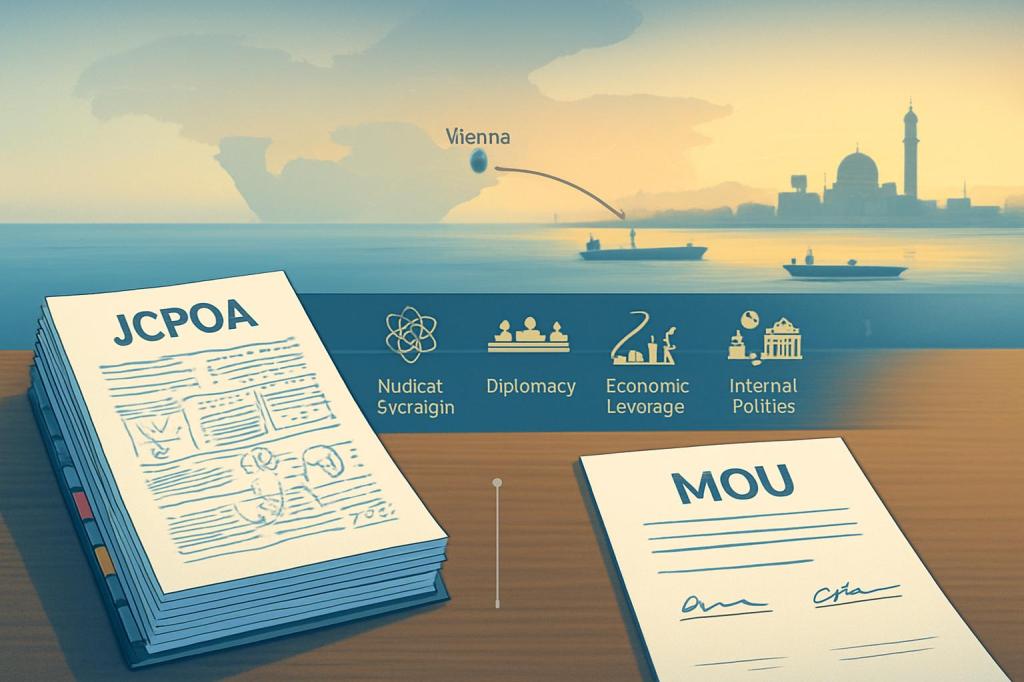
The release of the new U.S.–Iran memorandum of understanding (MOU) marks a sharp departure from the Obama-era Joint Comprehensive Plan of Action (JCPOA). This report compares the dense, multilateral JCPOA with today’s one‑and‑a‑half‑page, bilateral framework across four dimensions. First, it evaluates how far the MOU falls short of JCPOA‑style nuclear restraints and verification. Second, it situates the MOU in a wider diplomatic shift from Vienna negotiating rooms to the Strait of Hormuz. Third, it examines how sanctions, snapback, and economic leverage are being re‑engineered. Finally, it assesses how the Islamabad MOU reshapes internal power balances and incentives within the Iranian system.
The new U.S.–Iran memorandum of understanding (MOU) is a short, largely bilateral, wartime ceasefire framework that stands in stark contrast to the Obama‑era Joint Comprehensive Plan of Action (JCPOA), which was a dense, multilateral, and technically detailed nuclear accord. The JCPOA was an 18‑page core text with lengthy annexes negotiated among Iran, the P5+1, and the EU, explicitly trading verifiable nuclear limits and intrusive International Atomic Energy Agency (IAEA) monitoring for phased, conditional sanctions relief within a multilateral architecture.[2][3] The 2026 MOU, by comparison, is roughly a page and a half, built around a 60‑day window to halt active conflict, reopen the Strait of Hormuz, and create space for bargaining toward a possible follow‑on agreement—without itself functioning as a comprehensive nuclear deal.[1][3][4][5]
On the nuclear file, the JCPOA imposed detailed, quantified constraints across the fuel cycle: strict caps on enrichment levels, sharp limits on the size and chemical form of Iran’s enriched uranium stockpile, restrictions on the number and type of centrifuges, repurposing of key facilities such as Natanz, Fordow, and Arak, and a far‑reaching verification regime for IAEA access and monitoring.[2][3] These measures collectively extended Iran’s “breakout” timeline and anchored sanctions relief in verified technical performance. By contrast, the MOU “doesn’t include specifics on what will happen to Iran’s enriched uranium or its nuclear program,” merely committing to future talks to “discuss the issue of enrichment” and to “resolve the disposition of stockpiled enriched material” via a later‑agreed mechanism.[1][4][5] This omission is especially consequential given Iran’s current stockpile of uranium enriched to 60% purity—much closer to weapons‑grade than anything permitted under the JCPOA—because any credible nonproliferation outcome now would require stringent terms for exporting, diluting, or otherwise neutralizing that material.[4][5] The one concrete technical provision in the MOU is a minimum pledge to begin on‑site “downblending” under IAEA supervision, but with no clear end‑state for stockpile size, enrichment ceilings, or centrifuge R&D, the instrument’s immediate nonproliferation value is limited and contingent on later negotiations.[4][5]
The two frameworks also invert the core leverage logic around sanctions and economic relief. Under the JCPOA, nuclear‑related sanctions relief—by the U.S., EU, and UN—was phased and explicitly conditional: secondary U.S. sanctions were suspended and then terminated only after the IAEA verified Iran’s implementation of key nuclear commitments on “Implementation Day,” with a multilateral “snapback” mechanism available if Iran violated the deal.[2][3] The MOU, according to early readouts, front‑loads economic benefits for Iran in the first, ceasefire‑oriented phase—reconstruction funds, release of frozen assets, significant sanctions relief, and an end to a de facto U.S. “blockade” on Iranian ports—while deferring the substantive nuclear bargain to a second stage.[1][2][4] This sequencing diminishes Washington’s coercive economic leverage heading into nuclear‑specific talks, replaces juridical snapback with an explicit threat to “go back to bombing” if no follow‑on agreement is reached after 60 days, and reshapes corporate risk assessments by tying reversibility of relief to the prospect of renewed war rather than to multilateral legal processes.[1][2][4][5]
In legal and diplomatic terms, both the JCPOA and the new MOU are non‑binding political commitments rather than ratified treaties, but they differ radically in scope, geometry, and durability. The JCPOA embedded Iran’s nuclear file in a P5+1 framework backed by UN Security Council resolutions and linked to U.S. domestic oversight under the Iran Nuclear Agreement Review Act (INARA), giving Congress structured review of nuclear‑related understandings.[2][3][4] The MOU is a bilateral, interim “ceasefire‑plus” document whose short length and deferment of core nuclear issues allow the administration to argue that full INARA procedures should apply only to the anticipated, but uncertain, second‑stage deal.[3][4] This ambiguity invites partisan conflict over the extent and legality of sanctions waivers already being applied, raises questions about congressional sidelining compared with the JCPOA era, and underscores the reversibility of the arrangement across administrations. Experts warn that without a robust follow‑on accord, the MOU will be “volatile and impossible to sustain on its own.”[3]
Strategically, the JCPOA centered on nuclear governance; the new MOU centers on crisis termination and maritime access. In 2015, leverage ran primarily through coordinated sanctions pressure and the threat of renewed isolation if Iran violated nuclear rules.[2] In 2026, Iran’s demonstrated capacity to disrupt tanker traffic and threaten closure of the Strait of Hormuz has become a central bargaining chip, leading to an understanding that reportedly trades U.S. lifting of constraints on Iranian ports and shipping for Iran’s reopening of the Strait and halting of attacks, thus relocating core bargaining from centrifuge halls to a vital maritime chokepoint.[1][2][4] This shift intertwines energy security, reconstruction funding, and sanctions enforcement, affecting how global markets price risk and how international firms evaluate the durability of any window for Iran‑related commerce.
The new framework also broadens the regional linkage set in ways that were not built into the JCPOA. While both arrangements largely sidestep ballistic missiles, internal repression, and Iran’s domestic human rights record, the MOU explicitly folds in active conflict theaters: fighting around the Strait of Hormuz itself, Israel–Hezbollah hostilities, and questions about the future U.S. military posture in the wider region.[2][4][5] Ceasefire terms reportedly tie Iranian commitments not only to maritime behavior but also to the stance of Hezbollah and other proxies vis‑à‑vis Israel, thereby elevating the role of Iran’s regional network as both bargaining chip and enforcement mechanism.[2][4][5] This can create new ladders for de‑escalation but also new pathways for breakdown if expectations diverge or local actors test the limits of central control.
Inside Iran, the differing structures of the JCPOA and the MOU reshape internal political incentives. The JCPOA’s technocratic, IAEA‑driven compliance model temporarily empowered pragmatic factions and nuclear experts, while allowing the Supreme Leader to claim defense of Iran’s sovereign “rights” under a multilateral arrangement that promised gradual economic normalization.[1][4] The Islamabad MOU, negotiated in a wartime context and focused on a 60‑day ceasefire, re‑centers the Islamic Revolutionary Guard Corps (IRGC) and other security institutions whose battlefield performance, control over maritime disruption, and influence on proxies are now decisive bargaining tools.[2][3] Because the MOU softens near‑term nuclear conditionality—merely “reaffirming” that Iran will not seek nuclear weapons and postponing concrete enrichment and stockpile decisions—it affords the Supreme Leader greater latitude to balance hardliners and pragmatists while preserving strategic ambiguity over the nuclear program.[4]
The distribution of political and economic credit also shifts. Under Rouhani‑era JCPOA implementation, any uptick in trade and investment, however uneven, was associated with pragmatic diplomacy and the promise of reintegration.[1] In contrast, the MOU’s anticipated economic gains—reconstruction investment, unfrozen funds, and renewed oil sales—come in the wake of a costly war and are easily narrativized by the regime as victories won through resilience, missile capabilities, and coercive leverage in Hormuz, bolstering IRGC and hardline claims that steadfast resistance, not compromise, yields results.[2][3][4] The explicit omission of ballistic missiles from the MOU and the validation of regional proxy networks as central bargaining assets further entrench the security establishment’s dominance and reduce the space for moderates who had argued for limiting such programs to secure wider international concessions.[2][4]
In sum, the new MOU is less a successor to the JCPOA than a fundamentally different instrument: a brief, bilateral ceasefire framework that trades front‑loaded economic and maritime concessions for short‑term de‑escalation, while deferring the core nuclear questions that anchored the 2015 deal. Where the JCPOA tied sanctions relief tightly to specified, verifiable nuclear restraints within a multilateral rules‑based system, the MOU embeds nuclear issues in a broader war‑termination package, relies on the threat of rapid reversion to force rather than on structured snapback, and, in the process, shifts both regional dynamics and Iran’s internal balance of power in favor of hardline security actors.
Conclusion
The release of the new U.S.–Iran MOU marks a decisive shift from the JCPOA’s dense, enforceable nuclear architecture to a minimalist, time‑bound ceasefire framework. Technically, it replaces quantified enrichment caps, stockpile limits, and intrusive inspections with vague commitments to future talks and on‑site downblending. Diplomatically, it trades multilateral Vienna‑style process for a bilateral bargain centered on conflict termination and reopening the Strait of Hormuz. Economically and legally, it front‑loads sanctions relief and blurs INARA oversight, while enforcing compliance through threats of renewed force rather than UN‑anchored snapback. Politically inside Iran, it strengthens hardline security actors over technocrats. As a nonproliferation instrument, its value will hinge entirely on whether a robust follow‑on agreement materializes within sixty days.
Sources
[1] https://www.cbsnews.com/news/how-trump-iran-nuclear-deal-memorandum-of-understanding-compares-to-obama-nuclear-deal-jcpoa/
[2] https://en.wikipedia.org/wiki/Iran_nuclear_deal
[3] https://ofac.treasury.gov/sanctions-programs-and-country-information/iran-sanctions/joint-plan-of-action-jpoa-archive-and-joint-comprehensive-plan-of-action-jcpoa-archive
[4] https://www.aol.com/articles/trumps-memo-understanding-iran-compares-224507509.html
[5] https://www.cnn.com/2026/06/15/politics/obama-trump-iran-deal-comparison-jcpoa-analysis/
[6] Atlantic Council, “Experts react: The US and Iran just announced an interim peace deal. Here’s what we know so far,” https://www.atlanticcouncil.org/dispatches/experts-react-the-us-and-iran-just-announced-an-interim-peace-deal-heres-what-we-know-so-far
[7] Council on Foreign Relations, “Trump’s Iran Deal Reopens the Strait. Much Remains to Be Done,” https://www.cfr.org/articles/trumps-iran-deal-reopens-the-strait-much-remains-to-be-done
[8] NBC News/YouTube, “Comparing the Iran peace plan with Obama’s nuclear deal that Trump killed,” https://www.youtube.com/watch?v=Vp8HrM0hEH8
[9] https://x.com/TheStudyofWar/status/2065954733706063873
[10] https://www.congress.gov/crs-product/IF13247
[11] https://www.cbsnews.com/news/us-iran-deal-memorandum-of-understanding-text
[12] https://www.cfr.org/backgrounders/what-iran-nuclear-deal
[13] https://en.majalla.com/node/331633/politics/trump’s-2026-iran-deal-differs-obama’s-2015-jcpoa
[14] https://www.bbc.com/news/articles/c74ynmnrwmeo
[15] https://www.thebulwark.com/p/breaking-down-the-us-iran-mou-memorandum-understanding-ceasefire
[16] https://www.facebook.com/sbsnews/posts/the-united-states-and-iran-have-released-the-full-text-of-their-memorandum-of-un/1464029065768649
Written by the Spirit of ’76 AI Research Assistant





Leave a Reply