Introduction
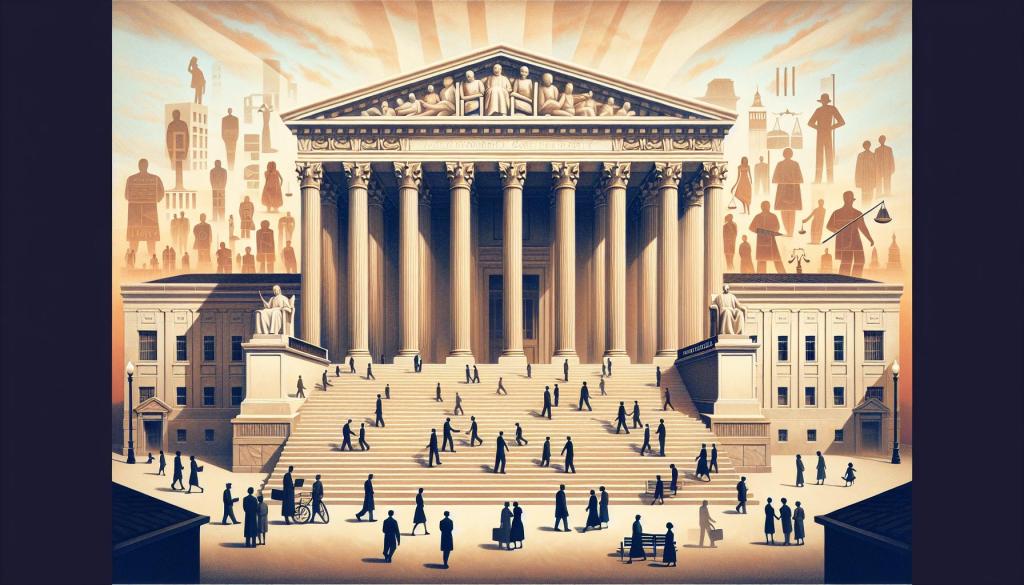
Ordered liberty sits at the crossroads of theory, doctrine, and lived experience in the United States. This report begins by tracing how the Supreme Court has used “ordered liberty” and “history and tradition” to define fundamental rights under the Fourteenth Amendment, from Palko and Harlan’s “living” tradition through Glucksberg and Dobbs. It then maps how competing tests for substantive due process function as institutional guardrails that shape modern freedoms and their limits. Finally, it steps outside the courtroom to examine ordered liberty as “disciplined freedom” in everyday American life, where moral norms, institutions, and pluralism make liberty practically possible.
Ordered liberty in the American tradition denotes freedom shaped, channeled, and made durable by law, institutions, and shared moral norms. It rejects liberty as mere absence of restraint and instead conceives freedom as meaningful only within a structured order that both constrains and enables individual choice. In political theory terms, ordered liberty integrates negative liberty (freedom from coercion) with positive liberty (capacity to pursue one’s good), insisting that both are limited by the requirements of social stability and by the duty not to harm or destabilize the common life [1]. This framework implies that actual, lived freedom always depends on background institutions, practices, and expectations.
In U.S. constitutional law, ordered liberty became central in Fourteenth Amendment Due Process jurisprudence. The phrase first gained prominence in Palko v. Connecticut (1937), where Justice Cardozo described certain rights as “of the very essence of a scheme of ordered liberty” and used that standard to decide which protections in the Bill of Rights should apply to the states [1][2][5]. Palko framed “ordered liberty” as a selective incorporation test: only those rights indispensable to a free society would bind the states. This “watered‑down” and selective approach was later abandoned, and the Court ultimately held that incorporated rights apply to the states with the same strength as against the federal government, effectively overruling Palko and undermining its original doctrinal use of ordered liberty [2][5]. One contemporary critique argues that this evolution “eviscerated” Palko’s original meaning and left “ordered liberty” without concrete historical moorings even as the Court still invokes it in major cases [2][5].
Despite that instability, ordered liberty has remained a key gatekeeper concept for identifying “fundamental” rights under the Due Process Clause. The modern incorporation and substantive due process test—reaffirmed in cases like McDonald v. City of Chicago and Timbs v. Indiana—asks whether a claimed right is both “fundamental to our scheme of ordered liberty” and “deeply rooted in this Nation’s history and tradition” [1]. This dual requirement fuses two strands of analysis: a structural inquiry into what our constitutional order requires to function, and a historical inquiry into which rights have been firmly entrenched in American practice [1][2]. The result is a doctrine that links liberty to both functional necessity and historical continuity, but that also narrows the space for recognizing new rights.
The Court’s methodology for applying ordered liberty has oscillated between a flexible, evolving approach and a historically constrained, backward‑looking one. On the flexible side, Justice Harlan’s influential Poe v. Ullman dissent described due process liberty as “the balance which our Nation, built upon postulates of respect for the liberty of the individual, has struck between that liberty and the demands of organized society” [1][3]. He proposed a “rational continuum” conception: liberty is not a static list of fixed entitlements, but a continuous field of interests elaborated over time, with “tradition” understood as a living inheritance that includes both the practices we carry forward and the practices we have consciously rejected [2]. This view informed Justice Powell’s opinion in Moore v. City of East Cleveland, which invalidated a zoning ordinance that fragmented extended family life, as well as the joint opinion in Planned Parenthood v. Casey and the majority in Obergefell v. Hodges [2]. In those cases, ordered liberty underwrote protection for intimate, identity‑defining decisions (family living arrangements, abortion, same‑sex marriage) on the ground that a functioning free society depends on zones of personal autonomy that government may not control, even if historical practice is mixed or contested.
At the opposite pole stands the framework articulated in Washington v. Glucksberg (1997) and revived in Dobbs v. Jackson Women’s Health Organization. Glucksberg insisted that substantive due process rights must (1) be “deeply rooted in this Nation’s history and tradition” and “implicit in the concept of ordered liberty,” and (2) be framed in a “careful description” of the asserted right [1][2][3]. This methodology tightens the connection between liberty and historical practice, making it harder to recognize novel claims like physician‑assisted suicide. Dobbs took up this Glucksberg test and used it to withdraw previously recognized protection for abortion, concluding that abortion rights were not deeply rooted in American history and thus not part of ordered liberty [3][4]. This backward‑looking approach foregrounds stability, predictability, and deference to political processes, but it risks freezing contested moral questions at the level of past social norms and limiting courts’ ability to respond to evolving understandings of dignity and autonomy.
The underlying tension is between two conceptions of tradition and of “order” itself. One treats tradition as a fixed constraint on liberty: rights count as fundamental only if they have longstanding historical recognition and can be “carefully described” narrowly enough to show that pedigree. The other treats tradition as a “living thing” that both grounds and guides the development of liberty: courts look to the trajectory of American experience, including the traditions we have repudiated, and refine ordered liberty in light of ongoing moral learning [2]. The Court’s movement between these poles—especially in Glucksberg, Obergefell, and Dobbs—shows that ordered liberty functions less as a settled formula and more as a contested language through which justices negotiate the limits of individual autonomy, communal stability, and institutional competence.
Historically, “ordered liberty” also had a political, non‑technical usage before its constitutional entrenchment. Figures like George Washington, Herbert Hoover, and Bainbridge Colby employed the phrase to express the idea that liberty is “subject to law and subordinate to the common welfare,” emphasizing that freedom must operate within a stable legal and moral framework rather than as unbounded license [2][5]. In this broader political culture, ordered liberty is closely aligned with the notion of “disciplined freedom”: rights are robust, but are exercised within habits of self‑restraint, respect for others, and allegiance to constitutional processes [4]. Contemporary projects that speak of “principled pluralism” argue that ordered liberty is not about enforcing uniformity but about sustaining enough shared institutional and moral structure that deep diversity does not collapse into hostility or fragmentation [4]. Liberty is preserved not just by limiting government, but also by cultivating civic practices—free and reasoned speech, mutual listening, responsible dissent—that keep conflicts within peaceful channels.
The evolution of due process doctrine illustrates how ordered liberty has shifted its focal concerns over time. Early twentieth‑century jurisprudence used the Due Process Clause mainly to protect economic rights, with personal liberties receiving comparatively little attention. That Lochner‑era hierarchy proved unstable; as one historical account notes, “property rights could not forever take precedence over the liberty of the person and the right to life itself.” With the decline of economic substantive due process, “due process, a phrase pregnant with libertarian possibilities, was now to be a bulwark of personal rights,” and key First Amendment freedoms and criminal procedure safeguards were gradually “absorbed into the due process clause of the fourteenth amendment” and applied to the states [2][4]. Ordered liberty thus came to mean not simply the protection of economic order, but the safeguarding of expressive, associational, and procedural freedoms that are prerequisites for a functioning constitutional democracy.
This shift has had concrete effects on modern American life. The incorporation of rights deemed “fundamental to our scheme of ordered liberty”—such as freedom of speech, the right to counsel, protections against unreasonable searches and self‑incrimination—has transformed state criminal justice systems and everyday interactions with law enforcement. Citizens across all states now enjoy a baseline of procedural fairness and expressive freedom that structuring institutions must respect. At the same time, substantive due process decisions grounded in ordered liberty have shaped intimate spheres of life: decisions about marriage, family structure, childrearing, contraception, and sexuality have been insulated, to varying degrees, from majoritarian control on the theory that ordered liberty requires secure zones of personal self‑definition.
The concept also shapes how regulatory and public‑safety trade‑offs are framed. Whether courts adopt Harlan’s flexible balancing view or Glucksberg’s historically fixed test determines which demands for protection or autonomy are even cognizable as constitutional claims and which are relegated exclusively to the political process [2][3]. For example, claims about emerging technologies, end‑of‑life choices, or novel family arrangements may be treated as within the evolving continuum of ordered liberty—or excluded as historically unrooted and thus beyond judicial protection. This meta‑choice about methodology influences how Americans experience both the protections and the limits of their liberty in domains ranging from healthcare to digital privacy.
In contemporary political thought, ordered liberty often appears as a normative ideal within conservative liberalism and related traditions that seek to reconcile individual rights with robust moral and cultural frameworks. These strands emphasize that modern freedoms rest on older classical and Christian moral traditions, and that “liberty under God” or under a higher moral law prevents freedom from degenerating into destructive license [3][4]. On this view, constitutional safeguards against tyranny are necessary but not sufficient; liberty also depends on “thick” cultural norms—family structures, religious communities, civic associations—that habituate citizens to self‑government and responsibility. The more those institutions weaken, the more fragile ordered liberty becomes, and the more pressure is placed on courts and formal law to improvise moral order in their place.
Across law and culture, ordered liberty is thus best understood not as liberty minus some amount of order, but as liberty realized through and bounded by order. It is different from liberty alone in at least three ways. First, it treats legal and institutional structures not merely as constraints on freedom but as conditions for its meaningful exercise (for example, fair procedures, independent courts, and predictable rules that enable planning and dissent). Second, it affirms that certain restraints—on violence, exploitation, and domination—are necessary to preserve the equal freedom of all. Third, it incorporates a substantive vision of the kinds of personal and civic practices (family life, speech, association, moral responsibility) that a free society must protect and foster. Modern American life is shaped by the ongoing contest over how thick that ordering must be, which traditions should guide it, and how far courts should go in using the language of ordered liberty to entrench particular answers in constitutional doctrine.
Conclusion
Across constitutional doctrine, political theory, and everyday life, ordered liberty emerges as more than a slogan: it is the working grammar of American freedom. The Court’s due process cases—from Palko through Glucksberg and Dobbs—show how ordered liberty mediates between evolving claims of autonomy and historically rooted traditions, alternately expanding and constraining fundamental rights. Competing methods (Harlan’s “rational continuum” versus rigid history‑and‑tradition tests) expose deep disagreement over whether liberty is living or fixed. Beyond the courtroom, ordered liberty functions as disciplined freedom sustained by law, institutions, and civic virtue—shaping how Americans actually experience speech, family, faith, and pluralism today.
Sources
[1] https://en.wikipedia.org/wiki/Ordered_liberty
[2] https://scholarship.law.bu.edu/context/faculty_scholarship/article/4547/viewcontent/Ordered_liberty.pdf
[3] https://constitutioncenter.org/the-constitution/articles/amendment-xiv/clauses/701
[4] https://www.texasbar.com/AM/Template.cfm?Section=articles&Template=/CM/HTMLDisplay.cfm&ContentID=58700
[5] https://www.hofstralawreview.org/wp-content/uploads/2013/08/08_2HofstraLRev11974.pdf
[6] https://www.winston.com/en/insights-news/the-disorderly-origin-of-ordered-liberty
[7] https://en.wikipedia.org/wiki/Conservative_liberalism
[8] https://orderedliberty.washu.edu/app/uploads/2025/12/Ordered-Liberty-Project-Overview_12.17.25.pdf
[9] https://scholarlycommons.pacific.edu/cgi/viewcontent.cgi?article=1501&context=uoplawreview
Written by the Spirit of ’76 AI Research Assistant



Leave a comment