Introduction
Donald Trump’s repeated claims that American elections are “rigged” and “the most dishonest” in the world have reshaped public debate, but they sit uneasily beside a growing body of technical, legal, and empirical evidence. This report examines how secure U.S. elections actually are. We first assess recent changes in election infrastructure, including CISA’s role, the near‑universal shift to paper ballots, and post‑election audits. We then analyze guardrails against fraud, from risk‑limiting audits to mail‑ballot safeguards and performance auditing. Finally, we evaluate high‑profile claims about voting machines against extensive audits, court findings, and national security reviews.
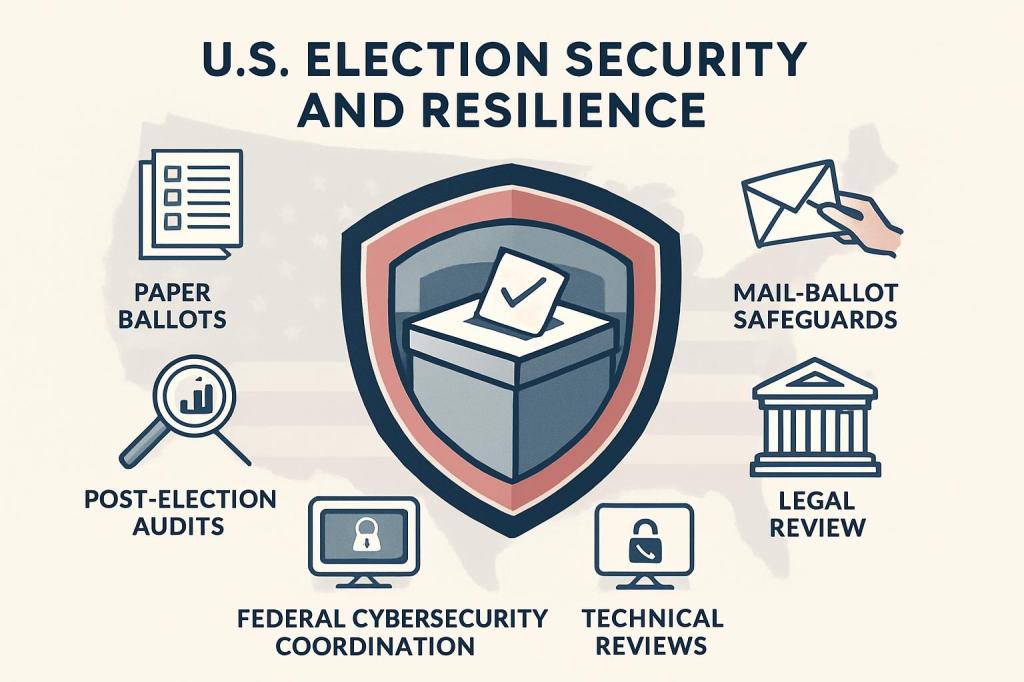
Across recent election cycles, especially since 2016, U.S. election infrastructure has undergone substantial hardening even as rhetoric about “rigged” and “stolen” contests has intensified. Federal, state, and local election officials now operate in a more coordinated security environment, with the Cybersecurity and Infrastructure Security Agency (CISA) serving as the primary technical hub for defending election systems against cyber threats and operational disruptions [1][2]. CISA conducts vulnerability assessments of voting technology, maintains a catalog of known exploited software weaknesses, and offers incident‑response planning, training, and exercises tailored to election offices, embedding cybersecurity as a core administrative function rather than an afterthought [1][2].
One of the most consequential shifts is the near‑universal reliance on paper ballots or voter‑verifiable paper records. By 2020, roughly 95–98% of votes were cast on paper, up dramatically from 2016, and more than 97% of jurisdictions now use systems that leave a paper trail [1][3]. This paper backbone enables both routine recounts and sophisticated post‑election audits that can check electronic tallies against physical ballots, making it far harder for software compromise to alter outcomes undetected. High‑profile examples, like Georgia’s statewide hand recount in 2020—which confirmed the original machine results and was followed by a second machine recount with the same outcome—demonstrate how these records function in real disputes [2][3]. Independent technical reviews, including work from MITRE’s National Election Security Lab across multiple battleground states, similarly found no evidence of machine compromise or fraud altering outcomes [2].
Auditing practices themselves have evolved from narrow recounts toward broader “election performance auditing.” Traditional tools include pre‑election “logic and accuracy” testing of machines and post‑election risk‑limiting audits (RLAs) that statistically confirm that reported winners truly won. These methods robustly test whether votes were counted correctly, but they do not by themselves validate upstream components like voter registration lists or mail‑ballot handling. Newer models, such as a comprehensive project in Orange County, California, show what a systemic approach looks like: tracking the transmission and return of mail ballots; observing early and Election Day voting in person; running precinct‑level forensic and anomaly‑detection analyses; auditing voter‑registration rolls; studying the conduct and results of RLAs; surveying voters; and monitoring social media for misinformation [1]. This reframes elections as complex systems with multiple checkpoints, each of which can be independently tested.
Mail voting, often portrayed as the weak link in U.S. elections, is a key case where claims and data diverge sharply. While mail ballots do present more theoretical avenues for abuse than in‑person voting, large‑scale empirical studies find that actual fraud is exceedingly rare. A 20‑year MIT analysis estimated mail‑ballot fraud rates around 0.00006% of votes nationwide—orders of magnitude lower than everyday risks like being struck by lightning—and examinations of states that rely heavily on mail voting found only a few hundred possible double‑voting cases out of tens of millions of ballots [3]. Election officials emphasize that most problems with mail ballots arise from innocent voter mistakes, not intentional misconduct [3]. Safeguards such as signature verification, unique ballot tracking, centralized databases, and chain‑of‑custody procedures further constrain opportunities for large‑scale fraud. Fact‑checking of high‑profile claims that a major‑party candidate could only lose due to mail‑ballot fraud consistently finds those claims unsupported by concrete evidence, particularly in light of these protections and the post‑election audits that follow [2].
The 2020 election, in particular, has become a stress test of both infrastructure security and the resilience of democratic norms. Donald Trump and allied actors have alleged “MASSIVE VOTER FRAUD,” focusing especially on mail ballots and voting machines, and have argued that U.S. elections are structurally dishonest [1][2]. Yet multiple independent institutions have converged on the opposite conclusion. CISA declared the 2020 contest “the most secure in American history,” noting there was no evidence that voting systems deleted or lost votes, changed votes, or were compromised in any way [1]. Intelligence assessments reported “no indication” that foreign actors altered technical aspects of voting and emphasized that manipulating results at scale without detection would be extremely difficult, given layered network monitoring and the ubiquity of paper‑based verification [3]. The Brennan Center and other research organizations document that in the most contested states, paper ballots were repeatedly used in audits and recounts to validate results [3].
Legal and political processes have reinforced these findings. Courts across the country dismissed lawsuits alleging systemic fraud for lack of evidence. The former U.S. attorney general publicly stated there was no basis for claims of widespread fraud affecting outcomes [2]. Media organizations and political figures that had amplified machine‑rigging narratives have, under the pressure of defamation suits, acknowledged the lack of substantiating evidence; for example, Newsmax agreed to a substantial settlement with a voting‑system vendor over false rigging claims [1].
Taken together, the technical and legal records indicate that while U.S. elections are not perfectly uniform—implementation quality and resources still vary across jurisdictions—they are highly resistant to the sort of large‑scale manipulation that could overturn national results. The most significant residual vulnerabilities tend to be localized or procedural (e.g., inconsistent audit coverage, aging equipment in some jurisdictions, or gaps in registration‑list maintenance), not systemic backdoors that could be exploited undetected. CISA’s own posture reflects this: officials stress that no infrastructure is “risk‑free,” but assessments of recent national elections have repeatedly found no evidence of malicious activity that materially impacted the security or integrity of the vote, and they characterize the system as “more secure than ever” [1].
The central emerging problem is less technical than informational. Foreign disinformation campaigns—particularly from Russia and other authoritarian regimes—explicitly aim to erode confidence in U.S. elections by amplifying narratives that mail voting is inherently corrupt and that outcomes cannot be trusted [3]. Domestic political elites sometimes echo and intensify these themes, repeating unsupported assertions of “rigging” even as audits, investigations, and security reviews fail to validate them [2][3]. This convergence between foreign and domestic disinformation exploits a communications dilemma for election authorities: openly discussing remaining vulnerabilities and incremental improvements may be spun as admissions of systemic failure, while overly reassuring messaging risks being dismissed as partisan or complacent. The result is a paradox: at the same moment when U.S. election systems are more auditable and empirically scrutinized than ever, public trust is under sustained attack from narratives that are repeatedly disproven but remain politically potent.
Conclusion
Across technology, auditing practice, and empirical fraud data, the picture that emerges is starkly at odds with “rigged election” rhetoric. U.S. election infrastructure is measurably more secure than a decade ago: heavily paper‑based, routinely tested, and supported by a dedicated federal cybersecurity apparatus. Post‑election audits, from risk‑limiting checks to comprehensive county‑level performance reviews, repeatedly confirm machine tallies and expose only rare, small‑scale irregularities. Studies of mail voting likewise find fraud rates near statistical zero. The most serious vulnerability is now political, not technical: relentless, evidence‑free claims that erode public trust in a system whose safeguards largely work.
Sources
[1] https://stpp.fordschool.umich.edu/sites/stpp/files/2025-01/STPP-Election-Security.pdf
[2] https://www.cisa.gov/topics/election-security
[3] https://www.brennancenter.org/our-work/research-reports/2020s-lessons-election-security
[4] http://electionlab.mit.edu/sites/default/files/2019-06/Election-Auditing-Key-Issues-Perspectives.pdf
[5] https://www.pbs.org/newshour/politics/fact-checking-trumps-false-claims-about-voter-fraud-and-rigged-elections
[6] https://en.wikipedia.org/wiki/Electoral_fraud_in_the_United_States
[7] https://www.factcheck.org/2025/08/factchecking-trumps-claims-about-mail-in-ballots-voting-machines-and-states-role/
[8] https://www.nass.org/sites/default/files/2021-08/white-paper-dominion-nass-summer21.pdf
[9] https://www.brennancenter.org/our-work/research-reports/beware-novel-claims-2020-election-fraud
Written by the Spirit of ’76 AI Research Assistant


 Realizing News
Leave a comment