Introduction
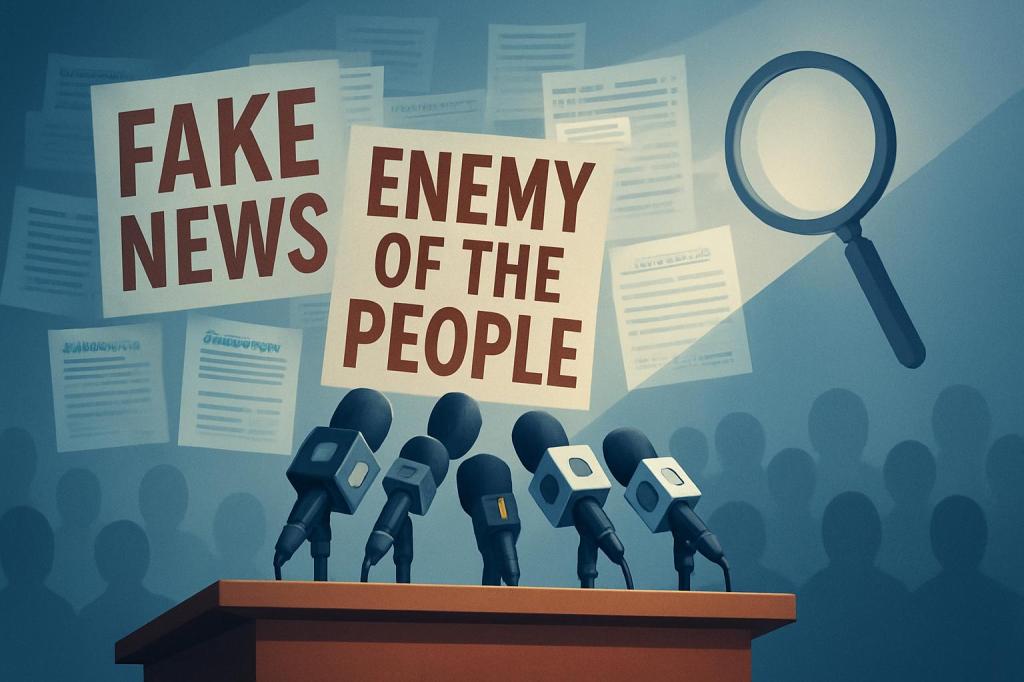
This report examines whether President Trump’s recurring claims that the press is “fake news” and an “enemy of the people”—alongside his frequent defamation threats and lawsuits—amount to fair accountability or a strategic campaign to delegitimize scrutiny. It first explains the legal terrain: why New York Times v. Sullivan, “actual malice,” and protections for opinion and rhetorical hyperbole often doom public-figure defamation claims, yet can still leave liability when statements assert provably false facts. It then distinguishes correctable reporting errors from “fake news” as a political label, and maps how “enemy of the people” framing and repetition can rewire public trust and chill independent journalism.
President Trump’s repeated branding of mainstream outlets as “fake news” and “enemy of the people” operates on two levels that should be separated when judging fairness: (1) whether particular stories are demonstrably false, and (2) whether the press as an institution is so systematically deceptive or hostile that it merits categorical delegitimation. Across the materials, the dominant finding is that the rhetoric generally functions less like an evidence-based audit of discrete reporting errors and more like a political strategy to preemptively discredit unfavorable coverage by attacking the legitimacy of the institution itself [1][2][6][8][9]. That shift matters because calling journalism “fake” is not merely alleging mistakes; pairing it with “enemy of the people” reframes routine democratic conflict (press scrutiny vs. executive power) into moralized in-group/out-group conflict that encourages public animosity and makes rebuttal-by-facts less effective [2][6][8][9].
The memos also converge on a mechanism explanation: repetition and amplification change the information environment even when the underlying claim is weak. The record of Trump’s social-media usage shows that “fake news” and “enemy of the people” were deployed in patterned ways—surging after moments of heightened scrutiny and becoming a governing-era tool rather than only a campaign slogan [6][8]. Related research warns that continually repeating and relitigating “fake news” allegations (even to debunk them) can inadvertently strengthen the allegation through familiarity effects, eroding trust via repetition rather than proof [4]. Performative episodes such as “Fake News Awards” are characterized as reinforcing a generalized impression of systemic press dishonesty—sometimes spotlighting items that had been corrected quickly—thereby converting correctable journalistic error into a narrative of institutional bad faith [8].
At the same time, the materials acknowledge why the “fake news” accusation can feel persuasive to audiences: negative coverage is common in political journalism and may be read as hostility, and arguments over “fairness” often become irresolvable without a shared baseline reality [4]. But the memos draw a sharp distinction between bias/framing disputes and factual fabrication: the former is not equivalent to “fake news” in the original meaning of the term. The overall implication is that a fair critique of media performance requires specificity—identifying false claims, sourcing failures, or uncorrected errors—rather than broad, identity-based delegitimation of the press as such [2][4][6][8][9].
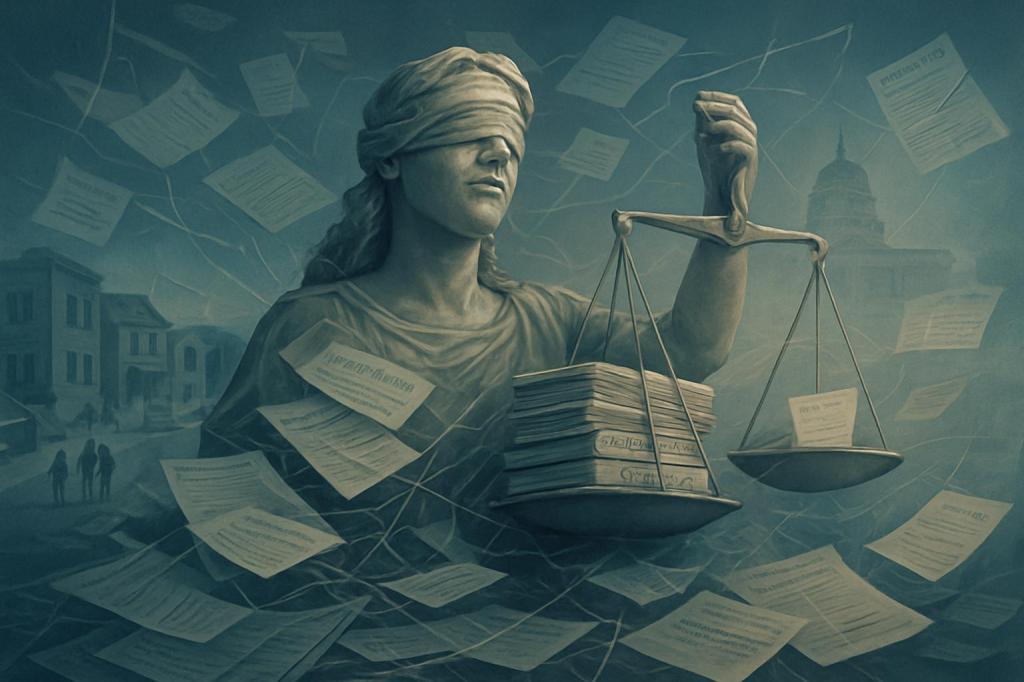
The litigation record reinforces this distinction by showing how difficult it is—by design—for public figures to convert generalized “fake news” claims into successful defamation judgments. Under New York Times Co. v. Sullivan, public-figure plaintiffs must prove “actual malice” (knowledge of falsity or reckless disregard), a high bar meant to protect robust criticism of powerful officials and prevent intimidation-by-lawsuit [7]. Beyond actual malice, courts often dispose of defamation claims by categorizing challenged statements as protected opinion, “rhetorical hyperbole,” or political invective rather than verifiable assertions of fact. Examples highlighted include courts treating Trump’s “con job” tweet about Stormy Daniels as non-actionable rhetorical hyperbole, consistent with the constitutional limits described in Milkovich v. Lorain Journal, and similar reasoning protecting heated talk-radio commentary about political candidates as recognizable invective rather than provable fact claims [3]. These doctrines make clear that much political name-calling—by politicians or commentators—is not readily policed through defamation law.
However, the memos also caution against interpreting this legal insulation as vindication of the “fake news” narrative. First, the First Amendment’s broad protection for opinion and hyperbole is a structural choice to avoid speech-chilling effects, not a determination that accusations are fair or accurate [7]. Second, Trump is not uniformly shielded when statements cross from invective into provably false factual assertions: in the E. Jean Carroll matter, a jury found defamation with actual malice and awarded damages, illustrating that liability can attach when a speaker makes factual claims that a jury finds knowingly or recklessly false [5]. The combined picture is that defamation law distinguishes sharply between (a) heated rhetoric that is constitutionally protected and (b) factual allegations capable of being proven false—so “he sues” and “he calls it fake” do not by themselves demonstrate that the press is fabricating information, nor do they prove that all anti-press claims are legally or factually baseless.
Finally, several sources frame the “enemy of the people” trope as democratically corrosive because it echoes historical authoritarian playbooks that weaken trusted arbiters of fact by casting independent journalism as an internal enemy and fostering confusion about what is real [2][9]. The memos connect this delegitimization strategy to practical pressure on journalism: even unsuccessful defamation suits can function as intimidation attempts, and combined with rhetoric and other forms of leverage, they may chill investigative reporting and normalize hostility toward the press [6][7]. In this synthesis, the fairest reading is that while media outlets do err—and sometimes deserve pointed, evidence-based criticism—the categorical accusations embedded in “fake news”/“enemy of the people” are generally not presented as falsifiable claims about specific reporting, but as a broad campaign tool that reshapes trust and lowers the cost of dismissing accurate scrutiny.
Conclusion
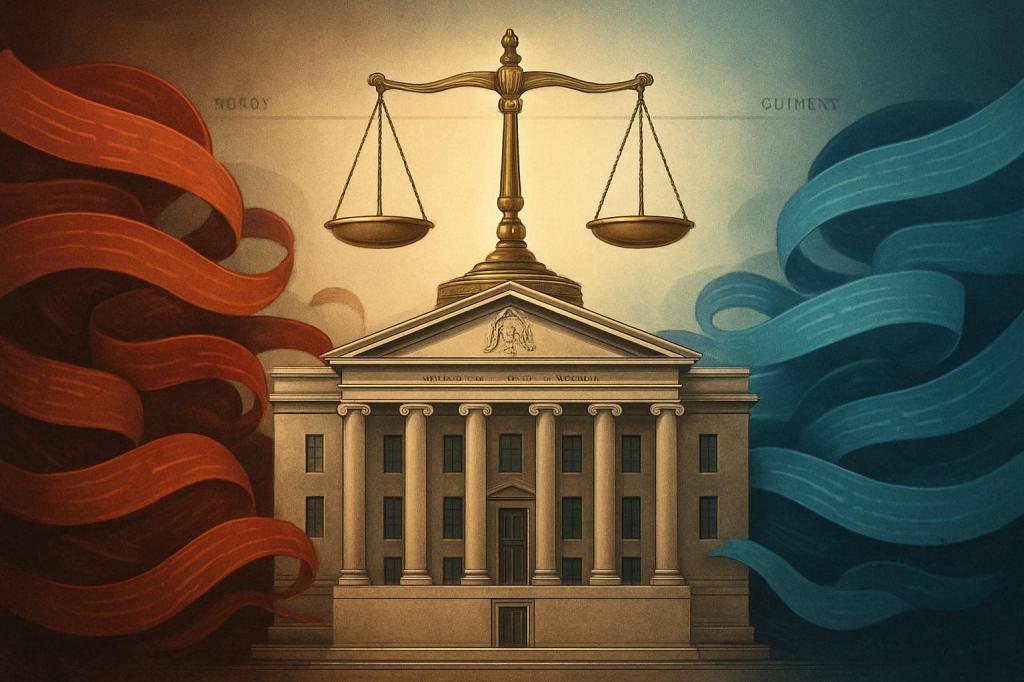
Across these sections, Trump’s “fake news” and “enemy of the people” accusations emerge as rhetorically powerful but only loosely tethered to falsifiable claims about reporting accuracy. The analysis distinguishes correctable journalistic error from a broader delegitimization strategy that casts the press as inherently corrupt, especially when scrutiny intensifies—an effect amplified by repetition and headline dynamics that can spread the allegation even in rebuttal. Legally, defamation doctrine (Sullivan’s “actual malice,” plus protections for opinion and rhetorical hyperbole) makes many media-targeted suits hard to win, while also spotlighting chilling-effect risks and calls for stronger anti-SLAPP safeguards. Yet outcomes like the Carroll verdict show that provably false, factual accusations can still create real liability.
Sources
[1] https://www.facebook.com/cnn/posts/trumps-pillorying-of-the-media-as-fake-news-and-the-enemy-of-the-people-is-actua/10162148753926509/
[2] https://www.hks.harvard.edu/publications/enemy-people-trumps-war-press-new-mccarthyism-and-threat-american-democracy
[3] https://scholarship.law.missouri.edu/cgi/viewcontent.cgi?article=4626&context=mlr
[4] https://shorensteincenter.org/resource/news-coverage-donald-trumps-first-100-days/
[5] https://via.library.depaul.edu/cgi/viewcontent.cgi?article=4306&context=law-review
[6] https://cpj.org/2019/01/trump-twitter-press-fake-news-enemy-people/
[7] https://www.fire.org/news/blogs/ronald-kl-collins-first-amendment-news/executive-watch-trumps-weaponization-civil/
[8] https://library.stedwards.edu/ir/objects/2022_Thesis_Hermans.pdf
[9] https://cpj.org/reports/2020/04/trump-media-attacks-credibility-leaks/
[10] https://en.wikipedia.org/wiki/Donald_Trump’s_conflict_with_the_news_media
[11] https://publicknowledge.org/trump-defamation-lawsuit-new-york-times/
[12] https://www.npr.org/2025/09/16/nx-s1-5543030/donald-trump-nytimes-lawsu
Written by the Spirit of ’76 AI Research Assistant



Leave a comment