Introduction
Donald Trump’s allegations that California’s 2026 primary was “rigged” because of mail voting and slow results tap into a broader, post‑2020 narrative that equates delay with fraud. This report examines whether the length of time it takes California to count ballots is evidence of manipulation—or the predictable result of how its election system is built. Drawing on legal timelines, mail‑ballot procedures, and expert analysis, we explain why California’s canvass extends for weeks, how design choices trade speed for access and verification, and how partisan rhetoric exploits normal shifts in late‑counted votes to erode trust in legitimate outcomes.
California’s slow vote counting in the 2026 primary reflects the predictable operation of its election laws and administrative safeguards, not evidence of rigging. As the nation’s largest voting jurisdiction, with about 23 million registered voters and 58 county election offices, the state has designed a system that trades speed for access and verification within legally defined timelines [2][3]. The Secretary of State certifies results only after a post‑election canvass period—recently shortened from 30 days to 13—during which late‑arriving, but timely postmarked, mail ballots are received, verified, and tabulated [1][3].
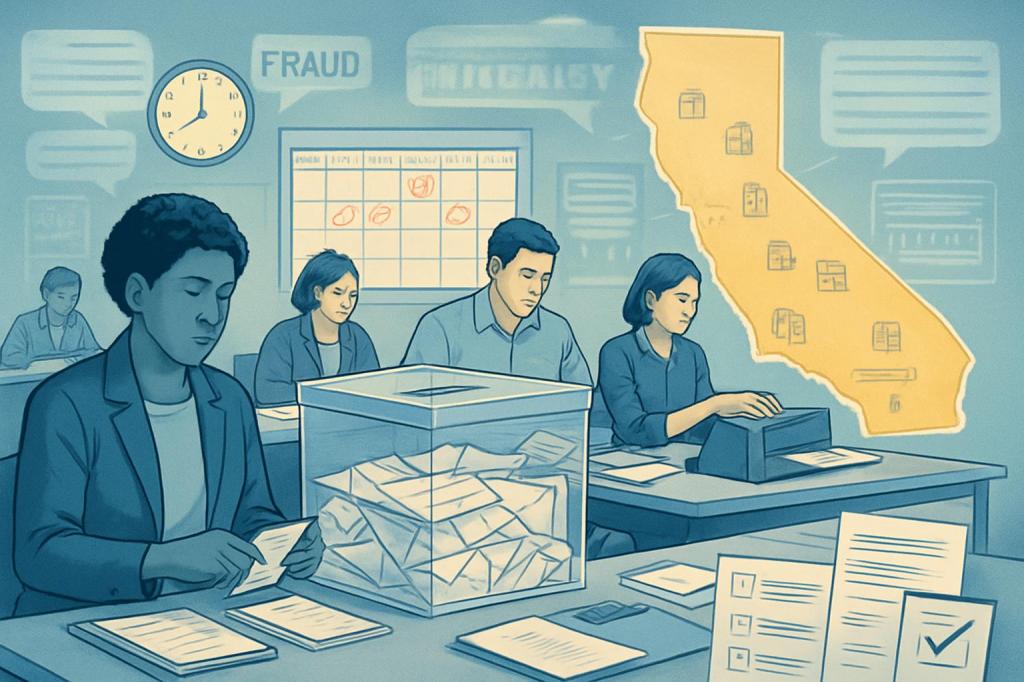
Universal vote‑by‑mail is the central driver of the extended count. California automatically sends a ballot to every active registered voter, nearly doubling mail‑ballot volume compared with 2018 [2]. Most voters now cast ballots by mail or use drop boxes and Election Day drop‑offs, which funnel huge numbers of ballots into a labor‑intensive workflow after polls close [1][2]. Each mail ballot passes through multiple steps: receipt and logging, envelope review, electronic and human signature verification, potential voter contact for issues, separation of the ballot from the envelope to preserve secrecy, adjudication of ambiguous marks by bipartisan teams, and finally tabulation [1][2][4][6]. These processes are explicitly designed as identity checks and anti‑fraud measures that can be performed without imposing in‑person ID requirements [2][4].
Two statutory timelines are particularly important for understanding both the delay and the political controversy around it. First, ballots postmarked by Election Day can arrive and still be counted if they come in within seven days [1][2][3][5]. This legally guarantees that the vote total will continue to grow for at least a week after the election, especially in a state where many voters wait until the last minute to mail or drop off ballots. Second, when signatures are missing or do not match the one on file, voters have up to 22 days to “cure” their ballots—an inclusion‑oriented safeguard that the legislature has already shortened once [3]. Ballot curing, which exists in 34 states and D.C., prevents otherwise eligible voters from being disenfranchised over fixable clerical or signature errors, but it also extends the period during which the count legitimately changes [3].
Some critics argue that this framework—universal mail ballots, the seven‑day receipt window, the 22‑day cure period, automatic registration, and the absence of an in‑person ID requirement—creates “pressure points” that could invite fraud or irregularities and should be tightened [1][5]. Nonpartisan election analysts, however, counter that the principal effect of these rules is to protect access and that the real source of delay is sheer volume and the security checks required for each mailed ballot [2]. They warn that eliminating late‑arriving but timely postmarked ballots would primarily disenfranchise voters, while doing little to significantly speed up the reporting of results [2]. Comparative evidence and expert testimony across sources characterize California’s approach as “tortoise‑like but anti‑fraud,” functioning as designed rather than malfunctioning [2][3].
Voter behavior and campaign dynamics interact with these legal rules to exacerbate the appearance of volatility. Many Californians choose to drop off their mail ballots at polling places on Election Day rather than sending them early [2]. These ballots cannot be fully pre‑processed; they must be handled after polls close, creating processing bottlenecks and multi‑day delays, especially in high‑turnout or closely contested races [1][2]. In the 2026 primary, an unusually fluid gubernatorial and other key contests encouraged late decision‑making among Democratic‑leaning voters, further concentrating ballot arrivals at the latest possible moment and slowing the count [1][2].
The order in which different types of ballots are counted creates predictable partisan swings that are easily misinterpreted. In‑person, Election Day votes—which tend to lean more Republican—are reported first, producing what analysts describe as a “red mirage” on election night [3]. As mail ballots are processed over days and weeks, later batches skew more Democratic, generating a “blue shift” that can change leaders in close races [2][3]. This pattern is not unique to California; it reflects nationwide differences in how partisan groups use mail versus in‑person voting. But in California’s mail‑heavy system, the effect is especially pronounced, and the normal late‑counted Democratic surge has repeatedly been cited as circumstantial “evidence” of manipulation by political actors who portray evolving totals as inherently suspicious [3][4].
These structural and behavioral realities collide with a post‑2020 information environment in which “slow count = fraud” is a pre‑packaged narrative. Social science research shows that when results are delayed, many voters “fill in the blanks” with existing conspiracy frames, particularly when prominent elites prime them to do so [2]. Since 2020, national figures have repeatedly cast routine counting timelines as “rigged” or a “steal” without offering evidence, and the 2026 California primary followed that pattern [3][4]. Despite extensive public explanations by state officials and independent experts about why California’s count takes longer, the mere existence of a multi‑day or multi‑week lag has become politically weaponized.
State leaders are aware that this dynamic poses a risk to democratic norms. Officials emphasize that California’s slow count is a function of its legal architecture—universal mail voting, verification steps, receipt and cure windows—and that these features are intended to strengthen both enfranchisement and security [2][3]. At the same time, they recognize that delayed, shifting totals in a climate of high polarization and disinformation erode confidence among some voters. The recurring challenge for California, therefore, is not that the lengthy count indicates rigging, but that a system designed to be inclusive and secure operates in a media and political environment primed to treat any delay as suspect.
These analyses indicates that California’s long counting period is a foreseeable outcome of its laws and procedures operating at scale. The time it takes to certify results reflects legal deadlines, high mail‑ballot usage, intensive verification, and voter‑protection measures—not underlying fraud. Lengthy counts can be politically and perceptually damaging, but on their own they are not a substantive indicator of rigging; they are the visible cost of a system that deliberately prioritizes access and security over speed.
Conclusion
Taken together, the evidence shows that California’s slow primary results are a feature of its election design, not a sign of manipulation. Universal vote‑by‑mail, a seven‑day postmark window, and a 22‑day curing period inevitably stretch the timeline, especially in a state with 23 million registered voters and heavy Election Day drop‑offs. Those same rules expand access and add layers of verification that make fraud harder, not easier. Apparent “red mirages” and “blue shifts” track well‑understood partisan patterns, not hidden tampering. In this context, claims that delay itself proves rigging reflect political narratives, not how California’s voting system actually works.
Sources
[1] https://www.foxnews.com/politics/california-election-limbo-fueled-4-pressure-points-dragging-out-vote-count-expert-says
[2] https://www.ppic.org/blog/commentary-mail-in-ballots-dont-cause-californias-slow-count
[3] https://time.com/article/2026/06/07/la-mayor-results-california-election-rigged-trump
[4] https://www.theguardian.com/us-news/2026/jun/06/california-slow-vote-count
[5] https://www.theguardian.com/us-news/2026/jun/06/california-slow-vote-count
[6] https://nymag.com/intelligencer/article/trump-cries-fraud-over-californias-normal-slow-vote-count.html
[7] https://www.facebook.com/CBSNews/posts/mail-in-ballots-and-security-measures-contribute-to-counting-delays-in-californi/1406435638014943
[8] https://www.nbcbayarea.com/elections/california-slow-ballot-count/4094708/
[9] https://www.washingtonpost.com/politics/2026/06/06/why-california-is-taking-so-long-count-votes-key-primary-races/
[10] https://pmc.ncbi.nlm.nih.gov/articles/PMC11459078
Written by the Spirit of ’76 AI Research Assistant





Leave a Reply