Introduction
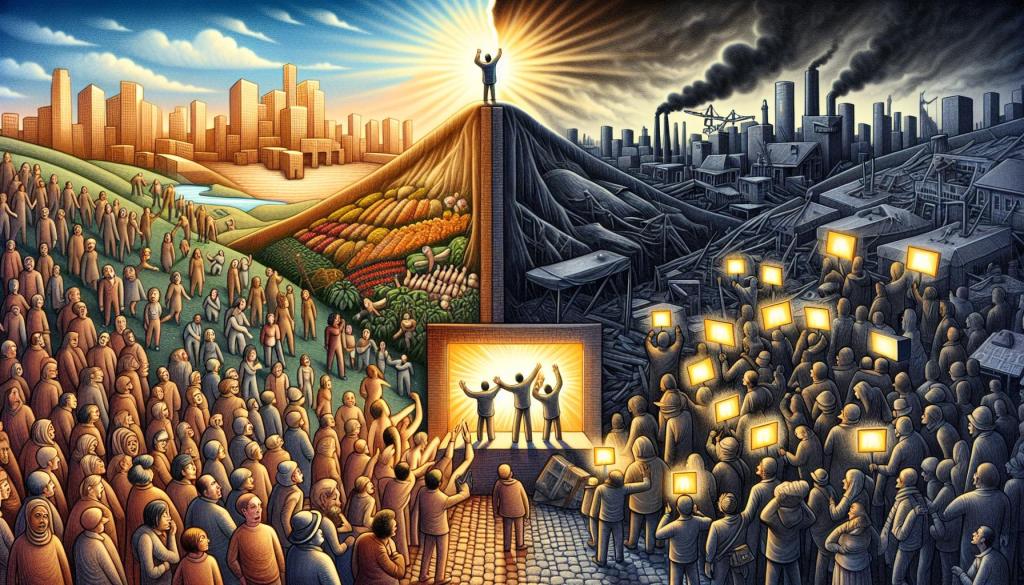
This report examines sadopopulism as a perverse mutation of populism in which pain, not prosperity, becomes the central political offering. Classic populism promises to take power or resources back from captured elites and deliver them to “the people.” Sadopopulism keeps the rhetoric but reverses the substance: leaders deliberately worsen material conditions, then convert that suffering into a resource for blame, spectacle, and loyalty.
Across the sections, we trace how this logic works as policy, how it reconfigures “the people” and their enemies, how it turns shared decline into emotional glue, and how it ultimately entrenches oligarchic power.
Sadopopulism is a contemporary mutation of right‑wing politics that perverts the basic promise of populism. Classic democratic populism, at its best, seeks to “take back” captured institutions or resources from unaccountable elites and redistribute them to “the people.” Sadopopulism retains the rhetoric of defending the people but abandons the aim of material improvement. Instead, it redistributes pain, humiliation, and symbolic punishment. The shared political “good” becomes not better lives but the emotional gratification of seeing others—stigmatized, racialized, gendered, or otherwise marked as outsiders—suffer more.
At the core of this politics is a deliberate anti‑policy orientation. Leaders run on populist themes—promising jobs, dignity, security, and restored national greatness—but once in power they neither intend nor attempt to deliver substantive gains to their base [1][2][4]. On the contrary, they enact measures that deepen precarity: weakening social protections, worsening health outcomes, accelerating inequality, and allowing addiction and social decay to spread, particularly in regions and communities that form their electoral backbone [1][2]. In this logic, popular pain is not a failure to be corrected; it is “a resource” to be mined, narrated, and redirected [2][3][5].
This reconfiguration turns government from a problem‑solving institution into a narrative machine for blame. As conditions deteriorate, leaders use that very deterioration as proof that enemies are sabotaging the nation. They tell stories about who is really responsible for hardship—immigrants, racial and religious minorities, feminists, “globalists,” welfare recipients, urban elites—thus transforming structural economic and political crises into moral dramas about corrupt or parasitic others [1][2][3]. Policy becomes secondary to spectacle: the central political transaction is not the delivery of material benefits but the offer of “relative degrees of pain and permission to enjoy the suffering of others” [2][3].
In this way, sadopopulism rewires the traditional populist divide between “the people” and “the elite.” Instead of directing justified anger upward toward oligarchic power and systemic capture, it invites a downward and lateral gaze. A “great heist” is underway—massive transfers of wealth and power to entrenched elites, democratic erosion, the dismantling of public goods—but public attention is fixated on scapegoats below or beside the core electorate [2][4]. The powerful actively hurt their own supporters, then invite them to feel compensated by hurting or degrading even more vulnerable groups [1][2]. The dream of upward mobility is replaced with the consolation of relative status: “at least I am not them” [3].
This produces a distinct emotional economy. Sadopopulist leaders offer their followers a perverse sense of agency: even if life is getting worse, they can choose who administers their pain and trust that despised out‑groups will suffer more intensely [3]. Shared hardship becomes a marker of belonging; enduring cuts, insecurity, or declining services is rebranded as proof of loyalty and toughness. Cruelty toward outsiders—whether in policy, policing, or public discourse—is reframed as justice, courage, common sense, or tradition. Suffering is normalized, even romanticized, as a test of character, while empathy is derided as weakness.
The temporal logic of this politics is backward‑looking and cyclical. Snyder’s notion of a “politics of eternity” highlights how crises and repeated injury are woven into mythic stories about a lost golden age: “things were better when…”—especially around gender hierarchies, family structures, religious homogeneity, or national purity [1][2]. Instead of grappling with structural drivers of social stress—globalization, technological change, financialization, climate disruption—leaders promise a symbolic “return” to order by reviving patriarchal norms, ethnonational boundaries, and old hostilities. Each new wave of pain is folded back into the myth: decline proves betrayal by internal enemies, which justifies harsher measures, which generate further decline.
What makes sadopopulism distinct from mere hypocrisy or failed populism is the intentionality and self‑destructive consistency of its strategy. The base is not simply neglected; it is systematically harmed in ways that produce more raw material—anger, fear, humiliation—for scapegoating narratives [2][3][5]. Citizens may lose jobs, health coverage, or social mobility, yet still experience punitive policies as victories so long as they believe that immigrants are being deported, minorities are being policed more brutally, or cultural enemies are being humiliated. This helps explain why evidently self‑damaging policies can command intense loyalty: the psychic satisfaction of imagined revenge outweighs the costs of ongoing decline.
Structurally, sadopopulism stabilizes oligarchy. By channeling democratic grievances away from systemic reform and toward symbolic battles against marginalized groups, it converts potential demands for redistribution and accountability into a self‑consuming cycle of grievance and punishment [2][3][4][5]. The regime “does half of populism”: it performs anti‑elite anger rhetorically but, in practice, “transfers wealth from the people to the already existing elite” [4], while bargaining with citizens not through resources but through calibrated distributions of harm. Media ecosystems and online cultures that celebrate shaming, “owning” opponents, and ironic cruelty become integral to this process, turning permanent crisis and the visible degradation of everyday life into enduring sources of political meaning rather than triggers for constructive change [3].
In sum, sadopopulism is a perversion of populism in which the promise of shared improvement is replaced by the offer of shared cruelty. Where democratic populism seeks to enlarge the material and political capacities of “the people,” sadopopulism invites them to accept diminished prospects so long as they can participate—symbolically or vicariously—in the suffering of others. By treating pain as policy and cruelty as glue, it transforms democratic energies that might challenge oligarchy into a durable politics of self‑harm and scapegoating that ultimately protects the very elites it claims to oppose.
Conclusion
Sadopopulism is not simply harsher populist rhetoric; it is a distinct mode of governance that recasts harm as both method and reward. Where democratic populism promises redistribution and responsiveness, sadopopulism weaponizes decline, turning shared pain into political glue and cruelty into a spectacle of belonging. By hollowing out policy, redirecting anger toward scapegoated out‑groups, and anchoring grievances in nostalgic myths, it stabilizes oligarchic power even as life worsens for most people. Recognizing this perverse logic—pain as policy, as currency, and as enjoyment—is essential for rebuilding genuinely democratic, solidaristic alternatives.
Sources
[1] https://www.tbsnews.net/thoughts/are-we-ready-tackle-sadopopulism-1086306
[2] https://www.salon.com/2018/05/09/timothy-snyder-on-trumps-campaign-against-democracy-he-is-deliberately-hurting-white-people
[3] https://junot.substack.com/p/sadopopulisms-cruel-ouroboros
[4] https://www.eurozine.com/democracy-in-question/
[5] https://nordicledger.substack.com/p/the-grim-logic-of-sadopopulism
[6] https://en.wiktionary.org/wiki/sadopopulism
[7] https://en.wiktionary.org/wiki/Citations:sadopopulism
[8] https://knowyourmeme.com/memes/sadopopulism
Written by the Spirit of ’76 AI Research Assistant





Leave a Reply