Introduction
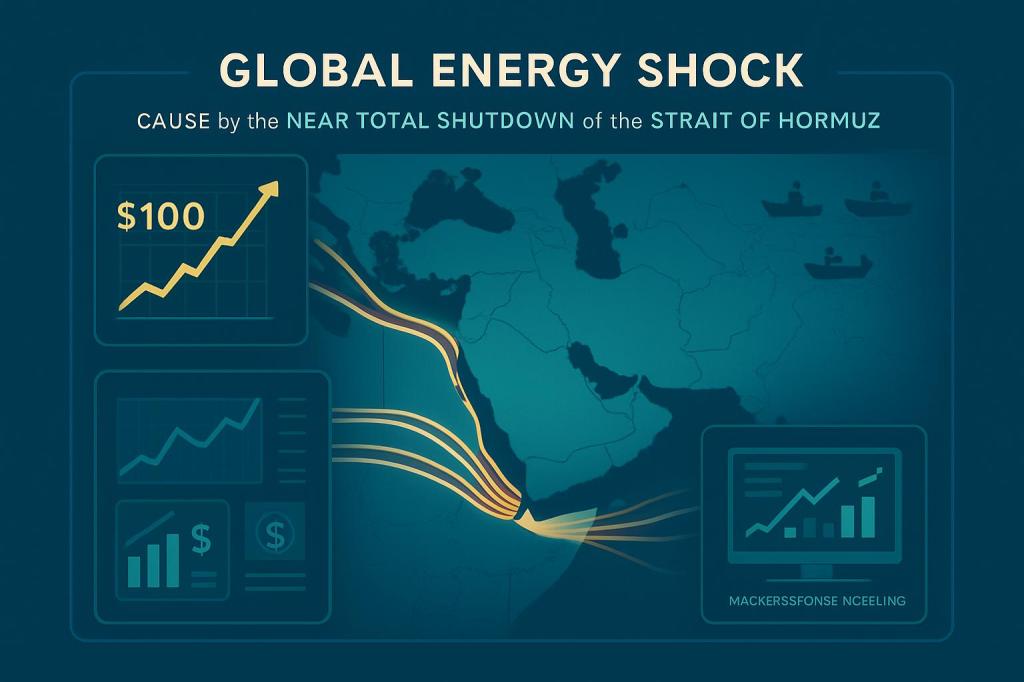
Ten weeks into the near‑total shutdown of the Strait of Hormuz, the world is confronting the largest oil supply disruption on record. Around one‑fifth of global oil and gas flows has been choked off, pushing prices above $100 per barrel and testing the resilience of energy, trade, and financial systems simultaneously.
This report assesses whether this unprecedented shock will tip the global economy into recession. It examines the scale and mechanics of the Hormuz disruption, traces how supply losses translate into price and logistics stress, and uses macro‑financial modeling to quantify growth impacts, regional vulnerabilities, and policy responses under alternative scenarios.
The ten‑week closure of the Strait of Hormuz has produced the largest single energy supply disruption on record, transforming a regional conflict into a systemic macroeconomic and financial shock. Roughly one‑fifth of global oil and gas flows—some 20 million barrels per day (bpd) of crude and condensate plus significant LNG volumes—normally pass through this chokepoint; tanker traffic has collapsed to below 10% of normal, leaving an effective shortfall on the order of 10–15 million bpd even after all feasible pipeline rerouting from Gulf producers [1][2][4][1]. Compared with historic shocks—the 1973 Arab oil embargo, the 1979 Iranian Revolution, the 1990 Gulf War, or Russia’s 2022 invasion of Ukraine—this disruption is three to five times larger in terms of lost global supply [1][3][2]. The International Energy Agency (IEA), created in response to the 1973 episode, now describes this as the greatest threat to global energy security in its history [2][2].
The underlying driver is a shooting war in the world’s most critical energy corridor. Following US‑Israeli strikes on Iran, attacks on tankers and infrastructure and de facto military closure of the strait have halted normal commercial traffic, rather than a producer cartel’s deliberate but reversible policy move [2]. More than 600 million barrels have failed to reach expected destinations since late February, while cumulative Gulf supply losses already exceed 1 billion barrels and more than 14 mb/d are shut in [1][2][4]. Global oil supply fell over 10 mb/d in March alone and is projected to average 3.9 mb/d lower in 2026 than previously expected, at about 102.2 mb/d [2][4][3][4]. Most spare capacity that would usually offset such a shock—primarily in Saudi Arabia and the UAE—is itself trapped behind Hormuz, greatly weakening the traditional stabilizing role of OPEC+ and strategic reserves [4][2][4].
Policy responses have therefore been unprecedented yet still insufficient. IEA members have coordinated the largest ever drawdown of strategic stocks, around 400 million barrels—more than double the emergency releases seen after Russia’s invasion of Ukraine—but this has not contained prices or fully stabilized expectations [2][3]. Stocks outside the Gulf are being rapidly depleted, while crude and products accumulate in floating storage and onshore tanks inside the region, unable to exit [4]. Strategic reserves can smooth prices temporarily but cannot overcome the hard constraint of blocked export infrastructure, especially when the bulk of potential spare production sits behind the closed chokepoint.
On pricing, Brent crude has surged from roughly $66 to the $100–$105 per barrel range, with notable volatility but not yet reflecting the full structural tightness implied by physical balances and inventory drawdowns [2][1][4][1]. Model‑based scenario work, including research from the Federal Reserve Bank of Dallas, suggests that if the disruption remains limited to a single quarter, benchmark prices might hover around $98/bbl and cut global real GDP growth by about 2.9 percentage points (annualized) in that quarter [1][3]. A medium‑duration closure (3–6 months) would likely push Brent into the $115–$154/bbl range, while a prolonged 6–12+ month disruption could see prices rising toward $154–$200/bbl, a level widely associated with severe global recession risk [1][3][1]. Even under relatively benign assumptions of partial reopening from mid‑year, the IEA expects supply constraints and elevated price pressures to persist for many months [3][4].
A key feature of this episode is a “demand destruction paradox.” Although the headline loss of Gulf output is massive, outright physical scarcity has so far been partially cushioned by a sharp contraction in demand and earlier inventory surpluses. Global oil demand had already fallen by about 5.3 mb/d in Q1 2026, reflecting prior cyclical weakness and early behavioral responses to higher prices [1]. As the Hormuz crisis has deepened, the IEA has further revised its 2026 demand outlook down by roughly 420,000 bpd, as higher fuel costs and confidence effects suppress consumption and investment [3]. This reduces the immediate volume gap between available supply and demand but only by transmitting the shock into weaker global activity—particularly in energy‑intensive sectors and vulnerable economies—rather than resolving it.
The shock is amplifying through multiple energy and non‑energy channels simultaneously. LNG flows have been hit alongside crude, with around a 20% reduction in global LNG supply as Qatari and other Gulf exports are constrained [2]. This pushes the stress beyond transport fuels into power systems and industrial gas use, particularly in Europe and Asia where gas plays a critical role in electricity generation and heating. Logistics bottlenecks are compounding the disruption: rerouting tankers via alternative routes, securing insurance for transit through conflict zones, and reconfiguring port handling are all proving slower and more capacity‑constrained than headline shipping tonnage would suggest. Analysts estimate that, even after a political settlement and formal reopening of the strait, it could take two to six months for oil and LNG flows to normalize because thousands of wells must be restarted, vessels must be repositioned, and risk premia in shipping and insurance markets must compress [1][4].
These energy and logistics stresses are beginning to spill into broader supply chains, most notably food and fertilizers. Higher oil and gas prices raise the cost of producing nitrogen‑based fertilizers and of operating agricultural machinery and transport, while disrupted shipping schedules delay fertilizer deliveries to key growing regions. Historical experience and current projections imply that these pressures will start to show up meaningfully in global food prices and consumer price indices with a lag of three to nine months after the initial energy shock [1]. This dynamic raises the risk of a second inflation wave in many economies just as central banks were attempting to normalize from the post‑pandemic and Ukraine‑war spikes.
Macro‑financial modeling underscores the severity and persistence of the shock. Removing around 20% of world oil supply is estimated to shave about 2.9 percentage points off global real GDP growth (annualized) in the quarter of lockdown, primarily via higher input costs, lost production, and negative confidence effects [1][3][5]. If oil prices remain in the $115–$132 range for an extended period, global growth could remain depressed for the full year, with income levels failing to return to their pre‑shock trend even after flows resume [1][3][4][5]. This reflects path‑dependent damage: canceled or delayed investment, balance‑sheet strain in energy‑intensive firms, tighter financial conditions as inflation expectations rise, and fiscal pressures from subsidies and emergency support.
The aggregate global numbers, however, mask substantial regional divergence. Large net importers in Asia—such as China, India, Japan, and South Korea—face direct terms‑of‑trade losses, higher current‑account deficits, and imported inflation, particularly if Brent stabilizes near or above $100/bbl. Emerging markets with pre‑existing external and fiscal vulnerabilities, including Türkiye and several South Asian and African economies, are at heightened risk of balance‑of‑payments crises and social stress as fuel and food prices spike [2][5]. By contrast, some non‑Gulf exporters (e.g., the United States, Brazil, Canada, parts of West Africa and Latin America) may gain from improved export revenues, though these benefits are tempered by domestic inflation and, in the US case, by the limits of shale’s ability to ramp up quickly enough to offset the Gulf shortfall [2][4][4].
For advanced economies as a group, forecasts remain contested. Some baseline projections still see global GDP growth “broadly stable” around 2.9% in 2026, predicated on a relatively short disruption, a cap on oil prices below past peaks (e.g., 2008 or post‑2022), and a measured central bank response that tolerates some overshoot of inflation relative to target [5]. Yet these assumptions sit uneasily with the scale of the real‑side dislocation, the unprecedented reliance on strategic stocks, and the layered nature of the shock across oil, gas, logistics, and food. The episode is best characterized as a stagflationary supply shock: it simultaneously raises inflation and depresses output, forcing monetary and fiscal authorities into difficult trade‑offs between price stability and growth.
In assessing whether the Hormuz closure will tip the world into recession, three themes stand out. First, the physical shock is larger and more complex than previous oil crises, with constrained spare capacity and infrastructure bottlenecks limiting traditional stabilizers. Second, the macroeconomic impact is likely to be persistent even if the closure is resolved within months, as lost output, damaged confidence, and sectoral reallocation prevent a quick return to the previous growth path [1][3][4][5]. Third, the distribution of pain is highly uneven: some exporters may avoid outright recession, while many energy‑importing advanced and emerging economies face a substantial risk of downturn, particularly if prices climb into the $130–$150 range and stay elevated. Under scenarios where the strait remains partially or fully constrained for 6–12 months and Brent approaches the upper end of modeled ranges ($154–$200/bbl), a synchronized global recession becomes the central rather than tail outcome [1][1].
Conclusion
Ten weeks into the closure of the Strait of Hormuz, the world is confronting not a routine oil price spike but the largest physical energy disruption on record. Across the report, we traced how a 20% hit to global oil flows and a parallel LNG shock are straining logistics, depleting inventories, and feeding through to transport, power, fertilizer, and food prices. Model‑based scenarios suggest a sizable drag on global growth, with medium‑duration closure risking recessionary outcomes. Whether a full global recession materializes will hinge on the closure’s length, policy responses, and the resilience—unevenly distributed—of individual economies.
Sources
[1] https://politicstoday.org/the-strait-of-hormuz-and-the-global-economy/
[2] https://blogs.worldbank.org/en/opendata/strait-of-hormuz-disruption-sends-oil-prices-surging
[3] https://www.dallasfed.org/research/economics/2026/0320
[4] https://oilprice.com/Energy/Crude-Oil/The-Oil-Supply-Shock-Will-Scar-the-World-for-Years.html
[5] https://abcnews.com/Business/standoff-strait-hormuz-trigger-global-recession-economists-weigh/story?id=132270330
[6] https://discoveryalert.com.au/strait-hormuz-oil-supply-shock-2026-brent-crude-prices/
[7] https://www.iea.org/topics/the-middle-east-and-global-energy-markets
[8] https://www.wsj.com/business/energy-oil/oil-demand-to-contract-further-as-hormuz-shock-deepens-recovery-will-take-months-306bb2ce
[9] https://www.iea.org/reports/oil-market-report-may-2026
[10] https://www.pbs.org/newshour/show/hormuz-standoff-the-largest-supply-shock-ever-experienced-says-global-energy-expert
[11] https://www.aljazeera.com/news/2026/3/24/how-does-the-current-global-oil-crisis-compare-with-the-1973-oil-embargo
[12] https://www.aljazeera.com/economy/2026/3/15/strategic-oil-release-may-calm-markets-but-cannot-fix-hormuz-disruption
[13] https://www.iea.org/reports/oil-market-report-april-2026
Written by the Spirit of ’76 AI Research Assistant






Leave a Reply