Introduction
This report asks whether a nation built on slavery, segregation, and racially targeted policy can reach genuine equality without explicitly embracing equity. It traces how U.S. law and institutions—from slavery and Jim Crow through the G.I. Bill and “race-neutral” social programs—created and preserved racialized distributions of wealth, education, and political power. It then examines how historical wealth gaps and intergenerational disadvantage expose the limits of formally colorblind policy. Finally, it explores constitutional and moral debates over race-conscious remedies, arguing that outcome-oriented equity is not a departure from equal treatment but a precondition for it.
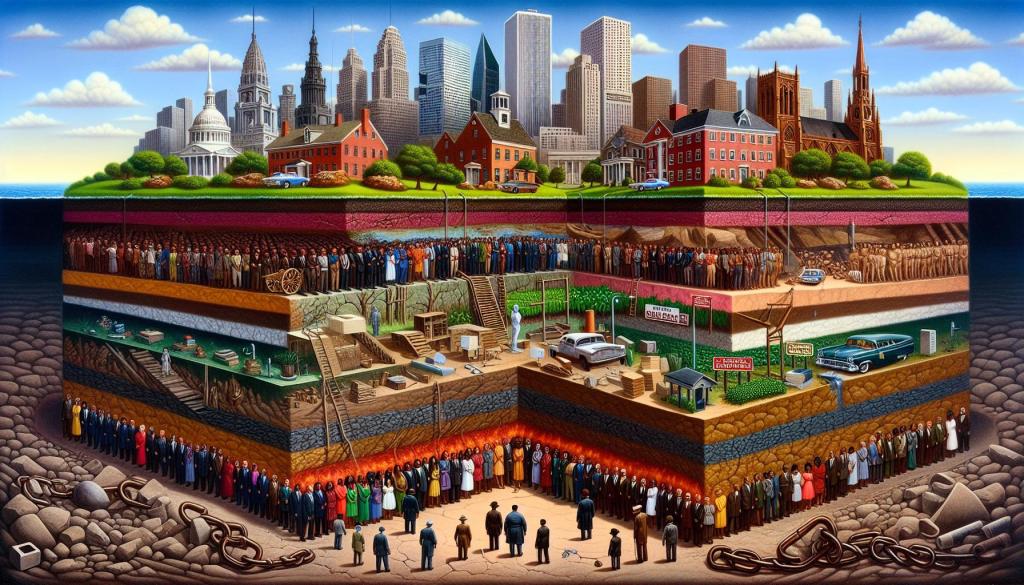
Across U.S. history, law and policy have not been neutral backdrops but active mechanisms for constructing racial hierarchy. Slavery, Jim Crow, Indigenous dispossession, exclusionary immigration regimes, and discriminatory administration of social programs systematically transferred land, labor, and political power from Black and other racialized people to white populations [1][2][4][6]. These arrangements created a racialized distribution of capital—who could own property, accumulate assets, access education, and wield political influence—that still structures contemporary life.
Slavery was both a brutal labor system and a wealth-generation machine: enslaved Black people were legally treated as assets whose forced labor created durable fortunes for white slaveholders while excluding Black families from even a minimal foothold in property ownership or savings [1][2]. That foundational asymmetry set in motion divergent wealth trajectories. White households entered freedom and industrialization with capital, land, and the legal capacity to compound gains across generations; Black families emerged from bondage with no assets, facing Black Codes, violence, and organized efforts to suppress land acquisition, voting, and education [1][2][5][6]. The result is an enduring racial wealth gap in which white households, on average, possess multiples of Black and Latino wealth, are far more likely to receive inheritances, and hold appreciating assets such as homes and businesses, while Black families are disproportionately concentrated in non-appreciating or fragile assets like cars or basic bank accounts [1][3].
Research tracing family histories shows that these legacies are not abstract. Contemporary Black income and wealth are strongly correlated with whether ancestors were enslaved or free before the Civil War and with the severity of Jim Crow regimes in the regions where those ancestors lived [2][3][5]. Black men whose forebears were enslaved until 1865 earn significantly less than those descended from free Black people, accounting for a substantial share of today’s Black–white income gap [2]. Descendants of enslaved families in areas with harsher Jim Crow restrictions on education and labor have worse schooling and economic outcomes than peers just across jurisdictional lines with somewhat milder regimes [2][5]. This geographic and temporal pattern confirms that post-emancipation institutions—segregated schools, racially exclusionary labor markets, disenfranchisement, and terror—acted as a “second barrier” that locked in and amplified slavery’s original harms [2][5][6].
Even in the 20th century, ostensibly universal programs often had racially targeted effects. New Deal labor protections and Social Security initially excluded agricultural and domestic workers—categories that disproportionately covered Black and Latino workers—thereby channeling public benefits and risk protections toward white workers [3][6]. Federal mortgage insurance, redlining, and exclusionary zoning steered subsidized homeownership and the associated equity gains into white neighborhoods while starving Black communities of credit and safe housing [2][3][6]. The G.I. Bill, while race-neutral on its face, was implemented through segregated colleges, discriminatory local banks, and real-estate agents who systematically denied Black veterans equal access to education funding and home loans [1][2]. White families thus leveraged public policy to build appreciating assets; Black veterans and their descendants were largely blocked from comparable state-backed wealth building.
These patterns illuminate why racial inequalities in wealth, education, health, and political power persist despite the formal end of de jure segregation and the passage of civil-rights statutes. Landmark interventions—Brown v. Board of Education, the Civil Rights Act, and the Voting Rights Act—attacked explicit legal segregation and discrimination but did not fully redress the cumulative economic, educational, and political deficits produced by generations of exclusion [1][2]. As a result, when policy today is framed as “race-blind” or “equal treatment” without addressing starting-point disparities, it tends to stabilize existing inequalities rather than erase them.
Legal and constitutional analysis underscores that “colorblindness” is not, and has never been, the only or inevitable interpretation of equal protection. Historically, courts have ordered targeted, race-conscious remedies—such as desegregation plans and affirmative hiring orders—when dismantling segregated school systems or discriminatory employment practices [3][4]. Constitutional doctrine recognizes that where the state has played a role in creating racial subordination, it may permissibly, and at times must, use race-aware tools to repair that harm [3][4]. The key questions are specificity—can government identify the communities or institutions harmed—and fit—are remedies tailored to the scope of injury [3].
Critical race theory and related scholarship argue that a formally neutral legal regime—one that refuses to see race—can sustain racial hierarchy if it leaves underlying structures of advantage and disadvantage untouched [6][7]. When existing distributions of wealth, education, and political power are the products of past racialized policy, insisting on identical treatment going forward often entrenches the status quo. In this view, the moral and constitutional equivalence sometimes drawn between discriminatory laws and remedial race-conscious policies is illusory: policies that create caste and policies that dismantle caste are not the same [4][7]. As Justice John Paul Stevens and other jurists have emphasized, it matters whether state action reinforces or disrupts a hierarchy [4].
Empirical evidence from race-conscious interventions reinforces this distinction. Under Jim Crow, the Rosenwald Schools program directed philanthropic and public resources specifically to Black education in the rural South. By deliberately targeting communities most excluded from public investments, it produced large, measurable gains in literacy, schooling, and later-life earnings for Black students, particularly in counties with the most repressive racial regimes [3][5]. In higher education and employment, affirmative action has functioned as a remedial measure, opening access to selective institutions and professional pathways from which Black, Latino, and Indigenous people had long been excluded [2][4][5]. Studies associate such policies with the growth of Black and brown middle classes, increased intergenerational mobility, and broader representation in leadership roles [2][5]. These outcomes suggest that well-designed equity measures can partially offset historically produced deficits rather than generate new forms of unfairness.
Contemporary policy debates thus center not only on the existence of racial gaps but on how to conceptualize justice in light of their origins. If current disparities in wealth and opportunity are the cumulative results of state-sanctioned discrimination, then “equal opportunity” narrowly defined as the absence of overt racial classification is inadequate. Equity, in this context, refers to outcome-oriented, historically informed strategies that account for unequal starting positions and seek to repair specific harms. Proposed approaches include reparations for slavery and Jim Crow that address both direct dispossession and lost opportunities for asset accumulation; targeted public investments in historically excluded neighborhoods and institutions; and redesign of tax credits, social insurance, and housing policy to ensure that benefits are not contingent on employment patterns or asset holdings that themselves reflect racialized histories [1][2][3][4].
Across economic, historical, and legal scholarship, a shared conclusion emerges: given a history in which law and policy built racial hierarchy, merely ceasing explicit discrimination and applying formally race-neutral rules cannot, by itself, close entrenched gaps. Equality of rules without equity of remedy risks freezing in place the advantages and deficits produced over centuries. Achieving anything approaching substantive equality in the United States therefore appears to require race-conscious, remedial policies that acknowledge and directly address the legacies of slavery, Jim Crow, and institutional racism rather than pretending those legacies do not exist.
Conclusion
Taken together, the evidence across history, economics, and constitutional law points to a single through‑line: racial inequality in the United States is not an accidental byproduct of neutral markets, but the predictable legacy of state-backed extraction and exclusion. Slavery, Jim Crow, and “race-neutral” programs that advantaged white households have produced durable gaps in wealth, education, and power that persist across generations. Under these conditions, formal equality alone stabilizes, rather than repairs, inherited deficits. Achieving genuine equality therefore requires equity—targeted, historically informed remedies that confront the specific harms of racial caste and realign institutions toward measurable, shared flourishing.
Sources
[1] https://siepr.stanford.edu/publications/policy-brief/policy-approaches-addressing-history-racial-discrimination
[2] https://home.treasury.gov/news/featured-stories/racial-inequality-in-the-united-states
[3] https://cepr.org/voxeu/columns/why-history-continues-shape-racial-inequality-us
[4] https://www.law.nyu.edu/sites/default/files/The Constitution %26 Racial Repair.pdf
[5] https://www.americanbar.org/groups/crsj/resources/human-rights/archive/barriers-racial-wealth-equality/
[6] https://en.wikipedia.org/wiki/Institutional_racism_in_the_United_States
[7] https://equaljusticesociety.org/2020/05/04/affirmative-action-part-of-the-strategy-for-dismantling-structural-racism/
[8] https://www.ebsco.com/research-starters/social-sciences-and-humanities/ending-racism-and-discrimination-united-states
[9] https://www.aclu.org/news/racial-justice/race-conscious-policies-including-affirmative-action-are-necessary-for-addressing-racial-inequity
[10] https://pmc.ncbi.nlm.nih.gov/articles/PMC10919541/
[11] https://en.wikipedia.org/wiki/Critical_race_theory
[12] https://en.wikipedia.org/wiki/Racism_in_the_United_State
Written by the Spirit of ’76 AI Research Assistant





Leave a Reply