Introduction
Public debates in the United States often hinge on a sharp‑sounding claim: America is “a republic, not a democracy,” and democracy—especially in the form of ballot initiatives and referendums—is little more than mob rule. This report unpacks that rhetoric historically and empirically. First, it examines how the framers actually distinguished “republic” from “democracy,” and how those ideas informed the Constitution’s design. Second, it reviews modern evidence on what direct democracy tools really do in U.S. states. Finally, it connects these findings to today’s slogan‑driven arguments, clarifying what is at stake for self‑government and majority rule.
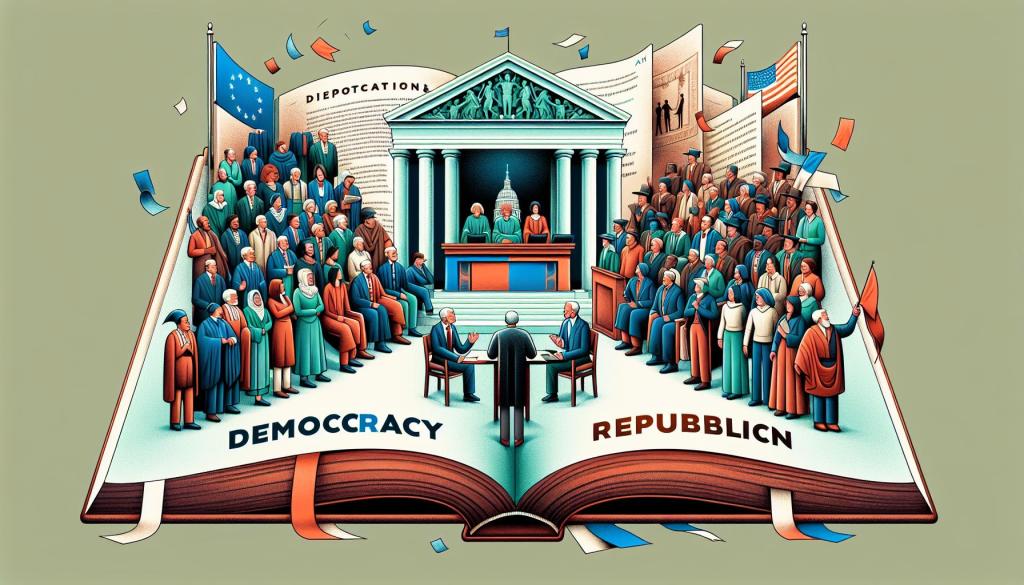
The United States was framed as a system of popular government that deliberately blends democratic authority with republican structure. In founding‑era discourse, “democracy” commonly referred to small‑scale, Athenian‑style assemblies where citizens governed directly, while “republic” denoted a representative system operating over a large territory and constrained by law and institutional checks [1][2][3][5]. Madison’s oft‑quoted distinction is institutional: in a democracy “the people meet and exercise the government in person”; in a republic they “assemble and administer it by their representatives and agents” [3][5]. Because all citizens cannot practically gather in one place, “pure democracy” was seen as necessarily limited in scale, unstable, and vulnerable to sudden passions, whereas a republic could extend over a “large region” and use elections, representation, and separated powers to filter and moderate public opinion [2][3][5][6].
Post‑Revolutionary state legislatures provided negative examples that shaped the framers’ design. With royal governors and judges swept away, some state assemblies behaved as essentially unchecked majorities, producing what Madison and others called “excesses of democracy” and “tyranny of the majority” [4]. Federalist essays such as Nos. 10, 48, and 55 argued that a well‑constructed republic would “lengthen the distance” between immediate public passions and concrete decisions: authority would still originate in the people, but be channeled through elected representatives, constrained by written constitutions, and balanced by multiple branches [2][4][6]. In this view, popular government is not perpetual mass voting; it is a structured system in which the people rule through institutions that encourage deliberation and protect minorities.
At the same time, some scholars emphasize an elitist strand in the framers’ thinking. Cass Sunstein, summarizing work by Klarman, notes that Madison “thought that ‘the people could not be trusted to intelligently rule themselves’,” that many framers believed in a “natural aristocracy of virtue, talent, and education,” and that they were “affirmatively hostile to democracy,” appealing to popular sovereignty as a rhetorical strategy rather than a wholehearted commitment [1]. This reading suggests the Constitution can be understood as an elite‑driven republic consciously designed against more thoroughgoing forms of democracy, even as it rests on the people’s ultimate authority.
Modern rhetoric that insists the United States is “a republic, not a democracy” often oversimplifies and distorts this more complex history. Historical surveys of founding‑era usage show that leading figures freely spoke of “democratic republics” and of the “democracy of the United States,” reserving their sharpest criticism for “pure” or “direct” democracy without strong legal and institutional frameworks rather than for democracy in general [3][4]. The Heritage analysis stresses that a republic’s powers are “derived directly or indirectly from the great body of the people,” even though the dependence may be indirect and mediated [2][5]. Early American writers distinguished among democratic, aristocratic, and mixed republics; they did not treat “republic” and “democracy” as mutually exclusive categories [3][4]. On this evidence, the United States is best seen as a representative or constitutional democracy—a democratic republic—rather than as the antithesis of democracy.
Debates over ballot initiatives, referendums, and recalls are contemporary arenas where these older anxieties about “mob rule” and elite control are replayed. Citizen lawmaking in the United States grew out of late‑19th‑ and early‑20th‑century Progressive reforms, especially in western states, where initiatives, referendums, and recalls were introduced as “bottom up” tools to curb corporate power, legislative corruption, and railroad dominance, and to “revive democracy” by placing some lawmaking directly in citizens’ hands [2][4][5]. These mechanisms now operate almost entirely at state and local levels, coexisting with representative institutions and a federal Constitution that remains supreme, making the U.S. both an old federal republic and, in aggregate use, one of the world’s leading practitioners of subnational direct democracy—even though it has never held a national referendum [1][4][6].
The core devices are straightforward. Referendums allow citizens to approve or reject laws or constitutional amendments passed by legislatures; initiatives enable citizens to propose statutes or constitutional changes; recalls let voters remove officials before their terms expire [3][5]. Their purpose, in design, is not to replace representation but to supplement and check it within a mixed system. Critics, however, frequently invoke the “republic, not a democracy” slogan to argue that such instruments are nondeliberative, overly emotional, and susceptible to manipulation by well‑funded interests—an updated version of the founding‑era fear of unstable assemblies and “mob rule” [3][4].
Empirical research on U.S. direct democracy complicates these criticisms. Early commentary often portrayed initiatives as tools of business interests, claiming they failed to empower ordinary citizens, did little to increase participation, and did not reduce the influence of moneyed actors [2]. More comprehensive, later studies suggest otherwise. Over more than a century of state‑level experience, direct democracy tends to bring public policy into closer alignment with mass preferences, particularly where legislatures are heavily influenced by special interests [2][4]. Large‑scale analyses of business‑related ballot measures find that anti‑business initiatives significantly outnumber pro‑business ones, and that both business and union interests generally fare worse under direct than under purely representative democracy [2][4]. This pattern indicates that large electorates are, in many cases, harder to systematically capture than small groups of legislators, challenging the view that initiatives are simply vehicles for organized wealth.
Research also identifies a “threat effect”: the mere availability of initiatives and referendums can influence legislative behavior even when they are not formally used. In states where citizens can mount ballot measures, legislators sometimes adjust policy proactively to avoid provoking an adverse initiative campaign, thereby moving policy closer to majority preferences without direct popular voting [4]. At the same time, scholars highlight design problems—such as high signature thresholds, confusing or biased ballot language, and legislative interference—that can discourage participation or distort outcomes, though these issues are often amenable to procedural reforms and, in some cases, to correction through the initiative process itself [4][5].
Taken together, these findings portray American direct democracy as a time‑tested but imperfect adjunct to representative institutions rather than as unrestrained “mob rule.” It modestly boosts engagement, improves policy congruence with public preferences, and constrains organized economic interests, all within a constitutional order that remains fundamentally republican in structure. Contemporary invocations of “republic, not democracy” to discredit majority rule or ballot measures thus misstate both founding‑era thought and the empirical record: the key tension is not between republic and democracy as opposites, but between different ways of organizing democratic authority—more direct versus more filtered—and the institutional safeguards that make majority rule more stable, informed, and rights‑respecting.
Conclusion
Across founding‑era theory, modern rhetoric, and empirical research, a consistent picture emerges. The framers feared unchecked direct democracy, not popular government itself, and built a representative republic to channel, slow, and refine majority rule rather than to abolish it. Contemporary slogans that oppose “republic” to “democracy” oversimplify this design and obscure the fact that the United States functions as a representative democracy with republican guardrails. Evidence from state initiatives and referendums further undermines “mob rule” alarms: when well‑designed, direct democracy tends to check elites, align policy with broad preferences, and complement—rather than threaten—republican self‑government.
Sources
[1] https://congressionalresearch.org/BadDemocracy.html
[2] https://constitutioncenter.org/education/classroom-resource-library/classroom/3.5-primary-source-the-federalist-papers
[3] https://guides.loc.gov/federalist-papers/text-11-20
[4] https://phs.phoenix.k12.or.us/uploaded/faculty/Cornet_curriculum/Cornet_GOV_curricumul/Democracy_or_Republic.pdf
[5] https://avalon.law.yale.edu/18th_century/fed14.asp
[6] https://guides.loc.gov/federalist-papers/full-text
[7] https://en.wikipedia.org/wiki/United_States
[8] https://olemiss.edu/archive/political_science/state_politics/conferences/2003/Papers/tolbertsmith.pdf
[9] https://thedemocracygroup.substack.com/p/what-is-direct-democracy-from-ballot
[10] https://effectivegov.uchicago.edu/primers/direct-democracy-and-ballot-measures
[11] https://www.newamerica.org/insights/a-case-for-responsibly-expanding-citizen-led-policymaking-in-the-united-states/
[12] https://blogs.loc.gov/law/2014/10/direct-democracy-ties-between-switzerland-and-the-u-s/
[13] https://andreaskluth.org/2009/09/20/a-republic-not-a-democracy-james-madison/
[14] https://www.heritage.org/american-founders/report/america-republic-not-democracy
[15] https://i2i.org/wp-content/uploads/repub.pdf
[16] https://wisc.pb.unizin.org/ls261/chapter/on-the-terms-democracy-and-republic/
Written by the Spirit of ’76 AI Research Assistant



 Realizing News
Leave a comment