Introduction
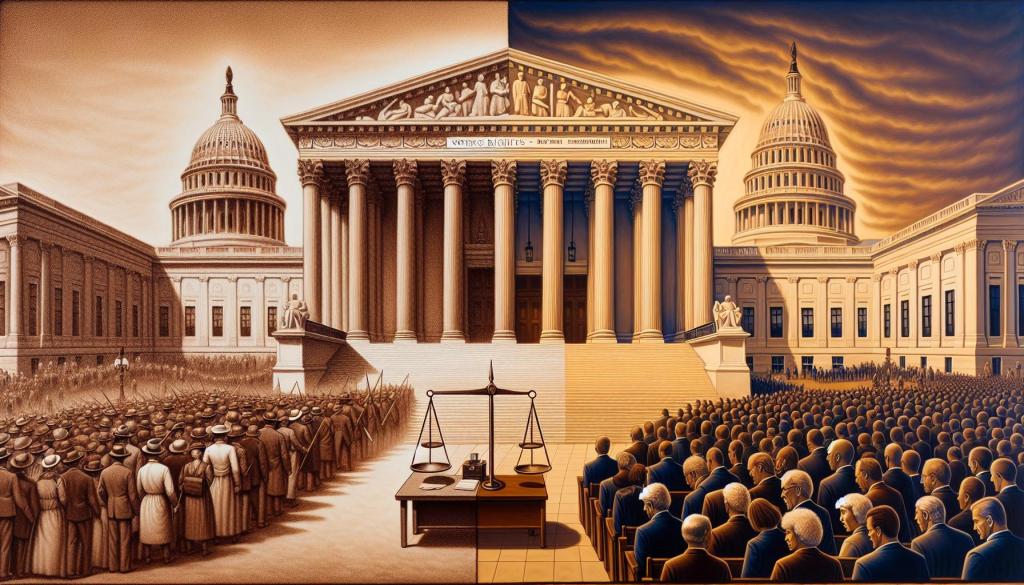
This report examines how the Supreme Court, in Shelby County v. Holder and Callais v. United States, has reshaped the constitutional foundations of the Voting Rights Act (VRA). It first traces the historical arc from Reconstruction’s broad vision of congressional enforcement power to the Roberts Court’s elevation of “equal sovereignty” and strict scrutiny for race‑conscious remedies. It then analyzes the shift from preclearance to ex post litigation, and the resulting contraction of federal protections for minority voters. Finally, it assesses whether Shelby and Callais are consistent with longstanding doctrine—or instead mark a sharp break in federal–state power over voting rights.
The trajectory from Reconstruction to the Roberts Court in voting‑rights doctrine turns on how expansively Congress may use its enforcement powers under the Fourteenth and Fifteenth Amendments and how far federal law may single out particular states or deploy race‑conscious remedies to protect minority voters. Shelby County v. Holder and Callais v. United States together represent a decisive shift away from the earlier, more deferential model exemplified by South Carolina v. Katzenbach and toward a framework in which equal state sovereignty and strict scrutiny for race‑based actions sharply constrain the Voting Rights Act (VRA).
Historically, Congress and the Court treated the Reconstruction Amendments as broad grants of authority to counteract entrenched racial discrimination in voting. Radical Republicans at the time of adoption understood the Fifteenth Amendment as empowering Congress to impose sweeping, even permanent, federal controls over state election practices where racial exclusion was endemic, and they did not view geographically targeted remedies as constitutionally suspect so long as they addressed “local evils which have subsequently appeared.”[1][3] The original VRA reflected that understanding: its coverage formula (§4) and preclearance regime (§5) applied only to jurisdictions with the worst records of discrimination, freezing their election‑law changes unless the federal government determined those changes would not worsen minority citizens’ position.[5] In Katzenbach, the Court upheld this architecture, reading the equal‑sovereignty principle narrowly—as a limit on conditions of state admission, not on Congress’s remedial choices in response to proven regional abuses—and deferring to Congress’s judgment and factual record.[1][3][4]
Shelby County marks a sharp doctrinal turn. The Court invalidated the coverage formula, elevating a “fundamental principle of equal sovereignty” among the states and insisting that singling out specific jurisdictions for preclearance is constitutionally suspect unless tightly matched to current conditions.[2][4] To support this principle, the majority relied on “equal footing” cases like Pollard v. Hagan, Texas v. White, Coyle v. Smith, and United States v. Louisiana, which dealt with the terms on which new states enter the Union, not with Congress’s later use of its enforcement powers to address localized constitutional violations.[2] Where Katzenbach treated those precedents as limited to admission, Shelby County generalized them into a modern federalism constraint that reorients the inquiry away from Congress’s fact‑finding and toward whether a statute comports with the “letter and spirit” of the Constitution as articulated by the Court.[2]
In doing so, Shelby County reworks the classic McCulloch v. Maryland “appropriate means” test. Rather than presuming broad latitude for Congress so long as its measures are plainly adapted to enforcing the Fourteenth and Fifteenth Amendments, the Court subjects enforcement legislation to a structural review keyed to state dignity, equal sovereignty, and a demand that remedies be congruent with contemporary, not historical, discrimination. This gives the judiciary the final word on whether Congress has gone too far, even when Congress assembles an extensive record of ongoing racial polarization and “ingenious defiance” of the Constitution.[2][3][4]
The practical consequences of Shelby County have been substantial. With preclearance disabled, states once covered under §4 and §5 have implemented changes—such as strict voter ID laws, polling‑place closures, and reductions in early voting—that previously would have required federal approval. Empirical studies identify nearly 100 new restrictive voting laws in the decade after the decision, many in jurisdictions that had been subject to the preclearance regime.[3][5] Enforcement has shifted from a preventive, administrative model to ex post, plaintiff‑driven litigation under the remaining provisions of the VRA, raising the burden on minority voters to generate timely evidence of discrimination and secure relief before elections occur.[3][5]
Parallel developments in racial‑gerrymandering and redistricting cases amplify this shift by tightening the constitutional constraints on race‑conscious line‑drawing even when undertaken to comply with the VRA. Earlier decisions had already expressed unease with the Department of Justice’s former “maximization” approach under §5, warning that aggressive insistence on additional majority‑minority districts could pressure states into “presumptively unconstitutional race‑based districting” and place the Act “into tension” with equal protection principles.[3] More recent cases refine this skepticism by raising the evidentiary bar for proving racial predominance. In litigation over South Carolina’s Congressional District 1, for example, a district court highlighted circumstantial indicators of racial intent—stable Black voting‑age population despite demographic change, disproportionate removal of Black precincts, and reliance on racial data in map‑drawing—but the Supreme Court reframed these patterns as the byproduct of an “avowed partisan objective” to entrench Republicans, leveraging the correlation between race and partisanship to reject an inference of unconstitutional racial motive.[4] This approach narrows the space in which courts will credit claims that race, rather than partisanship, drove redistricting, even where Congress has identified racially polarized voting as a systemic problem.
Callais v. United States takes this trajectory a step further and directly implicates the interpretation of §2 of the VRA. Louisiana enacted SB8 to create an additional majority‑Black congressional district in response to earlier litigation, but the Court held that the map was an unconstitutional racial gerrymander. Central to the majority’s reasoning was the conclusion that “the Voting Rights Act did not require Louisiana to create an additional majority‑minority district,” meaning that the State lacked a “compelling interest” sufficient to justify its race‑based line‑drawing.[1][2] The Court emphasized that §2 “was designed to enforce the Constitution—not collide with it,” making explicit that any governmental use of race in districting—even in purported compliance with §2—is subject to strict scrutiny and must be narrowly tailored.[2][6]
Under this framework, states face a paradox: if they use race proactively to protect minority electoral opportunity, they must prove that such districts are strictly necessary to avoid §2 liability; but the Court’s increasingly demanding interpretation of §2’s requirements and its willingness to attribute redistricting choices to partisanship rather than race make that necessity showing harder to establish. The evidentiary standard thus shifts from asking whether discriminatory structures and racially polarized voting justify race‑conscious remedies to asking whether the absence of such a district would itself constitute a clear §2 violation. If not, the state’s attempt to create a majority‑minority district can be struck down as unconstitutional.
Read together, Shelby County and Callais produce a “double narrowing” of the VRA. On the one hand, Shelby County cuts back Congress’s power to impose geographically targeted, prophylactic measures like preclearance by constitutionalizing an expansive equal‑sovereignty principle and subordinating deference to congressional judgment to structural federalism concerns.[1][2][4] On the other hand, Callais and related racial‑gerrymandering cases constrict how far states and the federal government may go in implementing even the remaining nationwide tools of the Act, such as §2, by insisting that all race‑conscious districting clear strict scrutiny and by construing equal protection as a hard limit on remedial line‑drawing.[1][2][3][6]
From the perspective of long‑standing doctrine and Reconstruction‑era constitutional interpretation, this modern framework is in tension with earlier understandings. The equal‑footing and equal‑sovereignty cases historically addressed the terms of state admission, not Congress’s remedial power to confront entrenched racial subordination once states are in the Union.[1][2] Katzenbach explicitly upheld geographically asymmetric preclearance as a valid enforcement measure, and the framers of the Reconstruction Amendments expected Congress to deploy robust, sometimes regionally focused interventions without the obligation to treat all states identically.[1][3][4] Likewise, race‑conscious remedies were long treated as permissible, if not necessary, tools to dismantle systemic discrimination in voting, so long as they were connected to demonstrated patterns of exclusion and dilution.
The Roberts Court’s recent decisions recast these premises. By foregrounding state equality, structural federalism, and strict scrutiny as the dominant filters through which VRA provisions must pass, the Court has significantly narrowed the practical and doctrinal space for aggressive federal protection of minority voting rights. Congress retains formal enforcement authority under the Reconstruction Amendments, and §2 of the VRA remains on the books, but the combination of curtailed prophylactic power and heightened skepticism toward race‑conscious implementation makes it substantially more difficult to design and sustain effective remedies against racial discrimination in voting.
Conclusion
Shelby County and Callais together mark a decisive reorientation of voting-rights doctrine. By elevating “equal sovereignty” and recasting McCulloch’s deferential enforcement standard, Shelby narrows Congress’s ability to impose geographically targeted, prophylactic protections once understood as central to the Reconstruction Amendments. Callais then tightens the vise, subjecting race‑conscious districting to strict scrutiny and demanding that Section 2 remedies be both narrowly tailored and nearly indispensable. Across these decisions, the Court has displaced Katzenbach’s broad deference with a structural, skepticism‑infused framework whose consistency with Reconstruction‑era understandings—and with the VRA’s original design—remains deeply contested.
Sources
[1] https://www.supremecourt.gov/opinions/25pdf/24-109_21o3.pdf
[2] https://www.law.cornell.edu/supremecourt/text/12-96
[3] https://www.scotusblog.com/2013/03/shelby-county-v-holder-the-original-understanding-of-congresss-enforcement-powers/
[4] https://www.scotusblog.com/2013/02/shelby-county-v-holder-the-voting-rights-act-doesnt-need-to-treat-states-equally/
[5] https://www.brennancenter.org/our-work/research-reports/effects-shelby-county-v-holder-voting-rights-act
[6] https://constitutioncenter.org/blog/the-supreme-courts-callais-decision-sets-new-framework-for-racial-gerrymandering
[7] https://scholarship.law.edu/cgi/viewcontent.cgi?article=1030&context=lawreview
[8] https://digitalcommons.tourolaw.edu/cgi/viewcontent.cgi?article=1026&context=jrge
[9] https://www.law.cornell.edu/supremecourt/text/22-807
[10] https://lawyerscommittee.org/wp-content/uploads/2015/07/0477.pdf
[11] https://harvardlawreview.org/?p=16802
[12] https://www.scotusblog.com/2025/09/clarity-about-callais-and-the-fate-of-the-voting-rights-act/
[13] https://www.scotusblog.com/2013/02/shelby-county-v-holder-the-voting-rights-act-doesnt-need-to-treat-states-equally/
[14] https://www.scotusblog.com/2013/02/shelby-county-v-holder-the-voting-rights-act-doesnt-need-to-treat-states-eq
[15] https://www.scotusblog.com/2013/03/shelby-county-v-holder-the-original-understanding-of-congresss-enforcement-powers/
[16] https://en.wikipedia.org/wiki/Roberts_Cour
Written by the Spirit of ’76 AI Research Assistant




Leave a Reply