Introduction
Across most of recorded history, concentrated, unaccountable rule has been more common than government by the people. Yet what counts as a “dictatorship,” and how we measure it, has changed dramatically. This report first examines how modern datasets—BMR, PACL, Historical V‑Dem—reshape our picture of democracy’s long-run rarity and the evolving mix of nondemocratic regimes. It then distinguishes dictatorship from broader autocracy and traditional monarchic authority, tracing the rise of military, party, personalist, and electoral authoritarian rule. Finally, it connects ancient Greek constitutional waves to today’s autocratic resurgence, asking whether dictatorship remains humanity’s modal political experience.
Across both ancient and modern history, forms of nondemocratic rule have usually been more common—especially when measured by population—than full, institutionalized democracies. However, whether dictatorship is truly the “default” form of government depends heavily on how we define dictatorship, how we distinguish it from broader autocracy, and which historical datasets and time horizons we use.
Recent advances in regime measurement have transformed our view of the long-run balance between democracy and autocracy. Earlier, widely used datasets such as Polity and Cheibub–Gandhi–Vreeland focused mainly on the post‑1945 period and treated regimes in fairly coarse, dichotomous terms (“democracy” vs. “dictatorship” or “autocracy”). Newer projects stretch coverage back to the early 19th century and even to the late 18th century, and they employ more fine‑grained regime categories.
The Boix–Miller–Rosato (BMR) dataset is central to this shift. It codes political regimes back to 1800 and explicitly refines earlier dichotomous democracy measures [1]. BMR changes the long-run picture in at least four ways. First, by extending coverage well before 1946, it recovers early democratic experiments, such as limited‑franchise parliamentary systems and republican episodes, that older datasets simply omitted, thereby challenging any assumption that democracy was nearly absent before the mid‑20th century. Second, BMR sets a minimal suffrage requirement, distinguishing between restricted oligarchic systems and genuine mass democracies over long spans of time. This is crucial for showing that many 19th‑century “constitutional” regimes were not democracies in a modern sense, even if they had elections. Third, BMR treats electoral alternation as informative but not strictly necessary or sufficient for democracy, avoiding the misclassification of long‑ruling but competitively elected parties as “dictatorial” [1]. Fourth, the dataset enables analysis of how the correlates and causes of democracy vary over time rather than assuming a single, timeless modernization path.
Complementary datasets further differentiate the types of regimes. The PACL tradition, as implemented in the pacl data within the democracyData project, classifies democracies (parliamentary, mixed, presidential) and distinguishes among civilian, military, and royal dictatorships, with precise coding of transitions [2]. This allows researchers to ask not only whether a regime is democratic but also what kind of dictatorship or autocracy it embodies. This is important for assessing which form of nondemocratic rule has historically been most common—hereditary monarchy, military junta, dominant‑party rule, or other variants.
The Historical Varieties of Democracy (Historical V‑Dem) dataset extends V‑Dem’s detailed indicators back to 1789, constructing nearly continuous coverage of “modern history” with hundreds of institutional and rights‑related measures across 91 polities [3]. Combined with the contemporary V‑Dem data, this enables analysts to differentiate liberal democracies, electoral democracies, electoral autocracies, and closed autocracies, along with finer distinctions in civil liberties, rule of law, and party competition. V‑Dem’s longitudinal work shows that while the share of hereditary autocracies has remained comparatively stable, the dominant contemporary nondemocratic form has become electoral autocracy—regimes that maintain multiparty elections but systematically tilt the playing field [4]. From 2012 to 2022, the share of the world’s population living under autocracy rose from 46% to 72% [5], even as overtly closed and hereditary forms have declined relative to more hybrid, competitive authoritarian arrangements.
These measurement advances interact with conceptual debates about what “dictatorship” actually is. Political science increasingly distinguishes “dictatorship” as a specific subset of nondemocratic rule, rather than a catch‑all synonym for autocracy. Several strands of theory clarify this.
The classic literature on totalitarianism identifies regimes whose leaders sought to organize all aspects of society and politics—not just repress opposition. In this view, Stalinist Bolshevism and National Socialism form a political category of their own, aiming at total ideological control and mobilization [1]. These regimes are often considered extreme or paradigmatic dictatorships, yet the history of state violence and repression does not map neatly onto totalitarian cases alone: other nondemocratic regimes without such comprehensive ambitions have perpetrated mass atrocities as well [1]. This complicates any simple hierarchy that would reserve “dictatorship” only for the worst or most violently repressive governments.
A separate but related distinction separates traditional authority—particularly hereditary dynastic rule—from modern authoritarian and dictatorial regimes. Linz emphasizes that traditional monarchies such as Saudi Arabia, pre‑1990s Nepal, or Bhutan rest on sacralized dynastic legitimacy, and should not be casually labeled “dictatorships” in the same sense as 20th‑century Latin American military regimes or single‑party communist states [1]. Modern dictatorships rely on parties, juntas, personalist cults, or bureaucratic structures rather than lineage-based tradition. In broader typologies of autocracy, absolute monarchies, juntas, and party regimes can all fall under autocratic rule [2][3], but they differ in institutional structure, sources of legitimacy, and patterns of succession.
Empirical work by Geddes and colleagues reflects this approach by distinguishing subtypes of dictatorship: military, single‑party (or dominant party), monarchic, and personalist regimes, along with mixed or hybrid forms [4]. Their time‑series findings show dominant‑party autocracies peaking during the Cold War and declining afterwards; military dictatorships peaking in the mid‑Cold War era; and personalist regimes rising steadily to rival dominant‑party systems as the most common type of dictatorship [4]. Monarchies appear unusually durable once they survive early shocks, again supporting the idea that they form a distinct and resilient subtype within autocratic rule [4]. In this framework, “dictatorship” tends to refer to these modern, non‑traditional autocracies structured around parties, militaries, or individual rulers rather than inherited dynastic legitimacy.
Today’s global regime landscape underscores the importance of these distinctions. V‑Dem data indicate that electoral autocracies now constitute the most populous single regime type, encompassing around 46% of the world’s population as of the mid‑2020s [5]. These are systems where elections occur and multiple parties may legally compete, but where incumbents use legal, media, financial, and sometimes coercive tools to ensure that competition is not fair. Russia is a salient example: it holds elections and maintains a formal multiparty system, but is widely characterized as authoritarian because opposition is marginalized and state control is pervasive [6]. Closed autocracies, which lack meaningful elections, account for about 26% of the global population [5]. Liberal democracies—those combining electoral competition with robust civil liberties, rule of law, and checks on executive power—are a small minority in terms of both country count and population.
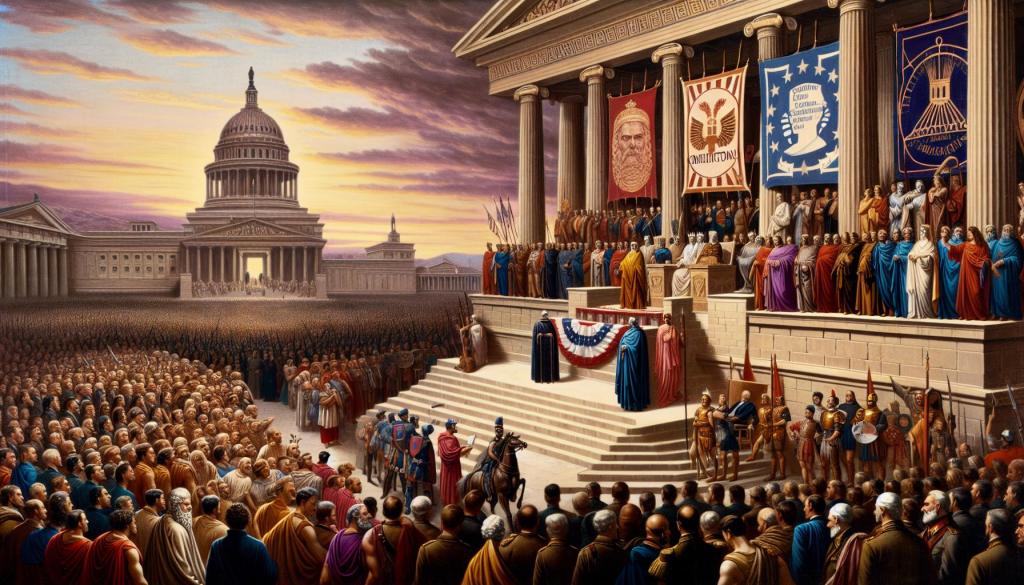
If we shift from contemporary classification back to longer historical patterns, the picture becomes more layered. In ancient Greek history, systematic data on poleis suggest that democracy was initially rare, accounting for under 5% of recorded constitutions, while tyranny or autocracy was the most common form [1]. Over roughly two centuries, however, democracy expanded to around half of all constitutions, in a wave‑like pattern. Tyrannies declined from their early predominance to about one‑fifth of regimes, then rebounded, and later fell again as democracy peaked [1]. Oligarchies occupied an intermediate position, sometimes becoming the most common constitution type during transitions between tyrannical and democratic dominance. This role resembles that of modern “anocracies” or hybrid regimes: neither full democracy nor outright dictatorship, but systems mixing elements of both [1].
Modern global data show an analogous, though not identical, pattern. Since the late 18th century, many narratives depict democracy as steadily advancing with occasional setbacks. Yet V‑Dem’s contemporary series indicates that the most recent change has been a wave of autocratization, not democratization [2][3]. By 2024–25, autocratic regimes—electoral and closed—again slightly outnumbered democracies in terms of country count, with 91 autocracies versus 88 democracies, reversing the democratic edge that had existed since 2002 [2][3]. Liberal democracies number only 29 states worldwide, a level comparable to 2009 [2][3].
Measured by population, the imbalance is starker. About 72% of the world’s people—some 5.8 billion individuals—live under autocratic rule, while fewer than 12% reside in liberal democracies and roughly 17% in electoral democracies [2][3]. Electoral autocracies are the most populous type, covering 46% of humanity and including highly populated countries such as India, Pakistan, Ethiopia, and, more recently, Indonesia [3]. Closed autocracies led by China, Myanmar, and Vietnam account for another 26% [3]. Some regions, notably the Middle East and North Africa, are now almost entirely autocratic by population (about 98%), with Israel reclassified from liberal democracy to electoral democracy [3]. Meanwhile, V‑Dem reports identify more than twice as many countries experiencing democratic backsliding (45) as those undergoing democratization (19) [2].
These patterns point to a recurring historical configuration: outright, closed autocracy often retreats from its height, but democracy does not fully replace it. Instead, intermediate or hybrid systems—ancient oligarchies, modern anocracies and electoral autocracies—expand and become the main arena of contestation [1][3]. The “middle” types can function as staging grounds either for deeper democratization or for renewed authoritarian consolidation, and in the early 21st century they have become central to a new wave of autocratization.
Taken together, the historical and contemporary evidence suggests that genuinely democratic rule has rarely been the dominant condition for the majority of the world’s population over long stretches of time. However, it is also misleading to treat “dictatorship” as a timeless, homogeneous default. The prevalence and structure of nondemocratic rule have shifted significantly: from traditional monarchies and personal tyrannies, to party‑based and military dictatorships, and more recently to electoral autocracies and hybrid regimes that blur older labels. Whether dictatorship is the “most common” form of government in history thus depends on how inclusively we define it within the broader universe of autocracy, and whether we count the number of regimes, their duration, or the share of people living under them. Modern datasets like BMR, PACL, and V‑Dem, combined with conceptual distinctions between dictatorship, autocracy, traditional rule, and totalitarianism, provide the tools to answer these questions in historically specific rather than purely generic terms.
Conclusion
Across ancient city-states and modern nation-states, dictatorship and wider forms of autocracy emerge less as historical anomalies than as recurring, adaptive defaults. The report has shown how refined datasets—from BMR and PACL to Historical V‑Dem—reshape our baseline about how rare democracy has actually been, and how much regime classification hinges on measurement choices. It distinguished dictatorship from broader autocracy and traditional monarchy, tracing the evolution from royal and military rule to today’s electoral autocracies. Finally, by pairing long-run patterns with current V‑Dem evidence, it demonstrated that while democracies have multiplied, most of humanity still lives under non-democratic or semi-democratic rule.
Sources
[1] Boix, C., Miller, M., & Rosato, S. “A Complete Data Set of Political Regimes, 1800–2007.” https://www.princeton.edu/~cboix/Boix_Miller_Rosato — Final_CPS.pdf
[2] pacl dataset documentation, democracyData R package. https://xmarquez.github.io/democracyData/reference/pacl.html
[3] Historical Varieties of Democracy (Historical V‑Dem) introduction. https://www.prio.org/publications/13560
[4] V‑Dem Users Working Paper No. 22 on varieties of non‑democratic rule. https://v-dem.net/media/publications/users_working_paper_22.pdf
[5] V‑Dem 2023/2024 Democracy Report (including long‑run regime‑type and population shares). https://www.v-dem.net/documents/60/V-dem-dr__2025_lowres.pdf
[6] Juan J. Linz, Totalitarian and Authoritarian Regimes (sections on traditional authority, totalitarianism, and typologies of nondemocratic regimes), https://www.rexresearch1.com/TotalitarianismLibrary/TotalitarianAuthoritarianRegimesLinz.pdf
[7] “List of forms of government – Autocracy,” Wikipedia, https://en.wikipedia.org/wiki/List_of_forms_of_government
[8] “Autocracy,” National Geographic Education, https://education.nationalgeographic.org/resource/autocracy/
[9] Barbara Geddes, “What Do We Know About Democratization After Twenty Years?”, Vanderbilt University (authoritarian regime types and temporal distribution), https://www.vanderbilt.edu/csdi/events/Geddes927.pdf
[10] “Russia,” Wikipedia (description of post‑Soviet Russia’s political regime), https://en.wikipedia.org/wiki/Russia
[11] https://link.springer.com/article/10.1007/s11127-025-01273-6
Written by the Spirit of ’76 AI Research Assistant




Leave a Reply