Introduction
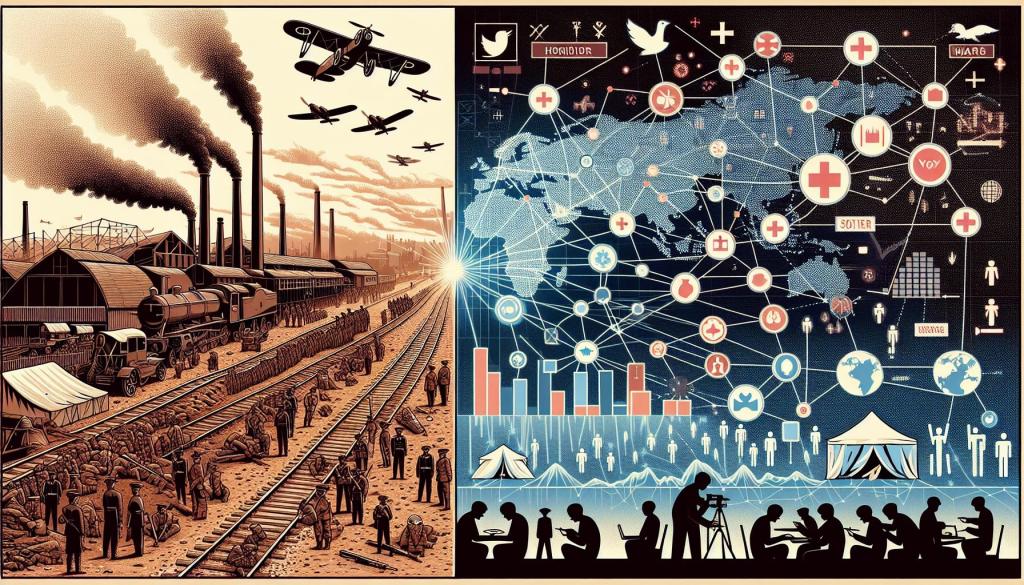
This report asks a deceptively simple question: what counts as a “major war,” and how has that changed from 1900–1925 to the post‑2000 era? Drawing on structured war databases, massacre timelines, and chronological conflict lists, it first shows how different datasets and coding choices reshape our picture of which wars are “big.” It then compares the industrial, empire‑shattering violence of the “long First World War” with today’s predominantly civil, proxy, and “forever” wars. Finally, it examines how both eras restructure states, societies, and humanitarian norms—even as contemporary conflicts rarely reach the catastrophic death tolls of the early 20th century.
Since 2000, major wars have been numerous but generally less cataclysmic than the conflicts that convulsed the first 25 years of the 1900s. Across the sources, three contrasts stand out: the scale of killing, the dominant types of conflict, and the way wars transform political orders.
Using structured war lists and casualty timelines, the early 20th century emerges as an era of unparalleled, industrialized mass death. World War I alone caused about 20 million deaths, with some 30 million military casualties and around 8 million civilian deaths from war and genocide, and it helped enable the Spanish flu pandemic that killed tens of millions more.[1][6] Scaruffi’s synthetic estimates place total 20th‑century war deaths at roughly 160 million, anchored in World War I, the Soviet Revolution and civil war (~5–6 million combined), the Chinese revolutions and civil wars (millions more), and the Ottoman genocides against Armenians, Assyrians, and Greeks (>2.5 million).[1][3][6] In comparison, the deadliest post‑2000 wars—Syria (~500,000), South Sudan (~400,000), and Ethiopia–Tigray (~600,000)—are catastrophic but fall far below these earlier peaks.[3][6] This suggests a need for at least two tiers of “major war”: a top tier of system‑shaping cataclysms like World War I, and a second tier of high‑fatality, often regionalized civil or hybrid wars that dominate the post‑2000 landscape.
Crucially, the 1900–1925 period cannot be reduced to World War I alone. Historians increasingly describe a “long First World War” from about 1912 to 1922, beginning with the Balkan Wars and continuing through revolutions, pogroms, and ethnic cleansing in the collapsing empires of Eastern Europe and the Middle East.[4] War‑memorial.net’s machine‑readable inventory and Wikipedia’s chronological war lists show that the early 1920s contained multiple large conflicts: the Russian Civil War, the Turkish War of Independence, and high‑casualty campaigns in China such as the Northern Expedition and Kuomintang–Gansu rebels fighting, each with six‑figure or higher death tolls.[1][2][4][5] These entries challenge the idea of the interwar 1920s as a “lull”: in China and several colonial or semi‑colonial regions, warfare was already on a scale comparable to some of the deadliest post‑2000 civil wars.
The organizational form of violence also changes sharply across the two eras. From 1900 to the early 1920s, the dominant pattern was industrial, state‑on‑state warfare and revolutionary civil war. The Russo‑Japanese War, Balkan Wars, and World War I itself involved mass conscription, artillery barrages, machine guns, and emerging technologies such as tanks and poison gas.[1][2][3] These were wars of empires and would‑be nation‑states mobilizing entire societies—“total war”—with front lines that increasingly blurred into civilian zones through sieges, blockade‑induced famine, deportations, and mass killing campaigns.
By contrast, post‑2000 conflict is dominated by civil wars, insurgencies, and hybrid wars rather than great‑power interstate clashes. The major entries in contemporary war lists and massacre datasets are Syria, Yemen, Afghanistan, Iraq, South Sudan, Ethiopia–Tigray, Myanmar, the Sahel, Boko Haram’s insurgency in Nigeria and neighboring states, and violence linked to Mexican and Central American criminal organizations.[3][5][6] Even the most prominent interstate dimension of recent years—the Russo‑Ukrainian war—has unfolded in an environment marked by nuclear deterrence, professional volunteer forces, and intense global media and surveillance, which may help explain why it has not (so far) reached World War I–style casualty levels.[1][3][5] Today’s large wars are often “civil‑plus”: internal conflicts with extensive foreign sponsorship, intervention, or proxy dynamics, rather than classic symmetrical contests between empires.
The 1920s were already beginning to resemble this proxy environment. Wikipedia’s detailed tables for 1919–1929 highlight conflicts such as the Great Syrian Revolt, the Zaraniq rebellion in Yemen, and the Saudi conquest of the Hejaz, where local actors were backed, constrained, or opposed by outside powers like Britain or Hejaz/Nejd.[2][5] Even ostensibly small colonial uprisings frequently involved multiple external sponsors and imperial garrisons, foreshadowing the externalized, multi‑actor civil wars common after 2000. War‑memorial.net’s typologies and casualty estimates, combined with these alliance structures, show that the line between internal and international war was already blurred in the early 20th century and has only grown more ambiguous over time.[1][3][5]
Politically and socially, early‑20th‑century wars were system‑shattering in a way that recent conflicts, though devastating, rarely match. The Great War and its associated revolutions destroyed the Russian, German, Austro‑Hungarian, and Ottoman empires, producing a wave of new states across Eastern Europe and the Middle East, from Poland to Yugoslavia, often under the auspices of postwar settlements and the League of Nations.[1][6] Japan’s victory in the Russo‑Japanese War (1904–05), with about 150,000 deaths, underwrote Japan’s rise as the pre‑eminent East Asian power and paved the way for the annexation and colonization of Korea by 1910, followed by decades of forced assimilation, heavy taxation, mass forced labor (about 5.4 million Koreans mobilized for Japan’s wartime economy), and the sexual enslavement of women as “comfort women.”[1][5] Here, the boundary between war and occupation dissolves into a long‑term system of coercion that incubated nationalist movements and set the stage for the wider atrocities of World War II.
In the 21st century, the political effects of war are often more about slow erosion than sudden collapse. The “Global War on Terror,” the invasions and occupations of Afghanistan and Iraq, the Syrian and Yemeni civil wars, Israel–Palestine escalations, and Russian interventions in Georgia, Crimea, Donbas, and Ukraine collectively form a dense tapestry of overlapping crises rather than a single, system‑wide breakdown.[3][5][6] These conflicts tend to produce fragile or hollowed‑out states, zones of chronic insecurity, and sustained displacement rather than outright imperial dissolution. Yet they remain system‑shaping in softer ways: by driving migration pressures, altering energy and commodity markets, and fueling the evolution of international law, humanitarian norms, and the language of “war crimes” and “crimes against humanity”—concepts that were themselves forged in reaction to the excesses of the 20th century’s earlier mass slaughters.[1][3][6]
Across both eras, there is continuity in the patterns of external sponsorship, the targeting of civilians, and the use of war as a tool of political reordering. The 1920s conflicts in places like China, the Middle East, and colonial peripheries already displayed complex multi‑actor struggles that look strikingly modern. What is genuinely novel in the post‑2000 landscape is not the presence of war but, so far, the relative absence of the truly global, industrialized, multi‑million‑death conflagrations that defined 1914–1925. Instead, high‑fatality violence has migrated into “forever wars”: prolonged, often fragmented civil and proxy conflicts that never quite add up to a world war but cumulatively impose enormous human and political costs.
Conclusion
Across these chapters, the comparison between 1900–1925 and the post‑2000 era reveals both rupture and continuity in how “major war” should be understood. Early‑20th‑century conflicts were dominated by industrial, state‑on‑state cataclysms—World War I, revolutions, genocides—that produced system‑wide political collapse and death tolls in the millions. Post‑2000 wars are generally less lethal at the single‑conflict level, but more fragmented, prolonged, and frequently fought within states and through proxies. Together, the datasets and case studies suggest a two‑tier conception of major war and show how the center of mass violence has shifted from imperial battlefronts to chronic civil and hybrid conflicts that erode states from within.
Sources
[1] Piero Scaruffi, “A History of Massacres / Wars and Casualties of the 20th and 21st Centuries,” https://www.scaruffi.com/politics/massacre.html
[2] “List of wars: 1900–1944,” Wikipedia, https://en.wikipedia.org/wiki/List_of_wars:_1900–1944
[3] War-Memorial.net, “List of Wars,” https://www.war-memorial.net/wars_all.asp
[4] “The Long First World War, 1912–1922,” Cambridge University Press chapter PDF, https://resolve.cambridge.org/core/services/aop-cambridge-core/content/view/B0F906DAE483A287829060C3B12BA737/9781474410830c2_p27-61_CBO.pdf/long_first_world_war_19121922.pdf
[5] Wikipedia table entries for 1919–1929 conflicts (e.g., Great Syrian Revolt, Italo–Yugoslav War, Zaraniq rebellion, Saudi conquest of Hejaz) extracted from https://en.wikipedia.org/wiki/List_of_wars:_1900–1944
[6] “World War I,” Wikipedia, https://en.wikipedia.org/wiki/World_War_I
[7] Helion & Company, “21st Century” conflict overview, https://www.helion.co.uk/periods/21st-century.php
[8] “Korea under Japanese rule,” Wikipedia, https://en.wikipedia.org/wiki/Korea_under_Japanese_rule
[9] “List of ongoing armed conflicts,” Wikipedia, https://en.wikipedia.org/wiki/List_of_ongoing_armed_conflicts
[10] “List of wars: 2003–2019,” Wikipedia, https://en.wikipedia.org/wiki/List_of_wars:_2003–2019
[11] “Wars of the World,” WorldStatesmen.org, https://www.worldstatesmen.org/WARS.html


 Realizing News
Leave a comment