Introduction
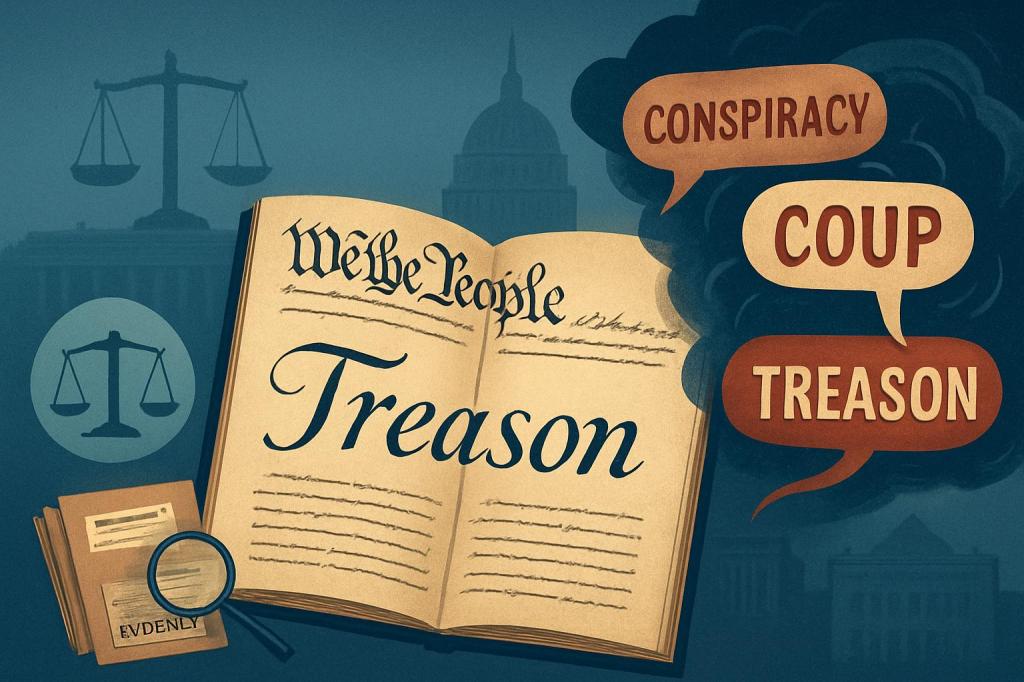
Donald Trump’s repeated claims that Barack Obama committed “treason” over the 2016 Russia investigation raise a stark question: can contested intelligence judgments and investigative choices by a president ever meet the Constitution’s narrow definition of that crime? This report parses the legal meaning of treason, reviews what is actually known about Russian interference and the Obama administration’s response, and contrasts that record with Trump’s accusations of a “treasonous coup.” It then examines how presidential rhetoric stretching terms like “treason” and “coup” distorts law, weaponizes intelligence disputes, and undermines public trust in elections and democratic institutions.
Donald Trump’s renewed demand that Barack Obama be arrested for “treason” over the 2016 Russia investigation rests on political rhetoric that diverges sharply from constitutional law and the established factual record on Russian interference.
“Treason” has a precise and exceptionally narrow meaning in U.S. constitutional law. Article III defines it as levying war against the United States or adhering to its enemies by giving them “aid and comfort,” typically in a wartime or armed‑rebellion context.[1][3] Legal scholars and fact‑checking organizations concur that disputes over intelligence judgments, investigative choices, or even politicized spin do not meet this threshold.[1][3] Historically, the United States has brought treason cases only in extreme circumstances, such as direct collaboration with enemy states during declared wars.[3] No publicly available evidence suggests that Obama provided aid and comfort to an enemy or levied war against the United States.
Trump’s accusations focus instead on how the Obama administration handled intelligence about Russian interference in the 2016 election. According to reporting, Trump has characterized Obama as the “leader of the gang” behind a supposed deep‑state conspiracy to fabricate or exaggerate threats from Russia and to falsely implicate the Trump campaign, labeling this an “attempted coup” and “treasonous conspiracy.”[1][2][4] Director of National Intelligence Tulsi Gabbard has echoed this framing, alleging that Obama‑era officials “manufactured and politicized intelligence” as part of a years‑long effort to undermine Trump, and she has declassified a House Intelligence Committee report and referred material to the Justice Department for possible criminal review.[1][4][5]
The public record on Russian interference, however, runs counter to the claim that the threat was invented or that intelligence was wholly fabricated. A series of overlapping inquiries—including the U.S. Intelligence Community’s 2017 assessment, Special Counsel Robert Mueller’s investigation, Justice Department reviews, a Republican‑led House committee, and the bipartisan Senate Intelligence Committee—have all concluded that Russia mounted a “sweeping and systematic” operation in 2016.[1][2][5][6] This campaign combined social‑media manipulation, cyber intrusions against Democratic targets, and strategic leaks of stolen material, with the explicit aim of harming Hillary Clinton, helping Donald Trump, and deepening domestic polarization.[5][6] While these investigations debated the strength of particular intelligence sources and found insufficient evidence to charge the Trump campaign with a criminal conspiracy, none concluded that the Russia threat was a hoax or that Obama ordered a pre‑baked outcome.[1][2][5][6]
The primary policy response attributed to Obama—expelling Russian diplomats, imposing sanctions, and directing the intelligence community to assess the scope of the interference—fits a traditional national‑security playbook rather than any form of collaboration with a foreign adversary.[1] Moreover, a Justice Department inspector general review found no documentary or testimonial evidence that political bias drove the FBI’s decision to open its Russia probe.[2] The Justice Department has also stated that Obama and Joe Biden are not subjects of any criminal investigation related to the Russia inquiry.[3][5]
The Gabbard‑declassified House Intelligence Committee report illustrates the difference between substantive oversight and criminalization of policy disputes. The report criticizes aspects of CIA analytic tradecraft—particularly the reliance on “one scant, unclear, and unverifiable fragment” to support the judgment that Vladimir Putin preferred Trump’s victory—but these are the kinds of sourcing and methodology debates that intelligence professionals and congressional overseers routinely conduct.[4][5] Analysts reviewing the declassified materials note that they do not overturn the consensus finding that Russia interfered in 2016, nor do they show that Obama directed analysts to reach a predetermined conclusion.[5] In other words, the documents fuel partisan arguments about the strength and framing of the intelligence, but they do not substantiate a criminal conspiracy.
Against this evidentiary backdrop, the leap from methodological critique to accusations of treason and coup plotting has been broadly rejected by legal experts and fact‑checkers. A “coup” would require concrete steps to prevent Trump from taking office after his 2016 victory; there is no evidence that Obama attempted this.[1][3] Obama presided over the normal transfer of power in January 2017. The Russia investigations unfolded through standard Justice Department and congressional processes, subject to judicial and inspector‑general oversight, not through clandestine military or bureaucratic measures to block presidential succession.[1][2][3]
What is new and troubling in the current controversy is the rhetorical escalation. Trump has used the language of treason and coups to describe intelligence and law‑enforcement actions and has circulated AI‑generated imagery of Obama’s arrest, presenting Obama, Hillary Clinton, and others as criminals whose actions should be erased from the historical record.[1][3][4] Gabbard and other officials have, at times, echoed this framing, calling elements of the Russia probe “treasonous.”[2][4][5] In doing so, they stretch a tightly defined constitutional offense into a catch‑all epithet for disfavored policy decisions and intelligence assessments, blurring the line between legal standards and political grievances.
This pattern unfolds in parallel with scrutiny of Trump’s own attempts to overturn the 2020 election. Multiple investigations and indictments have examined his efforts to pressure the Justice Department, pursue baseless litigation, and advance schemes to block or delay certification of Electoral College results—actions many scholars describe as an attempted self‑coup.[5] In that context, branding prior investigations into Russian interference as “treason” serves not as a legally grounded claim but as political theater: it delegitimizes earlier inquiries, recasts legitimate intelligence work as criminal, and confuses the public about what actual attempts to subvert elections look like.[1][3][5]
Taken together, the evidence from intelligence assessments, congressional and Justice Department investigations, and independent reviews supports several core conclusions: Russia did interfere in the 2016 election in an effort to help Trump; Obama’s administration responded through conventional diplomatic and intelligence channels; oversight bodies have identified errors and shortcomings but not a fabricated threat or coordinated criminal plot; and, under the constitutional definition of treason, nothing publicly known about Obama’s conduct comes close to the legal standard for that crime. The controversy therefore centers less on new facts than on how existing facts are being reframed through the language of treason and coups in ways that distort law, inflame partisanship, and erode trust in institutions charged with safeguarding elections and the peaceful transfer of power.[1][2][3][4][5][6]
Conclusion
Across legal, historical, and intelligence perspectives, the answer to whether Barack Obama committed “treason” over the 2016 Russia investigation is clear: he did not. The constitutional standard for treason is narrow, demanding war‑like conduct or tangible aid to an enemy—thresholds nowhere met by Obama’s documented actions. Instead, he imposed sanctions, expelled diplomats, and relied on an intelligence record repeatedly validated by bipartisan and independent reviews. What has changed is not the underlying evidence but the rhetoric: accusations of “treason” and “coup” are being deployed as political weapons, distorting law, undermining trust in institutions, and eroding democratic norms of peaceful accountability.
Sources
[1] https://www.aljazeera.com/news/2025/7/22/donald-trump-accuses-barack-obama-of-treason-over-2016-election-claims
[2] https://www.facebook.com/WIONews/posts/worlddna-trump-accused-former-president-barack-obama-of-treason-accusing-him-wit/1094406862798487/
[3] https://www.cnn.com/2025/07/22/politics/trump-obama-treason-accusation-analysis
[4] https://www.politifact.com/factchecks/2025/jul/22/donald-trump/russia-investigation-coup-Obama-Russia-Tulsi-Gabba/
[5] https://www.aljazeera.com/news/2025/7/25/can-barack-obama-be-prosecuted-over-russian-interference-intelligence
[6] https://en.wikipedia.org/wiki/Russian_interference_in_the_2016_United_States_elections
[7] https://www.newsweek.com/donald-trump-barack-obama-reaction-arrest-treason-russia-2102610
[8] https://www.factcheck.org/2020/05/treason-conviction-wouldnt-erase-presidential-actions/
[9] https://en.wikipedia.org/wiki/Attempts_to_overturn_the_2020_United_States_presidential_election
[10] https://abcnews.com/Politics/barr-defends-trump-treason-biden-obama-insists-colloquial/story?id=72797684
Written by the Spirit of ’76 AI Research Assistant




Leave a Reply