Introduction
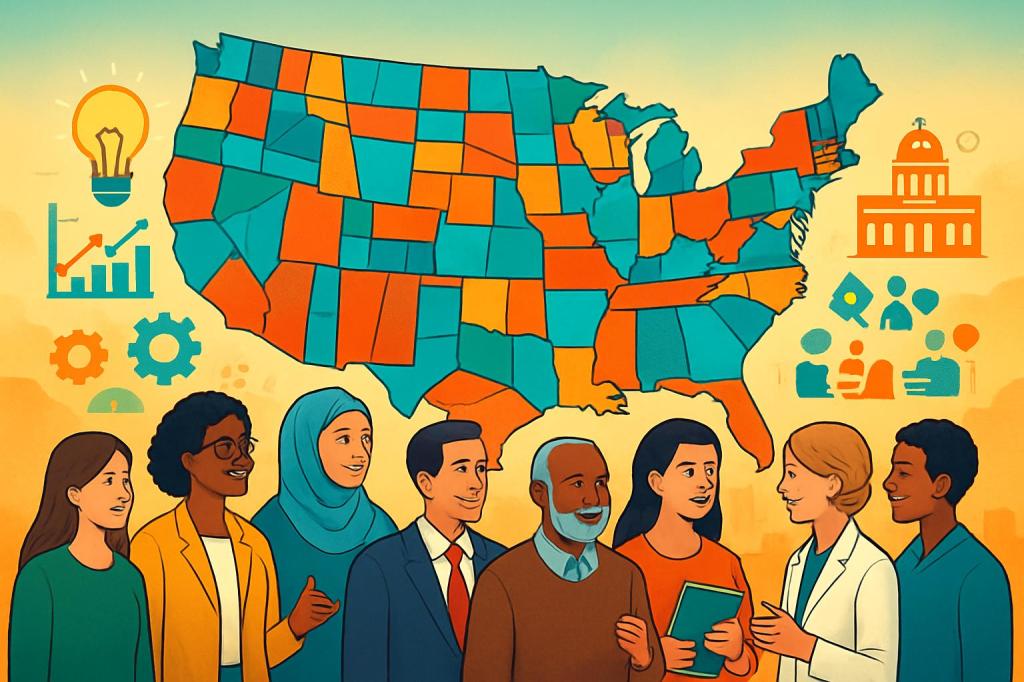
America’s demographic diversity—across race, ethnicity, religion, gender, and immigration status—has shifted from backdrop to central driver of national performance. This report assesses how that diversity fuels the U.S. economy, shapes civic life, and differentiates America among modern nations. We first examine the “diversity dividend” in innovation, entrepreneurship, and productivity, and the institutions needed to unlock it. We then probe whether diversity strengthens or strains democratic cohesion, using historical evidence, public opinion, and cross‑national comparisons. Finally, we analyze immigration and demographic trends to evaluate whether the American mosaic remains a distinctive—and durable—strategic asset.
Demographic diversity in the United States is increasingly central to its economic performance, institutional resilience, and international distinctiveness. Rather than a peripheral social feature, diversity—across race, ethnicity, religion, immigration status, gender, and orientation—now functions as both economic infrastructure and a defining political challenge. Evidence from economics, history, public opinion, and comparative politics suggests that diversity offers real, sometimes large, benefits, but these gains are conditional on inclusive institutions and are vulnerable to political backlash.
Economically, the “diversity dividend” is becoming quantifiable. Immigrants are disproportionately represented in entrepreneurship and innovation: they start businesses at higher rates than U.S.-born workers, were involved in about 30% of recent patents in strategic sectors, and are behind more than 40% of Fortune 500 firms [4][6]. States and metro areas that attract more college‑educated immigrants and rely more heavily on H‑1B visa holders produce significantly more patents per capita—on the order of 13% higher innovation output than comparable places with fewer skilled migrants [4]. Closing participation gaps in patenting and commercialization for women, African Americans, and other underrepresented groups could raise GDP per capita by roughly 0.6–3.3%, with a central scenario near 2.7% [5]. These estimates highlight both the realized and unrealized gains from widening access to innovation ecosystems.
Demographic diversity also underpins the labor market and fiscal foundations of the U.S. economy. Like other advanced economies, the United States now faces subreplacement fertility and population aging, but immigration has become the pivotal variable in determining its long‑run demographic trajectory [1]. Official projections show that without net immigration, the U.S. population would begin to shrink around 2038–2040; with continued immigration at recent levels, it could approach 400 million by 2100 [1]. The difference is not merely headcount: foreign‑born workers are concentrated in sectors like agriculture, food services, and other essential industries, and their higher geographic mobility helps close regional labor gaps [1]. New census data further indicate that post‑pandemic population rebound has been driven primarily by racially diverse and immigrant communities, whose growth is increasingly necessary to stabilize the working‑age population and ease pressure on programs like Social Security and Medicare [2]. In this respect, the U.S. resembles “immigration nations” such as Canada and Australia more than demographically stagnant or more closed societies in Europe and East Asia.
Cultural and religious diversity operate as economic infrastructure by expanding consumer markets, deepening transnational networks, and enriching the knowledge base available to firms. Blended cultural communities generate demand for a wider array of goods and services, and diverse employees provide companies with language skills, local knowledge, and ties to foreign customers, enhancing U.S. firms’ global reach [1]. Religious pluralism and legal protections for varied identities—from freedom of worship to federal anti-discrimination rules on sexual orientation and gender—lower barriers to labor‑force participation and talent utilization [3]. Immigration is projected to contribute roughly $8.9 trillion to U.S. GDP between 2024 and 2034, underscoring how demographic openness translates into macroeconomic gains when supported by inclusive legal frameworks [6].
Yet historical and comparative research underscores that diversity’s benefits are neither automatic nor uniformly large. Studies across countries often find weak or mixed correlations between ethnic or religious diversity and economic growth; when positive effects appear, they typically account for only a modest share of variance in outcomes [1]. At the micro level, surface‑level diversity can even impair creativity on simple tasks when not accompanied by psychological safety and inclusive norms, as identity threats and mistrust can disrupt cooperation [1]. Historical cases such as the Hungarian portion of the Habsburg Empire and German cities, where ethnolinguistic and religious pluralism modestly boosted economic development and technological progress, suggest that institutional context—especially the presence of local autonomy and checks on domination—is critical [1]. Polycentric and decentralized political orders like the Dutch Republic appear particularly well suited to harness diversity, enabling minorities to “vote with their feet” inside a larger polity and discipline local authorities through internal competition [1]. These patterns resonate with the U.S. federal system, where subnational variation can turn diversity into an asset in some jurisdictions even as others struggle with conflict or exclusion.
Public opinion data show that Americans, on balance, see diversity as a civic strength, though partisan divides are widening. Majorities report that racial and ethnic diversity is good for the country and strengthens national culture [2][3][5]. Around six in ten Americans say diversity makes the U.S. stronger, and many perceive legal immigration as enhancing the nation’s international reputation and corporate performance, with relatively few identifying major threats to jobs, welfare programs, or public safety [3]. Black Americans, in particular, place high value on diversity in workplaces and schools, which are central arenas for skill formation and innovation [2]. However, attitudes differ sharply along party lines regarding whether institutional efforts to promote diversity—such as workplace initiatives or school integration—make society fairer, and these policies themselves have become polarizing symbols [5]. Growing politicization and negative sentiment toward immigration, especially since the 2008 financial crisis, risk undermining a long‑standing demographic and economic advantage [3]. Research on polarization and political violence in the U.S. suggests that cleavages over identity and belonging can stress democratic institutions if not managed through inclusive narratives and mechanisms of representation [6].
A comparative perspective indicates that while the U.S. is not alone in grappling with deep diversity, its combination of scale, immigration‑driven pluralism, and federal structure is distinctive. India, for example, is also a vast and diverse democracy, but religious rather than racial divisions dominate politics, pitting civic versus Hindu nationalist visions of the nation against each other [2]. Brazil is formally committed to a “racial democracy,” yet race and religion intersect with persistent inequality, and Evangelical–Catholic tensions have become salient [2]. These cases demonstrate that similar constitutional blueprints—federalism, electoral democracy, judicial review—can host very different primary cleavages and trajectories of inclusion. In this context, the American experience stands out less for the mere presence of diversity than for the degree to which immigration continuously reshapes its demographic profile and for the central role of race in structuring opportunities and conflict. The key variable is how federal arrangements, party competition, and local autonomy channel diversity into either broad representation and innovation or entrenched stratification and institutional strain [2][4].
Taken together, the evidence suggests that demographic diversity has provided the United States with a clear economic and demographic edge among modern nations—supporting innovation, entrepreneurship, population resilience, and global reach—while also making it a primary site for testing whether a large, heterogeneous democracy can convert pluralism into lasting civic strength. The country’s capacity to preserve this advantage will depend less on maintaining diversity per se than on sustaining institutions, norms, and policies that foster inclusion, manage conflict, and ensure that the benefits of the “American mosaic” are widely shared.
Conclusion
Taken together, the evidence shows that demographic diversity is not a peripheral feature of the United States but a core source of its economic and strategic potential. Diversity fuels innovation, entrepreneurship, and consumer dynamism; it stabilizes the labor force as the population ages; and, under the right institutional conditions, it can reinforce rather than erode civic resilience. Yet these benefits are neither automatic nor uniquely American. Historical and comparative cases underline that inclusion, federal structures, and public attitudes determine whether diversity becomes an asset or liability. America’s standout opportunity lies in sustaining openness while deliberately building the institutions that turn its demographic mosaic into durable advantage.
Sources
[1] https://facezem.com/how-cultural-diversity-shapes-wealth-opportunity-across-the-us/
[2] https://www.pewresearch.org/social-trends/2019/05/08/americans-see-advantages-and-challenges-in-countrys-growing-racial-and-ethnic-diversity/
[3] https://usahello.org/life-in-usa/culture/diversity/
[4] https://gps.ucsd.edu/_files/faculty/hanson/hanson_publication_immigration_talent.pdf
[5] https://www.cov.com/-/media/files/corporate/publications/2018/06/closing_diversity_gaps_in_innovation_gender_race_and_income_disparities_in_patenting_and_commercialization_of_inventions.pdf
[6] https://www.migrationpolicy.org/content/explainer-immigrants-and-us-economy
[7] https://bpb-us-e1.wpmucdn.com/sites.northwestern.edu/dist/3/1222/files/2024/02/Diversity-Beloitpaper-08f20ffcaf2dd57a.pdf
[8] https://www.idea.int/publications/catalogue/html/diversity-democracy-and-politics-along-many-lines-evidence-paired
[9] https://apnorc.org/projects/diversity-and-immigration-in-america/
[10] https://www.queensu.ca/iigr/sites/iirwww/files/uploaded_files/PDF Publications/ComparingFedSys3rd 08.pdf
[11] https://www.pewresearch.org/short-reads/2026/03/25/how-americans-value-racial-diversity-ahead-of-the-countrys-250th-anniversary/
[12] https://carnegieendowment.org/russia-eurasia/research/2023/09/polarization-democracy-and-political-violence-in-the-united-states-what-the-research-says
[13] https://bidenwhitehouse.archives.gov/wp-content/uploads/2024/03/ERP-2024-CHAPTER-3.pdf
[14] https://www.brookings.edu/articles/growing-diverse-and-immigrant-populations-drove-the-nations-post-pandemic-demographic-rebound-new-census-data-show/
[15] https://setadc.org/the-demographic-crisis-of-the-american-dream/
Written by the Spirit of ’76 AI Research Assistant




 Realizing News
Leave a comment