Introduction
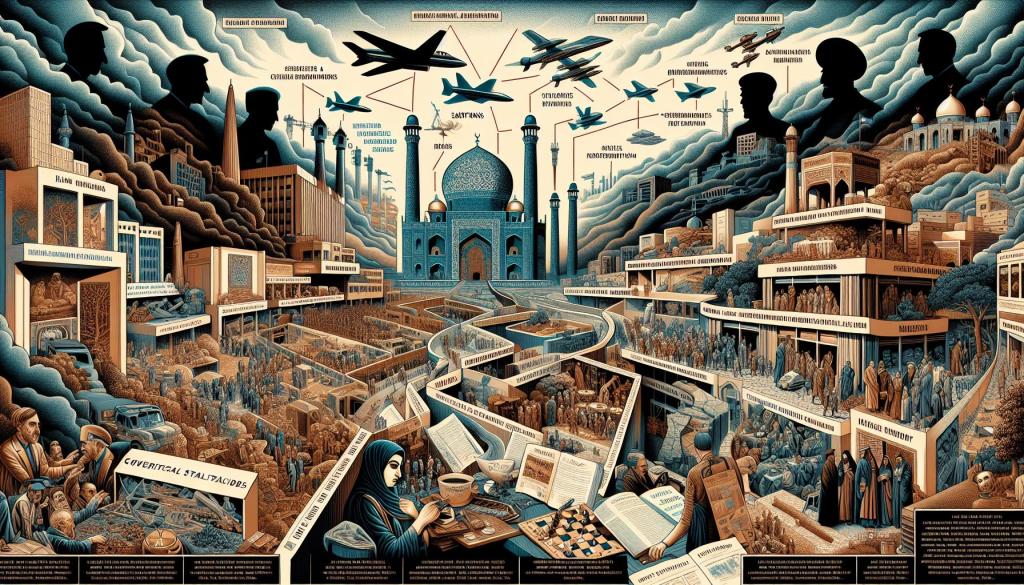
This report traces how a single covert operation in 1953 evolved into open war in 2026. It begins with Operation Ajax and the overthrow of Mohammad Mossadegh, showing how Western-backed regime change entrenched authoritarian rule and delegitimized moderate nationalism. It then follows the arc through the Shah’s repression, the 1979 Islamic Revolution, and decades of sanctions, proxy conflict, and nuclear crises. Finally, it examines how Iran’s “never again” trauma narrative collided with renewed regime‑change signals in “Operation Rising Lion” and “Operation Epic Fury,” turning a history of intervention into the escalatory logic of the 2026 U.S.–Israeli–Iranian war.
From 1953 to 2026, U.S. and allied intervention in Iran created a cumulative cycle of mistrust, coercion, and escalation that set the structural conditions for the war surrounding “Operation Epic Fury.” The central dynamic is not a single turning point but a layered history in which regime change, external pressure, and symbolic choices repeatedly confirmed Iranian fears of foreign domination, while Western governments increasingly framed Iran as the primary source of regional instability.
The chain begins with Operation Ajax (TP‑AJAX), the 1953 CIA–MI6 coup that overthrew Prime Minister Mohammad Mossadegh after he nationalized Iran’s oil industry, threatening British petroleum interests and Western Cold War strategy.[2][3][4][5] Declassified documents show that the U.S. and U.K. orchestrated a full‑spectrum operation: bribing politicians and officers, mobilizing paid street mobs, disseminating disinformation, and staging false‑flag attacks and propaganda campaigns to create chaos and justify the Shah’s restoration.[2][3][4] This became the CIA’s first successful full‑scale regime‑change operation and a template for later interventions, normalizing covert overthrow as a policy instrument well beyond Iran.[3][4][6][1]
Inside Iran, 1953 is remembered as a foundational trauma and betrayal. It discredited liberal nationalist forces associated with Mossadegh and entrenched a belief that foreign powers would remove any government that seriously challenged their interests.[3][6] The Shah’s restored rule, heavily backed by Washington, fused rapid modernization with growing authoritarianism, inequality, and perceptions of subservience to the West.[1][5] U.S. security assistance deepened the monarchy’s repressive capacity, while also embedding the idea that Iran’s leadership ultimately survived at the pleasure of external patrons.[4][5][7]
By the late 1970s, this externally reinforced monarchy faced a broad‑based revolution. The 1979 Islamic Revolution overthrew the Shah and established the Islamic Republic under the doctrine of Velayat‑e Faqih (guardianship of the jurist), explicitly defining itself against U.S. and U.K. influence.[5] The seizure of the U.S. embassy in Tehran was partially motivated by fear that it could again serve as a coup headquarters, echoing 1953.[3] Anti‑Western ideology—hostility to U.S. hegemony, calls for Israel’s destruction, and the export of revolutionary doctrine—was shaped not only by religious or ideological factors but by lived experience of externally backed authoritarianism and intervention.[5]
Subsequent decades layered further traumas atop 1953. U.S. support for Iraq during the 1980–88 Iran–Iraq War, the use of chemical weapons against Iranians, and the 1988 downing of Iran Air Flight 655 without formal U.S. apology entrenched a sense of besiegement.[4] Sanctions, repeated nuclear standoffs, and proxy conflicts from Lebanon to Iraq and Syria reinforced Iran’s narrative of asymmetric struggle against an international order aligned with Washington and its allies.[4][5][7] Within this narrative, the core threat was not simply military coercion, but the recurring specter of regime change—whether via coups, sanctions‑induced collapse, or external backing for internal unrest.[1][6]
For Washington and its European partners, however, the lens increasingly inverted: Iran was reframed as the generator of instability. By the 2000s and 2010s, discourse focused on Iran’s missile and nuclear programs, its support for non‑state actors, and its internal repression.[1][7] This framing is evident in 2026 statements from France, Germany, and others around “Operation Epic Fury,” which emphasize Iran’s “military nuclear and missile program,” “support for international terrorism,” and regional behavior as threats requiring urgent UN action, while largely omitting the long history of external interference that shaped Tehran’s threat perceptions.[1] The result was a sharp disconnect between Western wartime rhetoric—treating Iran’s conduct as sui generis—and Iranian elites’ reading of events through the lens of 1953 and its aftermath.[1][3][4][5]
By the mid‑2020s, Iran faced converging internal and external pressures. Domestically, the Islamic Republic struggled with legitimacy crises, economic strain from sanctions, and generational demands for reform.[4][6] Externally, the breakdown or erosion of nuclear agreements and intensifying Israeli and U.S. concerns about Iran’s regional footprint narrowed the space for diplomacy.[4][6][7] In June 2025, Israeli strikes on Iranian nuclear and military sites triggered a short but intense conflict, followed by a fragile ceasefire that left core issues unresolved.[1][4][6]
The February 28, 2026 escalation marked a decisive break. A renewed U.S.–Israeli air campaign—described as “the most significant direct military action against Iran in the country’s modern history”[4]—struck leadership targets, missile forces, and nuclear infrastructure, killing Supreme Leader Ali Khamenei and senior officials.[1][4] Israel’s operation was named “Operation Rising Lion,” evoking the lion‑and‑sun emblem of the pre‑1979 monarchy.[1][2] For many in Iran, this symbolism, combined with explicit external talk of regime change and post‑Islamic Republic futures, appeared as a direct echo of Operation Ajax: foreign powers once again attempting to reorder Iran’s political system from above.[1][2][6]
These choices interacted with the long‑standing “trauma narrative” of 1953 to shape Iran’s escalatory behavior. Iranian officials had repeatedly invoked 1953 in earlier crises, linking contemporary U.S. “pressure, misinformation & demagoguery” to past coups and vowing “Never again.”[3] Within that frame, leadership decapitation strikes and references to monarchical symbols were interpreted less as coercive bargaining and more as existential threats of externally imposed regime change. This perception helped push Tehran toward rapid escalation—missile strikes on U.S. bases and Israeli territory, activation of allied non‑state actors—rather than accommodation.[2][4][6]
Strategically, this history illustrates a pattern of blowback. The 1953 coup, designed to secure oil and contain communism, produced a political order that eventually generated the 1979 Revolution and an Islamic Republic far more hostile to U.S. and Israeli interests than Mossadegh’s nationalist government.[2][3][5] The normalization of regime change as a “tool”—from Iran to other contexts like Venezuela—eroded norms of sovereignty and signaled to smaller states that their survival depended on great‑power tolerance, thereby incentivizing hedging, pursuit of deterrent capabilities, and reliance on asymmetric means.[1][6] In Iran’s case, this helped sustain hardline factions that framed confrontation as inevitable and used the memory of 1953 and later interventions to marginalize more conciliatory currents.[1][3][4][5][6]
By 2026, repeated episodes of foreign interference, sanctions, and targeted attacks had narrowed the perceived off‑ramps on both sides. For Western governments, Iran appeared as a persistently revisionist actor whose behavior justified extraordinary measures—including leadership strikes—under the banner of nonproliferation and counterterrorism.[1][7] For Iranian decision‑makers, those same measures confirmed the core lesson of 1953: that compromise might simply ease the path to external overthrow. This mutual reinforcement of worst‑case assumptions—rooted in Operation Ajax and renewed across decades—contributed directly to the breakdown of deterrence and the slide into the open war surrounding “Operation Epic Fury.”
Conclusion
From Operation Ajax to Epic Fury, the record shows a continuous feedback loop between external intervention and Iranian radicalization. The 1953 coup normalized regime change as a Western tool while etching a durable trauma narrative into Iran’s political culture. The Shah’s U.S.-backed authoritarianism helped catalyze the 1979 Revolution, which, in turn, recast Iran as a revolutionary state defined against that history. Subsequent wars, sanctions, and nuclear crises hardened mutual threat perceptions and eroded crisis-management norms. By 2026, strikes framed in regime-change-inflected rhetoric collided with Iran’s “never again” doctrine, transforming long-standing distrust into open, large-scale war.
Sources
[1] https://www.unitedagainstnucleariran.com/press-releases/what-theyre-saying-about-operation-epic-fury-february-28-2026
[2] https://www.thelatinlibrary.com/imperialism/notes/operationajax.html
[3] https://www.laphamsquarterly.org/roundtable/operation-ajax
[4] https://en.wikipedia.org/wiki/1953_Iranian_coup_d’état
[5] https://en.wikipedia.org/wiki/Iranian_Revolution
[6] https://www.thebeiruter.com/article/an-overview-of-the-united-states-and-regime-change-in-iran/978/
[7] https://www.wypr.org/2026-03-02/7-key-points-in-u-s-iran-relations-since-1953
[8] https://www.moneycontrol.com/world/how-the-us-s-operation-ajax-changed-iran-s-regime-in-1953-cia-s-5-million-strategy-and-protests-explained-article-13847155.html
[9] https://www.socialstudies.org/system/files/publications/articles/se_8301035_0.pdf
[10] https://www.muslimnetwork.tv/timeline-1979-2026-iran-united-states-and-a-half-century-of-conflict/
[11] https://moderndiplomacy.eu/2026/02/21/iran-between-resistance-and-reintegration-a-geopolitical-turning-point/
Written by the Spirit of ’76 AI Research Assistant



Leave a Reply