Introduction
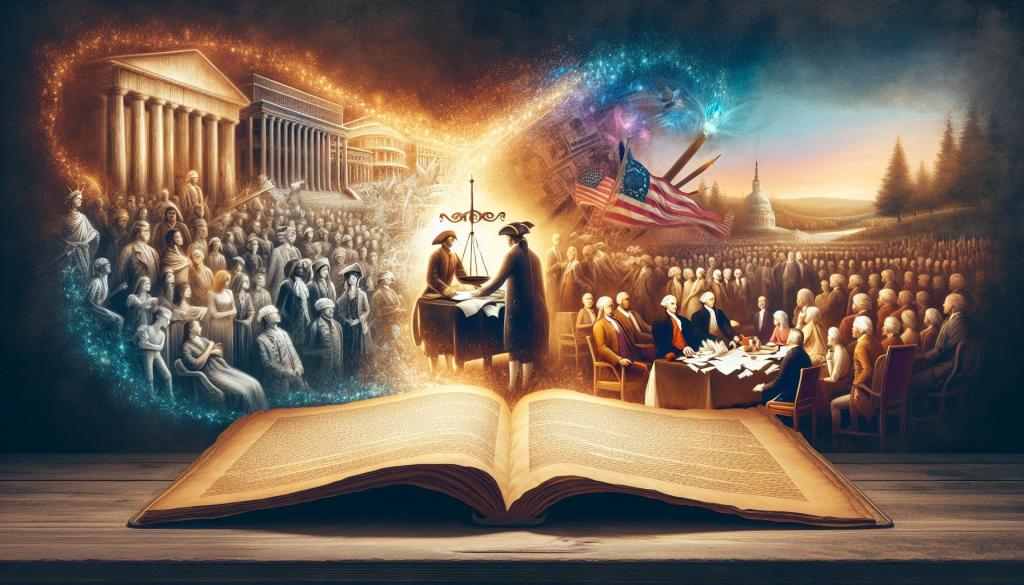
“Life, Liberty, and the pursuit of Happiness” remains the most famous promise of the Declaration of Independence—and a persistent question for modern Americans. This report examines which elements of that founding ideal still function as universal values today and how they are being reinterpreted. It first traces the enduring appeal and expanding scope of inalienable rights as reflected in contemporary polling. It then explores how Americans negotiate liberty amid intense polarization and competing policy visions. Finally, it assesses the Declaration’s framework of popular sovereignty, consent, and democratic “guardrails” under modern stress tests of trust, accountability, and institutional resilience.
Public attitudes suggest that the Declaration of Independence still supplies a widely shared moral grammar for American politics. The phrase “life, liberty, and the pursuit of happiness” retains strong legitimacy: about 85% of Americans affirm the Declaration’s claim that people are endowed with inalienable rights including life, liberty, and the pursuit of happiness, despite deep partisan divides on policy and culture [1][4]. A majority also believes that the founding ideals still guide the country “in meaningful ways,” though a substantial minority now sees them as disconnected from lived reality, underscoring the gap between aspiration and practice [2].
The content of these ideals has broadened. Historically, the Declaration’s universal language (“all men are created equal,” government by consent, the right to resist tyranny) was quickly reinterpreted to expose exclusions and demand wider inclusion. Reformers in the 19th century, notably in the 1848 Declaration of Sentiments, explicitly extended the claim of equality to “men and women,” highlighting the tension between founding rhetoric and actual rights [3]. Over time, movements for racial justice, women’s rights, and other expansions of citizenship have treated the Declaration less as a completed achievement than as a standing indictment of inequality and an authorization for reform.
In contemporary opinion, “life” and “liberty” are no longer understood as thin, minimalist protections alone; they are associated with a thick bundle of civil and political rights. Large bipartisan majorities now regard voting, equal protection under law, free speech, privacy, racial equality, and equal opportunity as “essential rights,” with agreement in the roughly 90% range across parties [3][4]. These rights are seen as core conditions for pursuing a good life, not optional add-ons. At the same time, more contested arenas—such as LGBTQ+ rights or gun ownership—also draw majority support as rights but show sharp partisan gaps, revealing how the same liberty language is mobilized to defend divergent, sometimes competing, freedoms [4][5].
The founding notion of “happiness” itself is often reinterpreted in modern terms. Historical analysis emphasizes that, in the 18th‑century context, “the pursuit of happiness” signified an enduring state of flourishing rather than fleeting pleasure—bound up with security, opportunity, moral agency, and social well‑being [1]. Placed alongside life and liberty, happiness implies that governments influence the conditions of a good life through policy affecting health, safety, work, and dignity, rather than guaranteeing subjective satisfaction. Today, Americans report moderate satisfaction with their lives overall, but well‑being is sharply stratified by age, economic status, and political outlook, suggesting that the shared right to pursue happiness collides with unequal capacity to secure it in practice [5].
The Declaration’s political theory—popular sovereignty, consent of the governed, and the right to alter or abolish governments that become destructive of people’s “Safety and Happiness”—also continues to shape civic self‑understanding. The document’s insistence that governments derive “their just powers from the consent of the governed” has evolved into modern expectations of continuous accountability through elections, public opinion, transparency, and institutional checks [2][4][5]. Historically, American thinkers framed this as a lending, not surrender, of popular sovereignty: people retain the ultimate authority and can revoke delegated power when it violates fundamental rights [3][4]. That principle underlies contemporary concern with democratic “guardrails”—free and fair elections, peaceful transfers of power, and procedural fairness—as non‑negotiable foundations for legitimate government [6].
Surveys show broad agreement that government has a responsibility to protect “the lives, livelihoods, and rights of all Americans,” even as many believe both government and citizens are failing to adequately protect and respect those rights [3]. This points to a duality at the heart of modern American views of liberty: the philosophical framework of rights and consent remains broadly endorsed, but trust in existing institutions to realize those ideals is eroding. Amid debates over emergency powers, surveillance, national security, and gun regulation, Americans are effectively arguing over how far government can go in constraining some liberties to safeguard others, and when such constraints cease to be compatible with a government “instituted” to secure rights.
Polarization intensifies these disagreements without fully erasing the shared creed. Long‑running research finds Republicans and Democrats now more distant on core values—size of government, immigration, business, racial discrimination, and social issues—than at any point in recent decades, with each party’s median voter more ideologically distinct from the other than before [2]. These divisions strongly color interpretations of what liberty demands in concrete terms: some emphasize limited, “wise and frugal” government that protects rights while avoiding “forced outcomes” or redistribution; others see robust public action as necessary to secure equal opportunity and guard against private forms of domination [1][2]. Yet cross‑cutting these conflicts is a surprisingly persistent belief that Americans still have “more in common than many people think,” and a widespread sentiment that “without our freedoms America is nothing” [2][4]. Independence Day rituals reflect this duality: large majorities celebrate the Fourth of July, express pride in the nation, and increasingly describe the holiday as a time not just for recreation but for reflection on “history and the freedoms it provides” [3][4].
Generational differences complicate the picture further. Older Americans, especially Republicans, are more likely to see the United States as “the greatest country in the world” or as standing above all others, and to link national greatness closely to the founding ideals [3]. Younger Americans—particularly younger Democrats—are more inclined to judge other countries as performing better on some measures, signaling a more critical engagement with how fully the nation has lived up to its professed commitments [3]. Still, across ages there remains a core recognition of rights as inalienable and of government’s legitimate purpose as their protection, even as younger cohorts press harder on issues of inclusion, systemic inequality, and the definition of a just social order.
Taken together, these attitudes suggest that several elements of liberty in the Declaration endure as widely held, quasi‑universal values among modern Americans:
- The belief in inherent, not state‑granted, rights to life, liberty, and the pursuit of happiness, grounded in a moral order that stands above any particular government [1][2][4].
- The conviction that legitimate government rests on the consent of the governed and exists chiefly to secure rights, not to define or bestow them [2][4][5].
- A broad, evolving understanding of liberty that encompasses political participation (especially voting), equal protection, free expression, privacy, racial equality, and equal opportunity as essential rights for all, not privileges for a few [3][4].
- Acceptance of limits on individual liberty when necessary to protect others’ safety and rights, alongside deep disagreements about where those limits should lie, as seen in debates over firearms, public health, and civil liberties [3][5].
- A persistent, if strained, sense of common identity rooted in shared freedoms, even amidst partisan polarization and growing skepticism about whether current institutions faithfully embody the founding promise [2][3][4].
In this way, the Declaration’s language functions less as a settled description of America than as an enduring standard against which Americans continuously measure, justify, and contest their laws, institutions, and social arrangements. Its central liberty claims still resonate as universal values in public consciousness, even as the nation struggles over how broadly they apply and what structures are required to make them real.
Conclusion
Across surveys, history, and contemporary debate, the Declaration’s promise of “life, liberty, and the pursuit of happiness” endures as both a unifying creed and a site of struggle. Americans still overwhelmingly affirm inherent rights, popular consent, and limited government as moral bedrock, even as they expand these ideals to encompass a broader bundle of civil and political rights. Yet widening partisan and generational divides expose sharp disagreements over whose rights are threatened, which freedoms matter most, and how government should secure safety and happiness. The result is a shared vocabulary without a shared script—an unfinished project of aligning founding ideals with plural, contested realities.
Sources
[1] https://spn.org/polling-spotlight-july-4/
[2] https://www.wcvb.com/article/nations-250th-anniversary-umass-poll/70943093/
[3] https://www.gilderlehrman.org/declaration-independence/pursuit-equality
[4] https://www.hks.harvard.edu/centers/carr/publications/national-survey-finds-bipartisan-support-expansive-view-rights
[5] https://americansforprosperity.org/blog/what-does-life-liberty-and-the-pursuit-of-happiness-mean/
[6] https://www.pewresearch.org/politics/2017/10/05/1-partisan-divides-over-political-values-widen/
[7] https://www.pewresearch.org/short-reads/2022/06/30/how-americans-see-their-country-and-their-democracy/
[8] https://www.newsobserver.com/news/politics-government/state-politics/article214404619.html
[9] https://news.emory.edu/stories/2014/06/er_pursuit_of_happiness/campus.html
[10] https://www.archives.gov/founding-docs/declaration-transcript
[11] https://constitutioncenter.org/essays/the-consent-of-the-governed
[12] https://americanheritage.org/the-american-principle-of-equality-in-the-declaration/
[13] https://en.wikipedia.org/wiki/History_of_democracy
Written by the Spirit of ’76 AI Research Assistant




Leave a comment