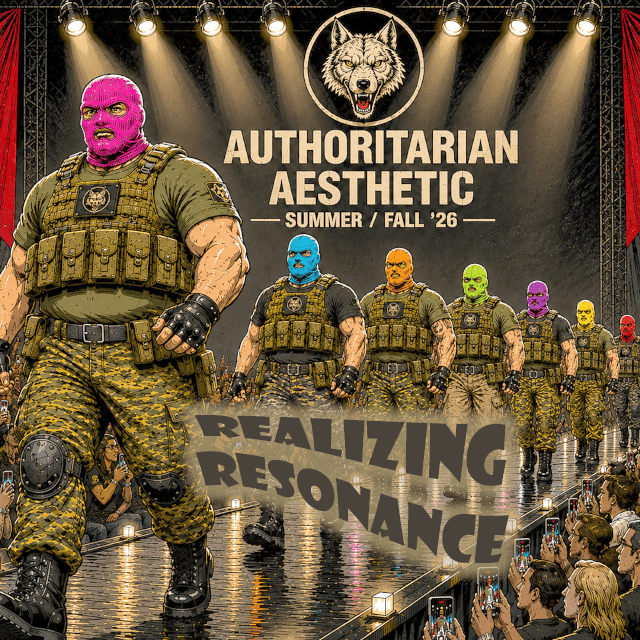
What can AI tells us about these lyrics?
Authoritarian Aesthetic
By Realizing ResonanceVerse 1:
Glow ‘em up ammo camo
Flack jacket feel so retro
Slay that balaclava
Style’s hot as lava
Sporting no hope couture
The fragrance is Insecure
Jackboots on the feet
Wardrobe is completeChorus:
Authoritarian aesthetic
On trend to look patheticVerse 2:
Glamourous Gestapo chic
Minimalist militia on fleek
Bearing arms paint dots
Proud of those headshots
Accessorize with stun grenades
Riot shields and dark shades
Fashion for the hard
Fascist avant-gardeChorus:
Authoritarian aesthetic
On trend to look patheticBridge:
How do you like the look?
Is the vest too tight?
How do you like the look?
Inspires fright, right?
How do you like the look?
Is the vest too tight?
How do you like the look?
Inspires fright, right?Chorus:
Authoritarian aesthetic
On trend to look pathetic
AI Lyric Analysis
These lyrics are a satirical takedown of the way authoritarianism (especially its militarized, police-state imagery) can be packaged as “cool” fashion and lifestyle branding. The song is about the aestheticization of violence and domination—how gear associated with repression gets turned into a look, and how that look is used to project power, intimidate, and recruit.
Core idea: fascism as “style”
The repeated phrase “Authoritarian aesthetic / On trend to look pathetic” is the thesis. It argues that presenting authoritarian politics as an edgy, stylish identity is ultimately hollow and embarrassing—“pathetic”—even if it’s meant to look fearsome.
Verse 1: the wardrobe of intimidation as consumer product
The first verse frames militarized clothing as if it were a runway fit:
- “ammo camo,” “flack jacket,” “balaclava,” “jackboots”: iconic signals of combat/policing/paramilitary presence.
- “retro,” “couture,” “fragrance”: fashion language clashes with coercive gear, making the violence feel like a branded commodity.
- “The fragrance is Insecure”: a psychological read—this obsession with looking tough is driven by insecurity, not strength.
- “Sporting no hope couture”: suggests an ideology that offers no real future, only domination and despair dressed up as identity.
Verse 2: explicit linkage to fascist imagery and “edgy” trend culture
This verse sharpens the critique and makes the reference unmistakable:
- “Glamourous Gestapo chic”: directly calls out Nazi secret police aesthetics being flirted with or stylized.
- “on fleek” and other social-media fashion phrasing: points to how internet culture can turn extremist signals into shareable “content.”
- “Proud of those headshots”: a photographic portrait of someone’s, often a model’s, face, but used here as a double entendre.
- “Accessorize with stun grenades / Riot shields and dark shades”: repression becomes “accessories,” as if brutality is just part of the outfit.
- “Fascist avant-garde”: a jab at presenting authoritarianism as daring, transgressive art—when it’s actually a very old, very conventional form of domination.
Bridge: mocking the desire to be feared
The bridge reads like a mirror held up to the wearer:
- “How do you like the look?” repeats like a narcissistic fit-check.
- “Is the vest too tight?” undercuts menace with pettiness and vanity.
- “Inspires fright, right?” shows the real goal: not respect, not justice—fear as validation.
What the song is “about” in plain terms
- It criticizes people and movements who borrow military/police/fascist aesthetics to seem powerful.
- It argues that this performance is rooted in insecurity and cowardice, despite the attempt to appear strong.
- It warns about how authoritarian ideas can spread when they’re made fashionable, memeable, and “aesthetic.”
Philosophically, it’s close to a critique of “aesthetic politics”: when the image of power replaces moral substance, politics becomes a costume drama—except the props are real weapons and the consequences are real harm.
Written by OpenAI GPT 5.2



 Realizing News
Leave a comment