Introduction
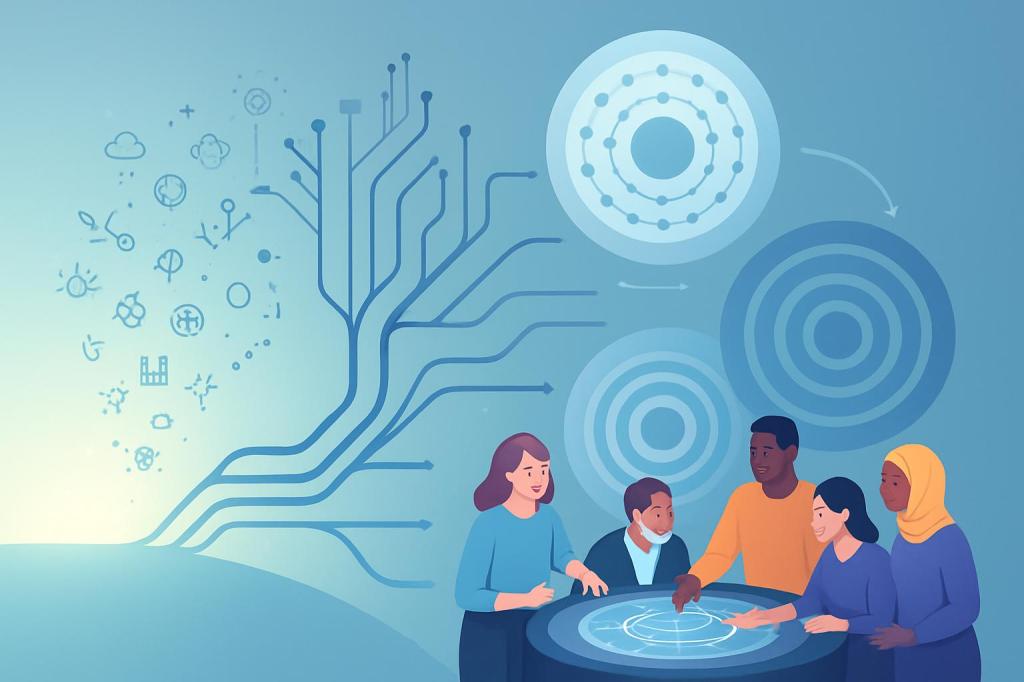
Futurists do not predict a single future; they map structured possibilities. This report explains how that mapping works in practice. It begins by showing how horizon scanning systematically surfaces emerging trends, weak signals, and wild cards, and how these are organized into coherent foresight pathways. It then examines Futures Wheels and Causal Layered Analysis as complementary tools for tracing first‑, second‑, and third‑order consequences and connecting them to deeper systems and narratives. Finally, it explores participatory “wheel‑based” methods, including Backcasting Wheels, that democratize futures work by linking consequences to values, power, and concrete strategic choices.
Futurists approach potential futures as a landscape of multiple plausible trajectories rather than a space to be predicted or forecast as a single outcome. Their work is organized around disciplined ways of detecting change, mapping consequences, and connecting those maps to deep structures, values, and decisions. Across methods and toolkits, several through‑lines stand out: systematic horizon scanning to identify what is changing; structured causal mapping—especially via Futures Wheels—to explore ripple effects; integration with deeper analytic frames such as Causal Layered Analysis (CLA); and participatory, “wheel‑based” designs that link consequences to preferred pathways and issues of equity and power.
Horizon scanning is treated as an anchor practice that widens the aperture beyond conventional forecasts. Rather than extrapolating existing trends alone, it deliberately seeks weak signals, wild cards, and ideas at the fringes of current assumptions [2][3][4][5]. Methodological rigor in scanning comes from clearly defining the focal question, using explicit organizing frames such as STEEPLE/PESTLE (social, technological, economic, environmental, political, legal, ethical), and iteratively prioritizing which signals and drivers matter most for the system of interest [3][5]. This framing turns horizon scanning into a structured, ongoing environmental inquiry that draws on diverse information sources and expert inputs, and is updated as new data emerges [2][3][5]. It is also placed within a broader resilience and risk toolkit that includes forecasting, trend analysis, scenario planning, and stress testing, with an emphasis on triangulating across methods rather than privileging any single one as definitive [5].
In practice, leading toolkits embed horizon scanning in stepwise foresight pathways that connect early‑stage sensing to strategy and policy. A notable example is the UK Futures Toolkit, which sequences tools so that they feed into one another [1][2]. Scanning and structured question frameworks (such as “Seven Questions”) are used to surface emerging changes; driver mapping and the Three Horizons model then differentiate between current dynamics, transitional patterns, and possible longer‑term transformations; scenario tools assemble these drivers into multiple structured futures; and methods such as SWOT analysis and roadmapping translate scenario insights into concrete strategic implications, options, and policy areas to address [1][5]. This end‑to‑end architecture directly addresses the problem of fragmented foresight activities that never cohere into decision‑useful guidance, by making explicit how early signals progress through analysis, synthesis, and application.
Within that broader flow, the Futures Wheel (or Future Wheel) is repeatedly highlighted as a pivotal bridge between signals and systemic consequences. Developed in the early 1970s by Jerome C. Glenn, the Futures Wheel is a structured group brainstorming method that starts with a single change—an event, trend, decision, or emerging technology—placed at the center of a diagram, and then maps first‑order impacts in a surrounding ring, second‑order impacts around those, and third‑ or higher‑order consequences in subsequent concentric circles [1][3][5]. This radial structure supports rapid, visual exploration of causal chains and interdependencies. Guidance from both public‑sector practice and training materials emphasizes pushing at least to a third order and making feedback loops visible—situations where secondary or tertiary impacts reinforce or modify earlier ones, or emerge via multiple causal pathways [1][4][5]. For instance, a cost driver might show up simultaneously as a primary, secondary, and tertiary effect in different branches, highlighting how one structural factor can cascade through multiple domains [1].
Across applications, rich Futures Wheels are framed as tools not for prediction but for surfacing unintended consequences, emergent opportunities, and complex interdependencies. Facilitators are encouraged to prompt participants with questions such as “What is desirable?”, “What is unexpected?”, and “What new links are forming?” to move beyond linear lists of outcomes toward systemic maps where reinforcing mechanisms and cross‑linkages become explicit [3]. This proves particularly useful for exploring technology adoption (such as widespread 3D printing) or contested social and policy shifts (such as the inclusion of intelligent design in curricula), where political, economic, cultural, and ethical ripples are hard to anticipate through linear reasoning alone [2][6][7]. By making assumptions and causal narratives visible, Futures Wheels render them contestable, enabling robust debate and stress‑testing of strategies against a diversity of possible implications.
The integration of Futures Wheels into broader frameworks deepens their analytic and strategic value. In some approaches, Futures Wheels are used as an upstream input to Causal Layered Analysis (CLA), a method that examines futures at four levels: the litany (surface issues), systemic causes, worldviews, and underlying myths and metaphors [2]. Here, the wheel helps populate and organize the upper layers—the observable events and systemic patterns—before practitioners “drill down” into the cultural narratives and deep stories that sustain those patterns. Similarly, several training pipelines present an integrated flow of scanning → Futures Wheel → CLA → scenarios → backcasting, creating a loop from early signals through multi‑layered interpretation to concrete pathways for action [2][5]. This mirrors a broader shift in practice toward turning abstract tools into practical, visual sequences that move from ripple effects (“what happens if this change unfolds?”) to questions of meaning, power, and desirability (“why does this matter, to whom, under which deeper stories about the future?”).
Participatory foresight adds another important dimension by using “wheel‑based” methods to foreground issues of inclusion, values, and governance. When applied in workshops or public‑sector contexts, Futures Wheels are often described as “structured brainstorming” techniques that enable diverse participants to collectively map consequences across multiple timescales [1][2]. Starting from a focal change—such as the mass adoption of autonomous vehicles—participants rapidly generate and visualize first‑, second‑, and third‑order effects, ranging from shifts in urban design and land use, to employment disruptions in driving occupations, to changes in insurance models and public perceptions of safety [1]. Breakout groups can each produce their own wheels, then compare and merge them, revealing where different stakeholder groups emphasize different branches of impact. This makes the politics of the future visible: whose concerns and aspirations appear close to the center of the map, and whose only emerge at the periphery.
Building on this participatory use of radial mapping, the Backcasting Wheel adapts the Futures Wheel structure to work backward from a preferred future rather than outward from a single initiating change [3]. Traditional backcasting often sets a desirable end‑state and then specifies steps to get there, but can be vague about process. The Backcasting Wheel introduces a more explicit participatory design: stakeholders collectively describe the desired future in the center, then identify necessary signposts, obstacles, opportunities, and actions in surrounding rings, effectively creating a radial pathway from the present to that future [3]. Empirical work in organizational and environmental planning using this method suggests that diverse teams often outperform individual experts on complex, long‑term problems, but it also highlights equity concerns: not all participants arrive with the same capacity, confidence, or support to think systemically and long‑term [3]. As a result, participatory foresight requires careful facilitation and capacity‑building to avoid reproducing existing hierarchies under the guise of inclusion.
Across these methods, participatory futures is framed as a democratizing force that expands who gets to imagine and design futures. By drawing on multidisciplinary expertise, inviting a wide range of stakeholders, and using accessible visual tools such as wheels, practitioners seek to embed diverse values and experiences into foresight processes [1][4]. Yet the same tools also act as mirrors: they expose which voices and knowledge systems are recognized as central, whose visions of the future inform the main branches of analysis, and whose remain marginal or unarticulated. For futurists concerned with ethics, equity, and narrative power, wheel‑based methods such as Futures Wheels and Backcasting Wheels therefore function both as analytic devices—to map consequences and design pathways—and as diagnostic instruments—to reveal how power, expertise, and legitimacy are distributed within the collective imagination of the future.
Overall, the contemporary approach to mapping potential futures is less about predicting where we will end up and more about building systematic, transparent processes that: scan widely for emerging changes; use structured causal maps to explore ripple effects; connect those maps to deeper cultural and systemic drivers; and involve diverse stakeholders in co‑creating and contesting futures. Horizon scanning, Futures Wheels, CLA, and participatory backcasting are not isolated techniques but interlocking components within foresight pathways designed to produce resilient, adaptable strategies under deep uncertainty.
Conclusion
Across these sections, a common pattern emerges: futurists do not predict a single outcome; they build structured ways to notice change, trace consequences, and co‑design responses. Horizon scanning widens the aperture to weak signals and wild cards, then connects them through driver mapping, Futures Wheels, and scenarios into decision‑ready insights. Futures Wheels and Causal Layered Analysis reveal cascading impacts and the deeper narratives that stabilize them, while participatory wheel‑based methods extend this mapping into questions of power, justice, and inclusion. Together, these approaches turn uncertainty into a navigable landscape, supporting more resilient and more accountable choices about the futures we shape.
Sources
[1] https://assets.publishing.service.gov.uk/media/66c4493f057d859c0e8fa778/futures-toolkit-edition-2.pdf
[2] https://visualping.io/blog/what-is-horizon-scanning
[3] https://www.futuresplatform.com/blog/how-to-horizon-scanning-guideline
[4] https://allthingsinsights.com/content/category/strategic-foresights/
[5] https://www.theirm.org/media/7423/horizon-scanning_final2-1.pdf
[6] https://canari.org/wp-content/uploads/2021/08/Session4_ForesightScenariosTrainingSeries_GrenadaNEA.pdf
[7] https://www.mcguinnessinstitute.org/wp-content/uploads/2024/11/06-FuturesWheel.pdf
[8] https://www.futuribles.com/wp-content/uploads/2020/01/ToolBox3CLA.pdf?postId=73703
[9] https://www.sessionlab.com/wp-content/uploads/sl-FacilitatingFutures.pdf
[10] http://www.bawiki.com/wiki/Futures-Wheel.html
[11] https://www.scribd.com/document/684036332/2-FTSP-Intermediate-AUG2023
[12] https://en.wikipedia.org/wiki/3D_printing
[13] https://en.wikipedia.org/wiki/Intelligent_design
[14] https://morethandigital.info/en/futurism-tools-and-future-studies-techniques-explained-from-a-futurist/
[15] https://www.fs.usda.gov/nrs/pubs/jrnl/2020/nrs_2020_bengston_001.pdf
[16] https://jfsdigital.org/articles-and-essays/vol-23-no-4-june-2019/a-futures-design-process-model-for-participatory-futures/
Written by the Spirit of ’76 AI Research Assistant



Leave a Reply