Introduction
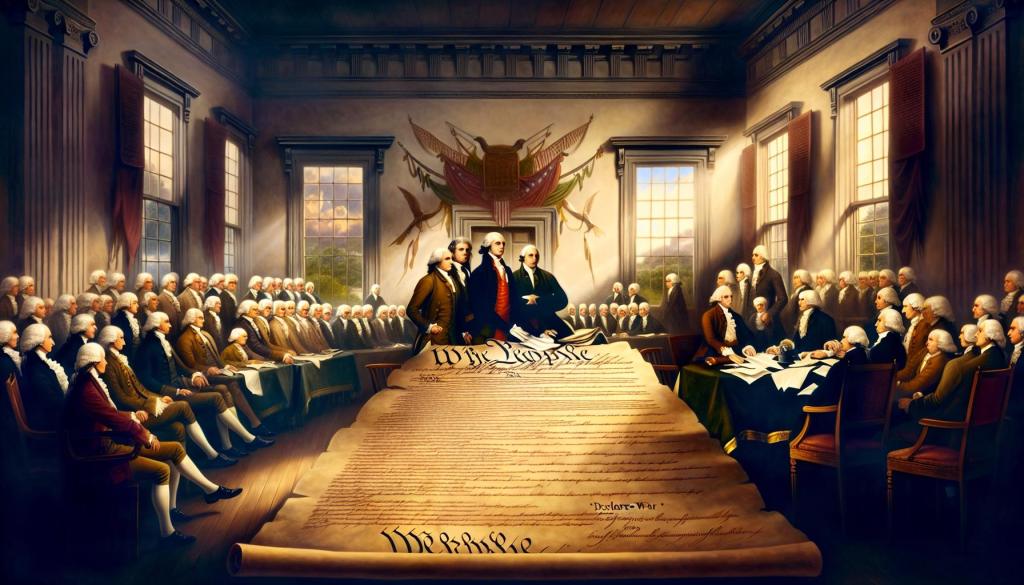
This report explores why the framers located the power to declare war in Congress rather than the President—and why that choice has proved so fragile. It first reconstructs the Philadelphia Convention’s cryptic “make” versus “declare” war compromise, showing how shifting drafts and contested notes produced a layered, not tidy, allocation of war powers. It then examines how that wording was meant to structure incentives and constrain presidential adventurism while preserving executive agility. Finally, it situates the Declare War Clause in a longer arc from monarchic war-making to modern presidencies, tracing how democratic control over war has eroded in practice.
The decision to vest the power to declare war in Congress rather than the President emerged from a contested but ultimately deliberate attempt to reconcile deep anti‑monarchical instincts with the practical need for an energetic executive capable of rapid military response. The framers were reacting against the British royal model, where kings could unilaterally embroil nations in war, and against the perceived weaknesses of the Articles of Confederation, under which a unicameral legislature nearly monopolized war powers yet often proved indecisive and ineffective [1][2][3]. The Constitution’s allocation of war authority reflects this “pendulum” swing: from monarch‑dominated war making, to legislative dominance, to a shared system designed to preserve democratic control over war’s initiation while empowering the President to execute and, in emergencies, to act first.
From early in the Philadelphia Convention, delegates treated war and peace as fundamentally legislative questions. James Wilson explicitly classified them as “of a Legislative nature” and rejected simply copying the British king’s prerogatives [2]. Yet the institutional home and form of that legislative power remained fluid. Different draft plans variously gave the Senate the “sole power of declaring war,” or allowed an executive to make war and peace with senatorial advice and consent [2]. These shifting proposals underscore that there was no single, preordained model; the final settlement was a compromise forged in real time rather than a straightforward translation of prior practice.
The focal point of that compromise was the shift in Article I from giving Congress the power to “make” war to the power to “declare” war. Initially, vesting a “make war” authority in the legislature suggested giving Congress both the decision to initiate hostilities and, potentially, elements of their conduct. Madison and Elbridge Gerry’s motion to substitute “declare” for “make” was defended as a way to preserve the President’s capacity to “repel sudden attacks” while reserving to Congress the choice to commence war in a deliberate, collective fashion [1][2][4]. In this design, the President would have agility for immediate defense, but not the unilateral authority to launch the nation into sustained conflict.
The debate around that change reveals how the framers were building guardrails against presidential adventurism while also defending an effective executive command structure. George Mason insisted that the power over war was “not safely to be trusted” to the President or the Senate alone; he favored “clog rather than facilitat[ing] war,” while making peace easier [3]. Elbridge Gerry reacted with alarm to proposals to vest war power in the President alone, saying he “never expected to hear in a republic a motion to empower the Executive alone to declare war” [3]. Their concern was that a single, ambitious executive might replicate European practices of using war for personal or factional advantage.
At the same time, some delegates worried that the specific wording could unsettle the separation of powers in the opposite direction. Roger Sherman thought “make” better preserved a structure in which the President could repel but not commence war, and feared that “declare” might “narrow[] the power too much” or be misread [2][3]. Rufus King warned that “make” war might be construed to encompass the “conduct” of war, which he regarded as an executive function; narrowing Congress’s role to “declare” war was, from his perspective, a way to avoid legislative micromanagement of military operations [1]. In this view, the final text was not merely a constraint on presidential initiative; it was also a shield for robust executive control over strategy and tactics once hostilities, duly authorized, began.
The Convention’s records on this episode are themselves somewhat opaque. Madison’s notes and the official Journal diverge on aspects of the voting sequence, though both agree that the substitution of “declare” for “make” ultimately passed [4]. Scholars differ over which account is more reliable; some, like John Yoo, treat Madison’s notes as superior and also argue that drafting‑stage choices at Philadelphia should be subordinated, as interpretive evidence, to understandings expressed at the state ratifying conventions [1][4][5]. This methodological dispute matters because it casts doubt on efforts to extract a singular, authoritative “intent” from the word change alone and pushes attention instead toward how the broader public and ratifiers understood the war powers settlement.
The ratification debates and early commentary show a system intended to be congressional in orientation but not as one‑sided as modern “Congress‑only” readings sometimes suggest. Under the Articles of Confederation, Congress already possessed the “power of determining on peace and war,” so many Anti‑Federalist worries focused less on the Declare War Clause itself and more on related questions: standing armies, the size and funding of forces, and the risk that federal military powers would underwrite executive overreach [2]. In Virginia’s ratifying convention, Madison emphasized Congress’s control over funding and the structure of the military—appropriations, army size, navy creation—rather than presenting the Declare War Clause as the sole or primary brake on presidential power [1]. This indicates an expectation that political and financial checks, as much as textual ones, would restrain executive war making.
At the same time, ratification‑era debates reveal how seriously Americans took the democratic stakes of going to war. Proposals for supermajority requirements to declare war reflected a belief that even Congress, though more representative than the President, might be too prone to corruption, faction, or haste to be trusted with war decisions absent extraordinary consensus [2]. The underlying concern was consistent: decisions over “life, death, and taxation” should not rest in a single pair of hands but should be the product of broad, transparent deliberation by the people’s representatives. Early constitutional commentators echoed this, interpreting the Declare War Clause to mean that Congress would “declare war by word or action” and treating it as a core restriction on unilateral executive war initiation, rooted in fears of “needless conflicts” stirred up by ambitious leaders [3].
The resulting constitutional architecture can be understood as a layered compromise. First, war and peace were treated as fundamentally legislative in character, a rejection of royal prerogative and a commitment to republican accountability. Second, Congress’s role was framed broadly: formal declarations of war, authorizations that “by word or action” place the nation in a state of hostilities, and control over the purse and military structure all served as levers to initiate, shape, and sustain war. Third, the President was given substantial operational authority as Commander in Chief and a recognized capacity to act unilaterally to repel sudden attacks, reflecting both the need for speed in crises and the framers’ belief in a “strong, action‑oriented executive” [3]. Finally, the system relied heavily on ongoing political struggle—appropriations battles, elections, and public opinion—to police the boundaries between these roles rather than on a single, rigid textual rule about who may “start” war.
Over time, especially in the post‑World War II era, practice has drifted from this intended equilibrium. Presidents have increasingly claimed broad unilateral authority to use force without formal declarations of war, as seen in Korea, Vietnam, and later conflicts, often relying on expansive readings of commander‑in‑chief powers or open‑ended statutory authorizations [4][6]. This trend has shifted the effective locus of war initiation toward the executive, eroding the friction the framers sought to build into the decision to wage war. Congress’s response in the War Powers Resolution of 1973—48‑hour reporting, a 60‑day clock absent express authorization, and a statutory framework emphasizing the “collective judgment” of both branches—was an explicit attempt to restore something closer to the founding balance [4][5]. Legislative reports at the time warned that the constitutional “balance” of war powers had “swung heavily to the President,” echoing the earlier “pendulum” narrative and self‑consciously invoking the framers’ goal of shared responsibility for war [5].
In this light, giving Congress the power to declare war was not a narrow drafting choice about a specific procedural step. It was the core mechanism through which the founding generation sought to embed democratic consent and institutional friction into the act of crossing from peace to war, to prevent a single executive—however energetic or well‑intentioned—from dragging the nation into conflict without the deliberation and authorization of its representatives. The President was designed to be fast, unitary, and capable of repelling sudden attacks; Congress was designed to be slow, plural, and accountable, precisely so that the gravest decision a republic can make would not be made lightly, secretly, or alone.
Conclusion
The founders’ choice to lodge the power to declare war in Congress emerged from a contested, incremental effort to balance energy in the executive with democratic control over war’s gravest decisions. The Philadelphia debates over “make” versus “declare” war, later ratification struggles, and early commentary reveal not a neat textual formula, but a layered compromise: Congress would control the formal initiation and funding of war, while the President retained agility to repel sudden attacks and conduct hostilities. Modern drift toward unilateral presidential action reflects less an original license than an erosion of the deliberate guardrails the framers designed to restrain executive adventurism.
Sources
[1] John C. Yoo, The Continuation of Politics by Other Means: The Original Understanding of War Powers, 84 Cal. L. Rev. 167 (1996), https://www.law.berkeley.edu/files/yoowarpowers.pdf
[2] Early Debates on War Powers in the Constitutional Convention, Constitution Annotated, https://www.law.cornell.edu/constitution-conan/article-1/section-8/clause-1/early-debates-on-war-powers-in-the-constitutional-convention
[3] Christopher J. Deering, The Founders’ Declaration of War, Georgetown Journal of Law & Public Policy (2023), https://www.law.georgetown.edu/public-policy-journal/wp-content/uploads/sites/23/2023/06/GT-GLPP230012.pdf
[4] “Make” War and “Declare” War at the Constitutional Convention, Constitution Annotated, https://www.law.cornell.edu/constitution-conan/article-1/section-8/clause-1/make-war-and-declare-war-at-the-constitutional-convention
[5] EveryCRSReport, The Constitution and the War Powers Resolution, https://www.everycrsreport.com/reports/LSB11231.html
[6] National Constitution Center, Article I, Section 8, Clauses 11–16: War and Military Powers, https://constitutioncenter.org/the-constitution/articles/article-i/clauses/753
[7] Oona A. Hathaway & Scott J. Shapiro, The Power to Threaten War, Yale Law Journal, https://yalelawjournal.org/article/the-power-to-threaten-war
[8] Memorandum for the President, War Powers Resolution, Gerald R. Ford Presidential Library, https://www.fordlibrarymuseum.gov/library/document/0019/4520942.pdf
[9] National Constitution Center, The Gulf of Tonkin and the Limits of Presidential Power, https://constitutioncenter.org/blog/the-gulf-of-tonkin-and-the-limits-of-presidential-power
[10] Debates in the Federal Convention of 1787, Avalon Project, Yale Law School, https://avalon.law.yale.edu/18th_century/debates_817.asp
[11] Diala Shamas & others, War Powers and the Return of Major Power Conflict, https://warpowers.lawandsecurity.org/findingsandanalysis/
[12] Aziz Z. Huq, War Powers and the Return of Major Power Conflict, University of Chicago Legal Forum, https://legal-forum.uchicago.edu/print-archive/war-powers-and-return-major-power-conflic
Written by the Spirit of ’76 AI Research Assistant



 Realizing News
Leave a comment