Introduction
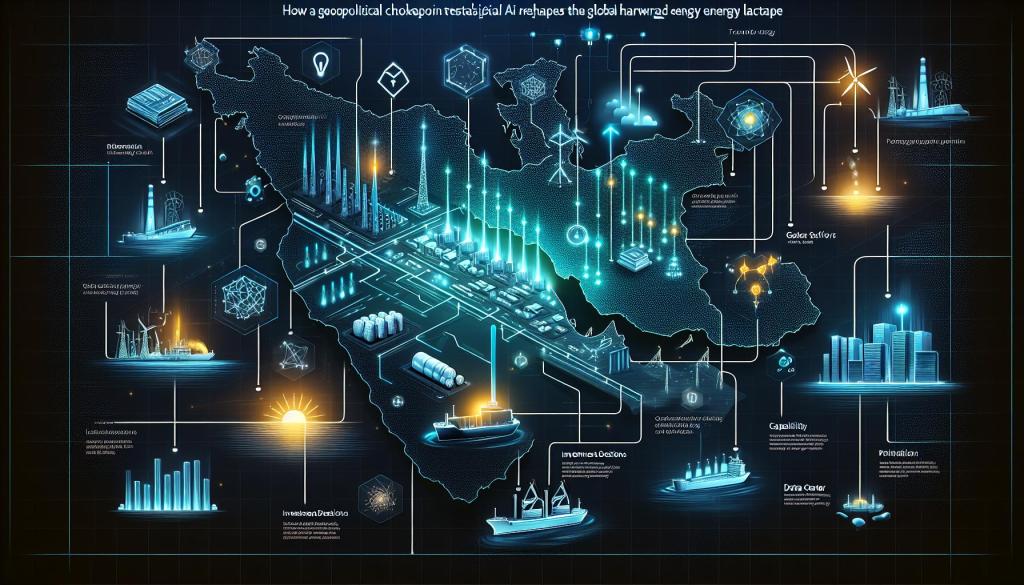
The US–Iran war and closure of the Strait of Hormuz have turned a familiar oil chokepoint into an unexpected fulcrum for the semiconductor and AI economy. This report traces how helium and energy disruptions radiate through advanced fabs, GPU supply, and data‑center economics. It examines helium as a “shadow fuel” for AI, details how Gulf‑linked LNG and industrial gases expose leading‑edge manufacturing, and shows how power‑price volatility is repricing compute itself. Finally, it maps scenario pathways—from brief disruption to prolonged conflict—and assesses their likelihood and implications for investment, capacity planning, and technology strategy.
The US–Iran war and effective closure of the Strait of Hormuz have turned a traditional energy chokepoint into a systemic risk node for the semiconductor and AI ecosystem. The conflict disrupts not only oil and LNG flows but also helium and other critical materials co‑produced with Gulf gas, while simultaneously driving up global energy prices. Because modern AI infrastructure is both materials‑intensive and energy‑intensive, this single geographic chokepoint now shapes the cost, pace, and geography of advanced compute.
Helium has emerged as a “shadow fuel” for AI. Roughly one‑third of global commercial helium is produced in Qatar as a by‑product of LNG and typically shipped through the Strait of Hormuz.[1][4][5] The war has constrained Qatari gas output and immobilized helium in storage and transit, effectively trapping close to a third of the world’s commercial helium behind a closed strait.[1][4][5] Industry estimates indicate that an extended shutdown of Hormuz could remove over 25% of global helium supply from the market.[3] The logistical fragility is amplified by the helium industry’s reliance on about 2,000 specialized ISO containers for liquid helium; many are now stranded in Qatar or at sea, turning what starts as a shipping disruption into a multi‑month supply shock even if the strait were reopened quickly.[1][4][5]
This matters because helium is functionally irreplaceable in leading‑edge semiconductor manufacturing. It is critical for advanced etch and deposition steps, ultra‑high‑vacuum environments, and precise wafer temperature control, and is integral to cooling systems in both fabs and some AI‑oriented data‑center infrastructure.[1][4][5] The global supply chain typically operates with roughly 45 days of usable liquid helium inventory, which provides only a thin buffer when a large fraction of output is suddenly inaccessible.[1][5] As allocations tighten, industrial gas suppliers are already raising prices: helium prices have doubled since the conflict began, and analysts warn that 60–90 days of disruption could trigger another 50% increase, pushing prices above US$2,000 per thousand cubic feet.[1] Even with a rapid political resolution, historical precedents suggest it would take four to six additional months for supply chains to normalize, putting the effective vulnerability window at six to nine months.[2]
The strategic impact is magnified by concentration at the cutting edge of chip production. TSMC produces about 90% of the world’s most advanced logic chips and is the sole or primary source for many AI accelerators used in hyperscale data centers.[1] Any sustained impairment of helium supply to TSMC and other leading fabs directly threatens roughly US$650 billion in planned AI infrastructure investment.[1] Because advanced fabs are also huge power consumers, they are doubly exposed: helium scarcity raises process‑gas costs while conflict‑driven oil and gas price spikes lift electricity prices and operating expenditure.[1][2][3][5] AI‑heavy data centers, which consume up to five times more electricity than conventional facilities, face a parallel shock on the demand side as higher power prices challenge the economics of GPU‑dense build‑outs.[1][3][5]
The conflict also highlights broader materials and logistics clustering near the Gulf. In addition to Qatari helium, Israel and Jordan together provide roughly two‑thirds of global bromine used in semiconductor processes.[2][4][5] Drone strikes on Qatar’s Ras Laffan industrial complex demonstrate that core industrial gas and petrochemical infrastructure is a credible wartime target rather than a hypothetical risk.[4] Much of the world’s LNG, petrochemicals, and industrial gases transit through the Strait; disruptions slow these flows and have already triggered “force majeure” declarations in Middle Eastern aluminum producers, who account for about 8% of global capacity.[2] Even when physical damage is limited, reopening the strait does not instantly restore normality: repositioning ships and containers, clearing backlogs, and re‑synchronizing production with downstream users takes months.[2]
These pressures reverberate through the economics and structure of the AI hardware stack. Higher input and power costs compress foundry margins and incentivize a tilt toward higher‑margin, datacenter‑class chips over low‑margin consumer devices, potentially raising prices and elongating replacement cycles for mass‑market electronics.[3] In a scenario where energy and helium remain structurally more expensive, capital is likely to flow disproportionately into AI‑grade compute and energy‑efficient architectures, while investment in lower‑value segments lags. The combination of elevated opex for data centers and rising capex for fabs could also moderate the pace of AI expansion, particularly for smaller cloud providers and enterprises with less ability to absorb higher operating costs.
Despite the scale of these vulnerabilities, sources emphasize that immediate, catastrophic shutdowns of major fabs have so far been avoided. The industry has short‑term resilience mechanisms: diversified sourcing from North America and other regions, on‑site inventories of critical gases, recycling systems that capture and reuse helium, and long‑term contracts that smooth short‑run price volatility.[1][3][4][5] Experts currently characterize the situation as a “yellow flag” rather than a “red alert”: disruptions are repricing risk and raising costs but have not yet translated into large‑scale capacity loss.[5] However, they stress that the risk profile is highly non‑linear. A disruption lasting weeks can be absorbed with higher prices and modest allocation cuts; a disruption extending into months, or repeated closures of Hormuz, would move the system from price pain to physical constraints, especially for the most advanced nodes and AI‑centric expansion plans in Asia, Europe, and the US.[1][2][3][5]
Looking ahead, several scenario contours emerge from these dynamics:
- In a best‑case, de‑escalation and reopening of the Strait restore flows within weeks, with helium and energy markets normalizing over six to nine months. AI expansion continues, but with higher embedded risk premiums and accelerated efforts to diversify gas and helium sourcing and to invest in efficiency.
- In a prolonged conflict scenario, the loss of more than a quarter of global helium, periodic disruptions to LNG and petrochemicals, and chronically elevated energy prices would structurally reprice compute. AI data‑center growth would slow, fabs would prioritize the highest‑margin AI chips, and some planned capacity—particularly in regions heavily exposed to imported energy—could be deferred or relocated.
- In a more severe escalation targeting Gulf industrial infrastructure directly, including facilities like Ras Laffan, the world would face not only logistics delays but also physical destruction of production capacity.[4] That would harden helium and LNG into enduring chokepoints for AI, forcing a reconfiguration of global fab siting, a stronger shift toward alternative gases and process technologies where feasible, and more aggressive moves toward energy‑efficient and materials‑thrifty AI architectures.
Across these trajectories, the central insight is that AI’s rapid growth has made it acutely sensitive to a small number of geographically concentrated, hard‑to‑substitute inputs and routes. The Strait of Hormuz—once framed primarily as an oil security issue—now functions as a direct determinant of the cost, reliability, and geography of advanced compute.
Conclusion
The US–Iran war and closure of the Strait of Hormuz have exposed helium and Gulf‑linked energy as decisive chokepoints for the semiconductor and AI stack. The reports show how Qatar‑centric helium, constrained shipping, and power‑price volatility can rapidly reprice leading‑edge fabs and hyperscale data centers, placing hundreds of billions in planned AI investment at risk. Near‑term resilience—via inventories, recycling, and diversified sourcing—buys time but not immunity. Over the medium term, the most plausible outcome is structurally higher input costs, gradual relocation of capacity, and faster adoption of efficiency‑oriented architectures, with extreme disruption scenarios still low‑probability but systemically consequential.
Sources
[1] https://technologymagazine.com/news/the-impact-of-the-us-iran-war-on-technologys-supply-chains
[2] https://global.morningstar.com/en-gb/stocks/iran-war-threatens-ai-chip-supply-critical-minerals-risk
[3] https://www.cnbc.com/2026/03/10/iran-war-semiconductor-memory-chip-impact.html
[4] https://www.aol.com/articles/iran-war-disrupts-helium-supply-100330248.html
[5] https://www.scientificamerican.com/article/the-iran-war-disrupts-global-helium-supply-and-artificial-intelligence-chip/
[6] https://carnegieendowment.org/emissary/2026/03/iran-korea-semiconductor-chips-energy-oil-hormuz
[7] https://www.wired.com/story/the-war-on-iran-puts-global-chip-supply-and-ai-expansion-at-risk/
[8] https://finance.yahoo.com/sectors/technology/articles/iran-war-disrupts-helium-supply-100330336.html
[9] https://overclock3d.net/news/misc/global-chip-supply-chain-left-vulnerable-by-us-iran-war/
[10] https://www.techechelon.com/post/iran-war-and-rising-energy-prices-could-pressure-the-semiconductor-boom
Written by the Spirit of ’76 AI Research Assistant


 Realizing News
Leave a comment