Introduction
This report examines Governor John Endecott as both a founding architect of Massachusetts Bay and a warning case in religious intolerance. First, it reconsiders his long career, tracing how his Separatist‑leaning zeal helped forge key institutions—from the Salem church to Harvard—while also hardening into coercive governance. It then analyzes his leadership in the persecution and execution of Quakers, showing how spiritual certainty, wedded to civil power, produced a theocratic regime only halted by royal intervention. Finally, it draws together these episodes to argue that Endecott’s legacy illuminates enduring risks to religious freedom whenever one creed dominates the state.
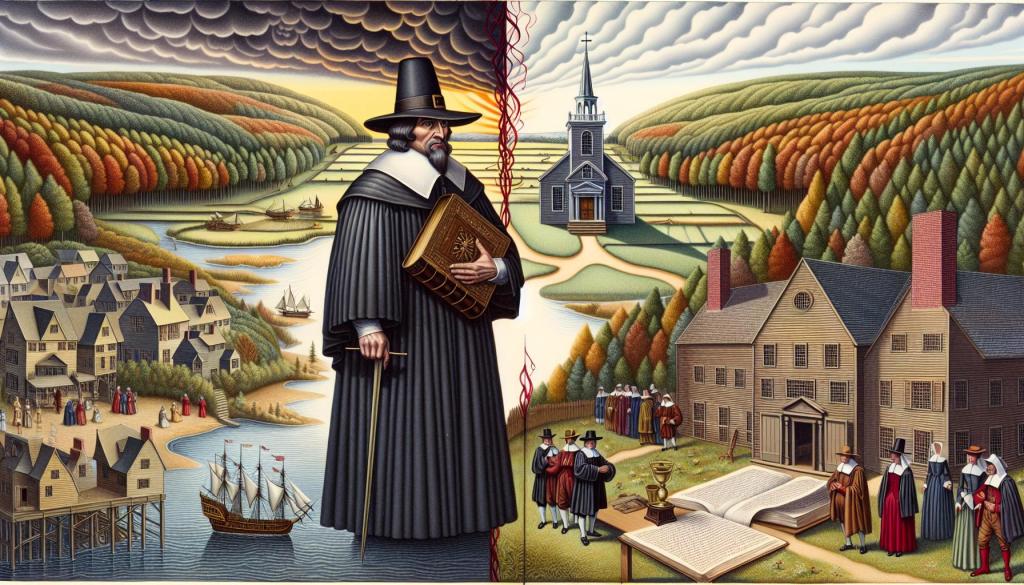
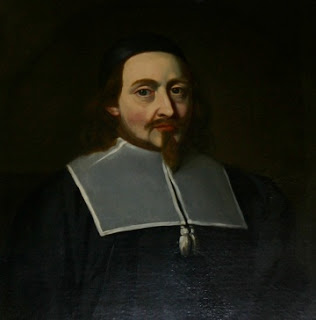
John Endecott was among the earliest and most enduring leaders of Massachusetts Bay, and his life captures both the creative energy and the coercive dangers of the Puritan “godly commonwealth.” Arriving with an advance party at Salem in 1628, he helped stabilize what was then a fragile outpost: supervising land clearing, overseeing local affairs, and shaping a church that stood in deliberate separation from the Church of England, reflecting a stronger Separatist tone than would later prevail in the colony at large [1][3]. This early religious posture partly explains why he initially sheltered Roger Williams, whose more radical Separatism would soon alarm other leaders [1]. From the outset, then, Endecott embodied a tension within Puritanism itself—between the impulse to purify the church from perceived corruption and an emerging consensus about how far separation and dissent could go.
Over nearly four decades, Endecott became one of the primary architects of Massachusetts Bay’s political and institutional life. He served as governor or deputy governor through most of the years between 1628 and his death in 1665, ultimately becoming the colony’s longest‑serving governor [1][2][3][4][5]. He also participated in major projects of elite and clerical formation: he sat on the committee that helped found Harvard College and acted as an overseer at its first commencement, embedding ministerial training and learned leadership at the heart of the colony’s future [3]. These long years of service complicate any simple portrayal of him as only a fanatic: he was a central builder of New England’s civic and educational infrastructure and a key figure in turning a precarious migration into a relatively stable society.
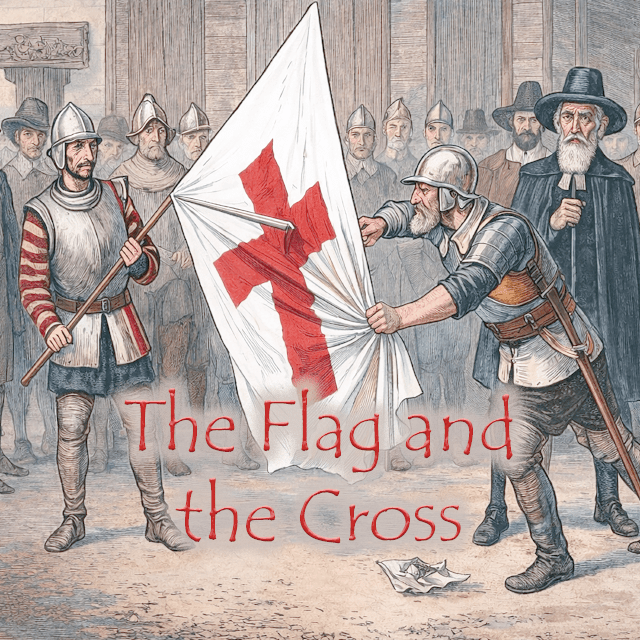
Yet the same religious zeal that fueled institution‑building also drove a program of strict moral regulation and severe repression of dissent. Endecott championed sumptuary and behavioral controls as part of enforcing a “godly” social order: he pressed for modest dress in women, short hair in men, and even veiling for women in church [1]. He supported and enforced banishments against theological dissenters, blurring the line between church discipline and civil punishment. His notorious act of cutting the red cross of St George out of the militia flag—denouncing the emblem as “popish”—became a public symbol of an uncompromising conscience that could defy even the English crown when it seemed to threaten Puritan purity [1]. This defacement was especially provocative because it occurred while the Privy Council was already scrutinizing Massachusetts, forcing Boston leaders to rebuke him in order to protect the colony’s charter [1]. Later writers such as Nathaniel Hawthorne, in “Endicott and the Red Cross,” seized on this moment to portray him as at once the embodiment of harsh religious intolerance and a figure of heroic resistance to external domination [1].
Nowhere is Endecott’s fusion of state power with religious zeal more stark than in his treatment of Quakers. Beginning in 1656, Quakers who arrived in Massachusetts were treated not merely as inconvenient dissenters but as existential threats to the colony’s church–state project, a “cursed sect of heretics … commonly called Quakers” whose presence, authorities feared, might unravel hard‑won religious uniformity [2][3][6]. Under Endecott’s influence, the General Court crafted specific statutes in 1656–57 targeting them: new laws authorized banishment, heavy fines, whipping, mutilation (including cutting off ears and boring tongues), and imprisonment simply for propagating Quaker beliefs or returning after expulsion [2][6]. This legal architecture of persecution was built despite the fact that the original Massachusetts Bay charter did not authorize imprisonment or corporal punishment solely for religious belief [2]. Rather than moderating his approach in light of this gap, Endecott helped to create a legal façade that allowed theological disagreement to be punished as a civil crime.
The enforcement of these statutes shows how quickly fear of doctrinal error slid into cruelty. Quaker arrivals were watched for even at the harbor; passenger lists were marked with “Q’s” to identify suspected believers, and eight Quakers from the ship Speedwell were seized straight off the vessel and hauled before the authorities [2]. When they pointed out that “there was no law that justified their imprisonment,” their clear grasp of both law and conscience only provoked further anger [2]. Quakers were jailed, whipped through multiple towns, branded, and banished “upon pain of death” [1][4]. Ship captains who transported them could themselves be imprisoned as a warning to others [1]. In this climate, Endecott famously warned, “Take heed ye break not our ecclesiastical laws for then ye are sure to stretch by a halter,” in a system where, as contemporary critics observed, it was nearly impossible not to violate some ecclesiastical regulation [1]. The state’s anxiety over maintaining a pure church converted scriptural and legal arguments into grounds for physical punishment.
This persecuting logic escalated from harassment to execution between 1659 and 1661. When Quakers such as William Robinson, Marmaduke Stephenson, and Mary Dyer defied banishment and returned to Massachusetts, Endecott’s court treated their persistence as criminal defiance rather than an appeal of conscience. Contemporary accounts depict him acknowledging that “neither whipping nor cutting off ears, nor banishment upon pain of death will keep ye from among us” and therefore resorting to the gallows [1][3][5]. At one hearing he refused to allow a condemned Quaker even to read a prepared statement, cutting him off with, “You shall not read it!” before pronouncing sentence [1]. Mary Dyer’s repeated returns, knowing they would likely end in death, dramatized the collision between an individual conscience convinced of divine leading and a civil authority determined to enforce religious uniformity at any cost [3][4][5]. In the scaffold speeches of the condemned, who exhorted their persecutors “in love … to take warning before it be too late,” critics saw not only courage but an appeal to a higher law that the colony’s rulers were ignoring [1].
The way this regime finally changed is crucial for understanding Endecott’s career as a cautionary tale about religious freedom. Reform did not come primarily from internal reevaluation or repentance among Massachusetts leaders. Instead, Quakers and their allies in England publicized the persecutions, arguing that “a vein of blood” had been opened in the king’s dominions [2][4][6]. Their lobbying helped convince Charles II to intervene. In 1661–1662, the king ordered Massachusetts to cease executing Quakers and to send accused offenders to England “unharmed” for trial [2][4][6]. Endecott complied with this royal directive, and capital punishment for Quakers ended, though lesser forms of persecution—whipping, fines, and various disabilities—persisted for some time [2][4]. By 1675, however, Quakers could live openly in Massachusetts [4]. The episode thus reveals how a tightly bound church–state regime, convinced of its own godliness, required external pressure from a broader imperial authority to curb its most violent impulses.
Taken as a whole, Endecott’s life underscores a set of linked lessons about religious liberty and political power. A leader profoundly committed to building a pious community can also, when entrusted with nearly unchecked authority, turn that commitment into a machinery of coercion that polices belief, suppresses dissent, and sanctions physical cruelty. Massachusetts’s founders fled England in part to secure freedom for their own worship, yet under Endecott’s guidance they constructed laws that denied that same freedom to religious minorities. The legal creativity used to justify punishing Quakers shows how easy it can be for a regime to bend its own constitutional limits in the name of defending truth. The execution of conscientious objectors like Mary Dyer illustrates how a state that claims to protect godliness can end up undermining the moral credibility of the very faith it seeks to uphold.
Endecott’s trajectory—church founder and colony builder; flag‑defacer and symbol of anti‑Anglican defiance; then chief persecutor of Quakers whose policies had to be checked by royal command—offers a vivid warning about merging spiritual and civil authority. When one theological vision controls the full apparatus of law and punishment, liberty of conscience narrows, violence against minorities becomes thinkable, and self‑correction from within grows unlikely. His story, preserved in both historical records and literary reinterpretations, remains a pointed reminder that religious freedom depends not only on sincere belief but on structural limits to the reach of any one faith through the state.
Conclusion
John Endecott’s life encapsulates both the creative and destructive possibilities of religious zeal when joined to civil power. As a founding governor, he helped stabilize Massachusetts Bay, shape its churches, and embed education and clerical training at Harvard. Yet the same convictions drove him to police belief, enforce intrusive moral codes, and authorize escalating violence against dissenters, culminating in the Quaker executions halted only by royal intervention. Across these episodes, Endecott emerges less as an outlier than as a warning: whenever one “godly” vision commands the state, conscience shrinks, cruelty becomes plausible, and the very faith being defended risks moral ruin.
Sources
[1] https://en.wikipedia.org/wiki/John_Endecott
[2] https://www.britannica.com/biography/John-Endecott
[3] https://collections.americanantiquarian.org/portraits/bios/42.pdf
[4] https://newenglandhistoricalsociety.com/shattuck-and-the-devil-try-to-stop-quaker-persecution-in-new-england/
[5] https://mises.org/mises-daily/first-execution-religion-american-soil
[6] https://digitalarchives.sec.state.ma.us/quakers/
[7] https://famous-trials.com/dyer/2495-an-account-of-quaker-sufferings-in-new-england-by-edward-burrough
[8] https://nvdatabase.swarthmore.edu/content/quakers-fight-religious-freedom-puritan-massachusetts-1656-1661
[9] https://minerdescent.com/2011/12/05/puritans-v-quakers-martyrs/
Written by the Spirit of ’76 AI Research Assistant

 Realizing News
Leave a comment