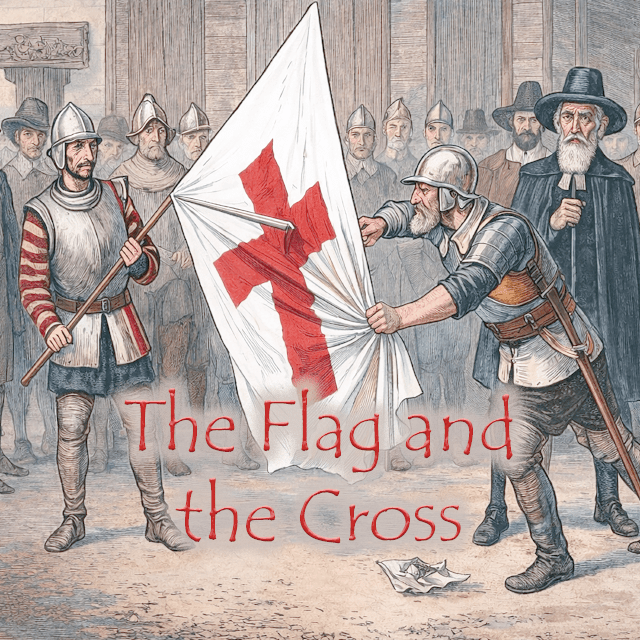
Today we count down the top 10 songs on the The Flag and the Cross Playlist.
10. “For the Greater Good of God” by Iron Maiden: From the album A Matter of Life and Death, this epic track critiques religiously‑justified warfare and the manipulation of faith by political powers. The lyrics question how violence, terror, and suffering can be committed “for the greater good of God,” highlighting the hypocrisy when institutions claim divine sanction for war and oppression.
9. “Hang Me Up” by War Babies: A hard rock track that rails against hypocrisy and moral posturing, “Hang Me Up” uses religious imagery to criticize those who wield faith as a weapon of control. The lyrics suggest a world where institutions and leaders cloak power plays in spirituality, leaving individuals feeling betrayed and spiritually manipulated.
8. “Canons of Christianity” by Phil Ochs: A biting folk protest song that criticizes how Christian institutions justify war, inequality, and hypocrisy. Ochs contrasts Christian teachings of love and peace with real-world practices like nationalism, militarism, and class prejudice, arguing that “canons” (church rules) and “cannons” (weapons of war) end up working together in politics.
7. “Mercy” by Lillian Axe: A melodic hard‑rock/metal track that wrestles with guilt, redemption, and the plea for divine forgiveness. The lyrics mix personal anguish with religious imagery—sin, judgment, and the hope of mercy—suggesting a struggle between human failure and spiritual salvation. While not overtly partisan, it implicitly critiques hypocrisy and moral decay, blurring the line between personal spirituality and the failings of society.
6. “Take Me to Church” by Hozier: Uses religious imagery to criticize institutional religion’s stance on sexuality, especially LGBTQ+ identities. By casting romantic love as a kind of “church,” Hozier contrasts intimate, human love with dogmatic systems that shame and marginalize, implicitly engaging with how religious doctrine shapes laws and social policy.
5. “American Jesus” by Bad Religion: A punk critique of American civil religion—the idea that the U.S. is specially chosen or protected by God. The song ridicules how political rhetoric merges Christian imagery with national identity, suggesting a self‑righteous, imperial mindset. It calls out the way religion is used to justify American exceptionalism and policy at home and abroad.
4. “Church and State” by Brandi Carlile: A contemporary, roots-influenced song examining the blurring of lines between religious conviction and governmental authority. Carlile reflects on how faith is often politicized, especially in debates around civil rights, bodily autonomy, and who is considered a “true” American, questioning whether religious morality should dictate public policy.
3. “Losing My Religion” by R.E.M.: Despite the title, it’s not literally about abandoning a religion; the Southern U.S. expression “losing my religion” means losing one’s temper or composure. Still, the song has become an anthem for people questioning faith and religious expectations. It uses religious language (religion, confession, “I thought that I heard you laughing”) to frame a crisis of belief, powerlessness, and longing—about both God and human relationships.
2. “God” by John Lennon: Lennon deconstructs religious and political “idols” by listing what he does not believe in—explicitly including God, Jesus, and also political/cultural figures like kings and even The Beatles. It critiques how people invest religious-style faith in both spiritual and political authorities, ending with the assertion that belief should be placed in people, not institutions.
1. “God Only Knows” by The Beach Boys: Often read primarily as a love song, it’s built around a quasi‑religious framing of devotion—the title invokes God, and the lyrics treat love as an ultimate, almost sacred mystery: “God only knows what I’d be without you.” Rather than organized religion or explicit politics, it leans into a spiritual tone, hinting at faith in something larger than the self, which has made it significant in cultural and even religious contexts.



 Realizing News
Leave a comment