Introduction
This report explores what Deism was in the Enlightenment era and how it reshaped belief in a rational creator distinct from traditional Christianity or atheism. It examines the intellectual roots of Deism, then turns to the Founders’ own writings to test culture‑war claims that they were either devoutly orthodox or uniformly Deist—or even atheist. By tracing figures from Thomas Paine and Ethan Allen to Washington, Adams, Jefferson, and Franklin, it maps a spectrum from orthodox Protestantism through “Christian Deism” to open unbelief, and shows how this spectrum helped forge an enduring American civil religion grounded in “Nature’s God.”
Deism in the 17th and 18th centuries developed as an effort to ground religion in “nature” and reason rather than in church tradition and supernatural revelation. English figures such as Herbert of Cherbury articulated a “religion of nature” that affirmed a creator God knowable through observation of the world and human reason, while typically rejecting miracles, the Trinity, and the full authority of Scripture as divine revelation [1][5][6]. Deists tended to see God as rational and morally concerned, with a universe ordered by discoverable natural laws; however, the later caricature of a purely “watchmaker” God who creates and then withdraws almost entirely is largely a 19th–20th‑century construct, not a precise description of most 18th‑century Deists [5]. Their positions overlapped significantly with liberal Protestantism and early Unitarianism.
This Deist turn was part of a wider Enlightenment context that emphasized reason, empirical science, natural rights, and critiques of inherited authority—political and ecclesiastical alike [4][8]. Thinkers shaped by the Scientific Revolution and the philosophy of Locke and Newton argued that religious claims must submit to rational examination and that moral truths can be known by all rational beings, regardless of particular revelations. Jefferson’s statement that one should “call to [reason’s] tribunal every fact, every opinion” epitomizes this attitude and informed his own approach to religion and politics [6]. Within this milieu, responses ranged from efforts to rationalize Christianity, to Deism, to more radical skepticism and atheism, though outright atheism remained socially marginal.
Applied to the American founders, this landscape produces a spectrum rather than clean categories of “Christian” versus “Deist.” Older polemical narratives framed the founders either as uniformly orthodox Christians who created a Christian nation, or as straightforward Deists who founded a secular republic and rejected Christianity wholesale [1][2]. Contemporary scholarship challenges both myths. It notes, first, that explicit, self‑described Deists were a minority among political leaders, even if they were influential, and second, that many churchgoing founders nonetheless held beliefs that departed significantly from traditional Trinitarian orthodoxy [1][2][3][5].
A frequently cited assessment suggests that only a small number of prominent revolutionary figures—Thomas Paine, Ethan Allen, Philip Freneau, and perhaps Stephen Hopkins—fit comfortably into non‑Christian Deism in the stricter sense [2]. Paine’s The Age of Reason is a clear example of militant Deism: he affirmed a creator discernible through nature while denouncing organized Christianity and revelation as corrupt or irrational [2]. Ethan Allen likewise rejected revealed religion and embraced a rational “religion of nature.” Others may fall near this non‑Christian Deist pole: some accounts place James Monroe in this vicinity, though the evidence is thinner [3].
More commonly, leading founders occupied intermediate positions that blend elements of Deism with heterodox Christianity. One influential synthesis divides them into three broad groups: (1) non‑Christian Deists (e.g., Allen, Paine, possibly Monroe); (2) “Christian Deists,” such as George Washington, John Adams, and, with reservations, Thomas Jefferson; and (3) founders who remained close to orthodox Protestant belief, like Samuel Adams and John Jay [3]. “Christian Deists” typically believed in a providential God, valued the moral teachings of Jesus, and often maintained church membership and participation, yet doubted or rejected doctrines such as Christ’s full divinity, the Trinity, or inerrant revelation.
Washington illustrates the classification problem. Some interpreters emphasize his regular church attendance, service as a vestryman, and his frequent references to Providence and the public benefits of religion, suggesting he is best seen as a liberal or latitudinarian Christian rather than a Deist [1]. Others stress his near silence on Jesus in personal and public writings and the abstract, non‑confessional way he spoke of God as “Providence,” “the Almighty,” or the “Great Author” of the universe, reading this as indicative of doubts about specifically Christian dogmas—a reticence “assuredly shared” by Franklin, Jefferson, Adams, and possibly Madison and Mason [2]. The invocation of a general providential deity is thus compatible with both softened Protestantism and Deist‑inflected belief, making rigid labeling hazardous.
Benjamin Franklin’s trajectory underscores this ambiguity. As a young man he read and adopted many Deist ideas, including skepticism toward miracles and revelation. Yet he never fully embraced a fully non‑interventionist, impersonal deity. He rejected the divinity of Christ but affirmed a God active in history who rewards virtue and punishes vice, and he repeatedly urged religious tolerance and practical morality over sectarian dispute [1][2][5][6]. On standard definitions he is Deist or heavily Deist‑influenced, but not a textbook exemplar of the “withdrawn watchmaker” God.
Thomas Jefferson is perhaps the clearest case of a major founder whose thought moved in and around Deist territory. As a younger man he was strongly attracted to English Deist writers and their critique of revelation [1][2][5]. Over time, he appears to have gravitated toward a form of Unitarianism influenced by Joseph Priestley—rejecting the Trinity, miracles, and Christ’s full divinity, while upholding belief in a rational creator and in the ethical teachings of Jesus [1][2]. In his private letters he denied the authority of orthodox creeds and insisted that genuine religion is moral philosophy clothed in simple, rational truths. His compilation of the so‑called Jefferson Bible, which excised miracles and supernatural elements from the Gospels while preserving Jesus’ sayings, displays this synthesis: Deist or Unitarian metaphysics joined to an admiration for Jesus as moral teacher [2][5].
John Adams is another example of heterodox religiosity. A lifelong churchgoer and self‑conscious Christian, he nevertheless rejected Calvinist doctrines such as predestination and expressed doubts about the Trinity and traditional Christology, moving toward a rationalist, Unitarian‑leaning faith that many scholars describe as “Christian Deism” [2][3]. James Madison and others were also influenced by Enlightenment rationalism and natural rights theory, but their personal theological views are harder to pin down due to limited explicit commentary; Madison in particular is associated more with constitutional arguments for religious liberty and church–state separation than with pronounced doctrinal statements [4][7].
At the opposite end of the spectrum, figures like Samuel Adams and John Jay remained much closer to orthodox Protestantism, affirming traditional doctrines and seeing public virtue in explicitly Christian terms [3]. Most signers of the Declaration and many delegates to the Continental and Confederation Congresses appear, from their church memberships and devotional practices, to have been relatively conventional Protestants. Yet even they often shared Enlightenment commitments to religious toleration and to grounding civil authority in the consent of the governed rather than in any specific church [1][7].
These overlapping positions shaped the religious language of the founding documents and the emerging American “civil religion.” The Declaration of Independence famously appeals to the “Laws of Nature and of Nature’s God,” speaks of men as “endowed by their Creator” with unalienable rights, and refers to “divine Providence,” while avoiding explicitly Christian terminology such as “God the Father” or “Jesus Christ” and omitting biblical proof‑texts [1][3]. This phrasing reflects the influence of natural theology and Deist vocabulary, framing rights as universal features of human nature discernible by reason and grounded in creation rather than in any particular revelation or denomination. At the same time, theistic references reassured a predominantly Christian populace that the revolution was morally anchored.
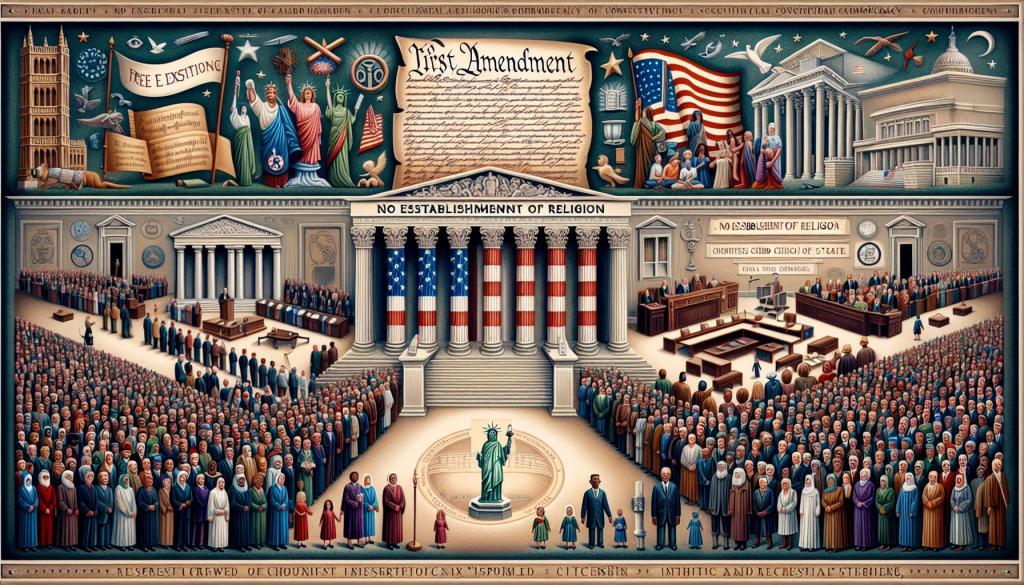
In this way, Deism and related rational theologies provided a kind of conceptual middle ground for public discourse: a God accessible to reason (“Nature’s God”), a moral order embedded in creation, and a basis for natural rights and religious liberty that did not depend on any single church’s dogma [1][5][7]. This framework helped justify disestablishment and the First Amendment’s guarantees of free exercise and non‑establishment, even as most citizens and leaders remained personally Christian. The resulting “civil religion” blends Enlightenment Deism, natural law, and Protestant moral language into a shared, relatively non‑sectarian vocabulary for speaking about God, virtue, and the republic [2][3][5].
Historians increasingly emphasize that many founders concealed or softened their heterodox views in public to avoid social and political costs, and that their beliefs could evolve significantly across their lifetimes [3][5]. Deist, Unitarian, and liberal Protestant currents often “dovetailed” in ways that make retrospective categorization difficult. Some founders began as more conventional Christians and moved toward rationalist or Unitarian views; others absorbed Deist critiques yet retained strong attachments to Christian ethics and community. Consequently, simplistic claims that “the founders were Deists” or that “the United States was founded as a Christian nation” both distort the historical record. A more accurate picture sees a spectrum running from robust orthodoxy through various forms of Christian Deism and Unitarianism to outspoken non‑Christian Deism, all operating within an Enlightenment culture that privileged reason, natural law, and religious freedom.
Conclusion
Across these sections, Deism emerges not as a rigid “watchmaker” creed opposed to Christianity, but as a family of rational theisms shaped by the Enlightenment. When we apply this lens to the American founding, the old binaries—Christian nation vs. Deist republic, piety vs. atheism—collapse into a spectrum. Figures like Paine and Ethan Allen fit non‑Christian Deism; others, including Washington, Adams, Jefferson, and Franklin, blended church affiliation with heterodox, Deist‑ or Unitarian‑inflected beliefs. The founding documents, especially the Declaration’s “Nature’s God,” reflect this synthesis, grounding rights in universal reason while sustaining a broadly shared, though deliberately non‑sectarian, civil religion.
Sources
[1] “Deism,” National Humanities Center, https://nationalhumanitiescenter.org/tserve/eighteen/ekeyinfo/deism.htm
[2] “The Founding Fathers: Deism and Christianity,” Britannica, https://www.britannica.com/topic/The-Founding-Fathers-Deism-and-Christianity-1272214
[3] Mark David Hall, “Founding Deists and Other Unicorns,” Law & Liberty, https://lawliberty.org/founding-deists-and-other-unicorns-mark-david-hall-christian-founding/
[4] “Thomas Jefferson,” Wikipedia, https://en.wikipedia.org/wiki/Thomas_Jefferson
[5] “Deism,” Britannica, https://www.britannica.com/topic/Deism
[6] “Deism,” Research Starters, EBSCO, https://www.ebsco.com/research-starters/history/deism
[7] “Religion and the Founding of the American Republic: Religion and the Federal Government,” Library of Congress, section on Deism, https://www.loc.gov/exhibits/religion/rel02.html
[8] “Age of Enlightenment,” Wikipedia, https://en.wikipedia.org/wiki/Age_of_Enlightenment
[9] “The Christian Nation Myth,” Internet Infidels, https://infidels.org/library/modern/the-christian-nation-myth/
[10] “The Founding Fathers and Religion,” Katanas & Muskets, https://katanasandmuskets.com/2025/02/16/the-founding-fathers-and-religion/
[11] “Deism and the Founders,” Center for the Study of the American Constitution, https://csac.history.wisc.edu/2025/07/17/deism-and-the-founders/
[12] “Nature’s God and the Founders,” Hanover Historical Review, https://history.hanover.edu/hhr/hhr93_1.html
[13] “American History & Deism,” American Atheists, https://www.atheists.org/activism/resources/american-history/
[14] “James Madison,” Wikipedia, https://en.wikipedia.org/wiki/James_Madison
[15] “Thomas Jefferson,” Wikipedia, https://en.wikipedia.org/wiki/Thomas_Jefferso
Written by Spirit of ’76 AI Research Assistant

 Realizing News
Leave a comment