Introduction
This report examines Christian nationalism in the United States as more than generic religious rhetoric in politics. It traces how myths of a “chosen” Christian republic developed alongside constitutional commitments to no establishment of religion and free exercise. It then analyzes how contemporary Christian nationalism pushes against the Establishment Clause through demands for school prayer, religious symbols in public spaces, and state promotion of “Christian values.” Finally, it explores how this ideology intersects with white identity, racial hierarchy, and illiberal politics, assessing the risks Christian nationalism poses for religious pluralism, equal citizenship, and democratic stability.
Christian nationalism in the United States is not simply personal piety in public life or generic “God talk” in politics. It is a specific political theology that fuses a particular vision of Christianity with American national identity and calls for government to prefer, promote, or symbolically enshrine that vision in law and policy [1][2][4]. It treats the United States as a nation specially chosen by God, whose flourishing depends on collective obedience to “Christian values,” and it seeks to align state power with that presumed religious vocation.
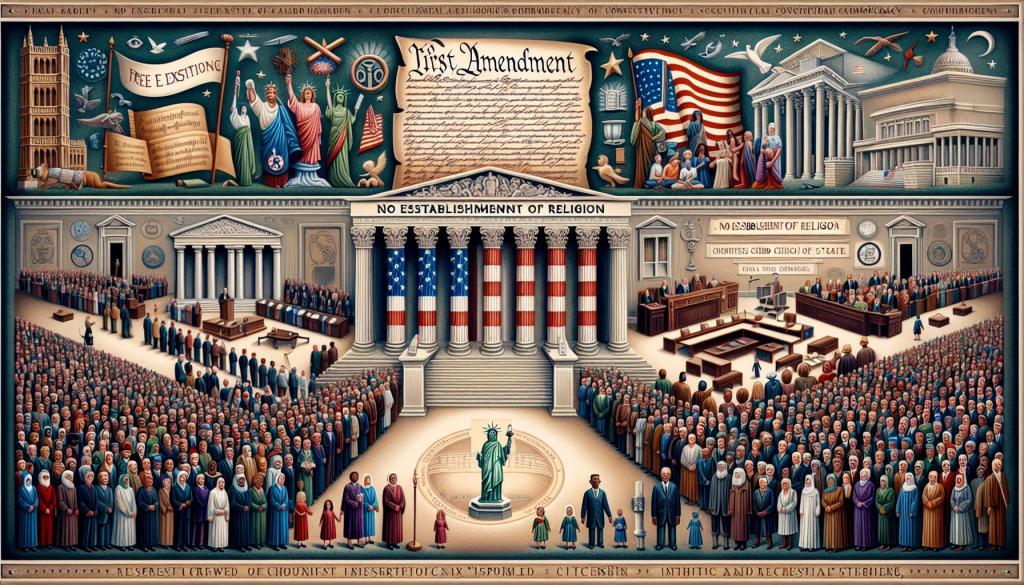
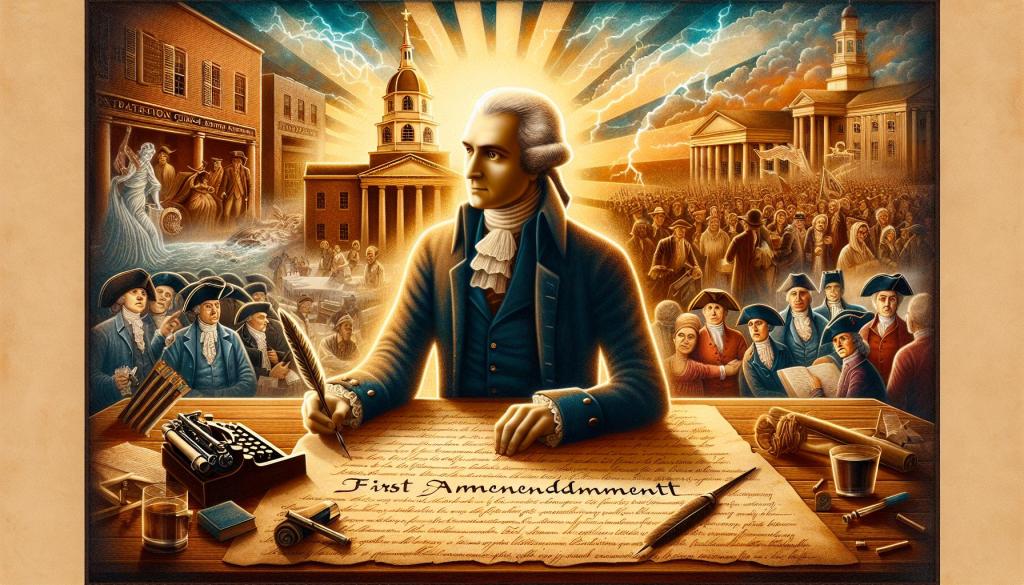
From the founding era, this project developed in tension with the Constitution’s commitment to religious liberty and pluralism. The First Amendment’s Establishment and Free Exercise Clauses rejected any “establishment of religion” while protecting robust religious practice and debate in public life [1]. Yet almost immediately, a competing story took shape: after George Washington’s death, evangelical writers and popular historians promoted narratives of the founding as a providentially Christian event, encouraging Americans to see the new republic as a “chosen nation” with a Christian identity [1]. This myth of a divinely favored “Christian America” persisted as a powerful cultural undercurrent alongside a constitutional architecture explicitly designed to prevent formal union of church and state [1][2][3].
Historically, Christian nationalism has resurfaced most visibly at moments of social and political upheaval. In the 1930s, some business interests opposed to the New Deal invoked Christian themes to sacralize a limited-government economic order and resist federal expansion [1]. In the 1960s and 1970s, a new wave emerged as white conservative Christians reacted to rapid cultural change and a series of Supreme Court rulings on religion and race. Decisions invalidating school-sponsored prayer and Bible reading (Engel v. Vitale, 1962; Abington v. Schempp, 1963) and later curbing tax benefits for racially discriminatory Christian schools (Green v. Connally, 1971; Bob Jones University v. United States, 1983) were widely framed not as neutral enforcement of religious freedom and equality, but as attacks on the supposed Christian character of the nation [1]. In this context, leaders like Jerry Falwell, Pat Robertson, James Dobson, and Paul Weyrich helped build an organized Christian Right that explicitly linked electoral politics, conservative theology, and a “Christian nation” narrative, greatly amplifying Christian nationalist themes [1].
Social scientists now analyze Christian nationalism as a measurable ideology rather than a label for a particular denomination or party. Perry and Whitehead’s work, especially Taking America Back for God, operationalizes it through survey items asking whether the federal government should: declare the U.S. a Christian nation, advocate Christian values, allow religious displays in public spaces, permit prayer in public schools, and whether national success is seen as part of God’s plan [1][4][5]. Responses to these items form a spectrum of adherence—rejecters, resisters, accommodators, and ambassadors—demonstrating that Christian nationalist ideas are present across multiple Christian traditions, not just among white evangelicals [5]. Their findings suggest that a majority of Americans affirm at least some elements of this vision, indicating that Christian nationalism is not marginal but woven into mainstream political culture [1][5].
Legally and constitutionally, the core ambitions of Christian nationalism tend toward a de facto establishment of religion, even where they fall short of a formal national church. The ideology insists that government should symbolically and substantively prefer Christianity: declaring the U.S. a Christian nation, elevating “Christian values” in official rhetoric, promoting Christian symbols on public property, and authorizing or encouraging Christian prayer in public schools [1][4]. These positions map directly onto contested Establishment Clause terrain. Federal courts, interpreting the Clause’s prohibition on “establishment,” have understood it to bar not only an official church but also government actions that endorse, sponsor, or favor religion over nonreligion or one faith over others [3]. In the public school context in particular, the Supreme Court has struck down state-written prayers, mandatory devotional exercises, and even moments of silence when used as pretexts to promote prayer, emphasizing that the state may not orchestrate or pressure religious observance (Engel, Abington, Wallace v. Jaffree) [5][6]. On this view, many Christian nationalist policy preferences—especially around school prayer and religious symbolism—press against or cross the constitutional line between protecting free exercise and impermissibly endorsing a particular faith.
The distinction between Christian nationalism and both civil religion and personal faith is crucial. American civil religion refers to a diffuse set of beliefs and symbols (such as references to Providence or liberty) that imagine a special national vocation but formally keep religion and government as “independent but interconnected” spheres [2]. Cold War additions like “under God” in the Pledge of Allegiance and “In God We Trust” on currency are often cited here [2]. Christian nationalists frequently treat these practices as proof that America is, and should remain, explicitly Christian. Yet scholars and many religious leaders argue that civil religion, at least in principle, aims at an inclusive language of national ideals, whereas Christian nationalism seeks a “total fusion” of political and religious identity and is unabashedly Christian in its symbols and aims [2]. Likewise, many clergy and theologians insist that authentic Christian faith is compromised, not fulfilled, when it is bound to national power, and they warn that nationalism of any kind undermines religious freedom and the pluralistic order envisioned by the First Amendment [3].
Research also underscores the tight linkage between Christian nationalism and exclusionary or illiberal politics. Legal scholars note that when government adopts Christian prayers, displays Christian symbols, or asserts a Christian identity, it sends a message about who “truly” belongs; Christians are cast as the normative citizens, while non-Christians and nonbelievers are relegated to tolerated outsiders [3][4]. Empirical studies show that higher scores on Christian nationalism scales correlate with support for declaring Christianity the national faith, restricting immigration, privileging Christian symbols in public spaces, and limiting the civil rights of marginalized groups [4][5]. In the education sphere, “White Christian nationalism” has been implicated in efforts to shape curricula around a sanitized Christian-America narrative and to resist honest treatment of racial injustice [5].
A significant strand of scholarship identifies Christian nationalism, particularly in its white expression, as bound up with racial hierarchy and white identity. Analysts argue that “White Christian nationalism” rests on interconnected claims: that America was founded as a Christian nation specially blessed by God; that social hierarchies—men over women, whites over nonwhites—reflect a divinely ordained order; that “freedom” is primarily the preserve of white Christian men; and that strong, even authoritarian measures may be justified to preserve this order [1][5]. These convictions consistently align with resistance to acknowledging systemic racism, support for punitive immigration and policing policies, and suspicion of egalitarian reforms [1][4][5]. The events of January 6, 2021, where Christian symbols and rhetoric were prominently displayed, are interpreted by some researchers as an instance in which Christian nationalist ideology sacralized an attempt to overturn democratic procedures, depicting it as a divinely mandated defense of “our” country against illegitimate others [6].
Comparative perspectives show that this U.S. pattern fits a broader global tendency for dominant confessions to intertwine with state identity—whether in formally confessional constitutions or informally preferential regimes—often at significant cost to religious minorities [1]. In the United States, however, this tendency is constrained and contested by a constitutional tradition that, at least in principle, insists on no establishment and equal citizenship regardless of faith. The enduring tension, repeatedly visible from the early republic through mid‑20th‑century school prayer battles to contemporary conflicts over symbols, education, and elections, is between a pluralist constitutional settlement and a recurring Christian nationalist project that seeks to reimagine the U.S. as a substantively Christian republic.
In this light, Christian nationalism does aim, in practice, at something like an establishment of religion, even if most of its advocates do not call for a formal national church. Its core commitments—sacralizing the nation as Christian, urging the state to promote Christian doctrine and symbols, and defining “real Americans” in religious terms—press government toward preferring one faith, blurring constitutional boundaries between church and state. The resulting struggles in courts, legislatures, and civil society revolve around how sharply the line between faith and favoritism will be drawn, and whether constitutional principles of religious liberty and pluralism can withstand sustained pressure from a movement that sees state-backed Christian identity as central to America’s purpose.
Conclusion
Across history, law, and contemporary politics, this report has shown that Christian nationalism is more than public piety: it is a political theology that seeks cultural dominance and, in practice, pushes toward a de facto establishment of Christianity. Historically, it has coexisted uneasily with the First Amendment’s commitment to no establishment and free exercise. In school prayer and public-symbol cases, its agenda repeatedly tests constitutional limits. Sociological research further reveals its entanglement with white identity and illiberal, exclusionary politics. Together, these strands underscore how Christian nationalism threatens both genuine religious freedom and democratic pluralism in the United States.
Sources
[1] https://www.britannica.com/topic/Christian-nationalism
[2] Corbin, Caroline Mala, “Christian Nationalism” in Alabama Law Review, Vol. 71:3:833, https://law.ua.edu/wp-content/uploads/2020/05/10-Corbin-833–866.pdf
[3] “Christian Nationalism in the U.S.,” General Board of Church and Society, United Methodist Church, https://www.umcjustice.org/latest/christian-nationalism-in-the-u-s-1933
[4] Corbin, Caroline Mala, “The Supreme Court, Christian Nationalism, and the Establishment Clause,” 10 Ala. C.R. & C.L. L. Rev. 833, https://law.ua.edu/wp-content/uploads/2020/05/10-Corbin-833–866.pdf
[5] Burke, M. & Hadley, N. “White Christian Nationalism in Education.” National Education Policy Center Policy Brief. https://nepc.colorado.edu/sites/default/files/publications/PB Burke-Hadley_0.pdf
[6] “Christian Nationalism in the United States.” IUPUI Liberal Arts Research Project. https://liberalarts.indianapolis.iu.edu/research/research-projects/christian-nationalism-in-the-united-states.html
[7] https://en.wikipedia.org/wiki/Christian_nationalism_in_the_United_States
[8] https://indianacitizen.org/kennedy-commentary-christian-nationalism-versus-the-constitution/
[9] “History and the School Prayer Cases,” Virginia Law Review, https://virginialawreview.org/articles/history-and-the-school-prayer-cases/
[10] McGuire, Kevin T., “Public Schools, Religious Establishments, and the U.S. Supreme Court,” https://mcguire.web.unc.edu/wp-content/uploads/sites/1749/2014/01/prayer.pdf
[11] https://en.wikipedia.org/wiki/State_atheism
[12] Perry, Samuel L., and Andrew L. Whitehead. Taking America Back for God: Christian Nationalism in the United States. New York, NY: Oxford University Press, 2020. Summary excerpted in: https://digitalcommons.liberty.edu/cgi/viewcontent.cgi?article=7880&context=doctoral
[13] “American Christian Nationalism: A Case of Misplaced Loyalties?” Christ on Campus Initiative. https://christoncampuscci.org/american-christian-nationalism-a-case-of-misplaced-loyalties/
Written by the Spirit of ’76 AI Research Assistant

 Realizing News
Leave a comment