Introduction
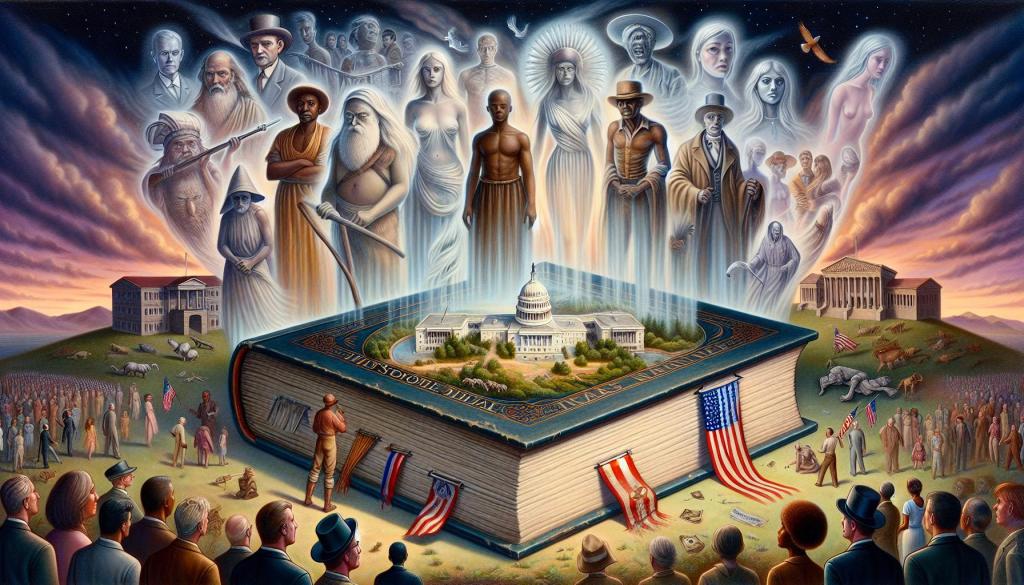
American political arguments lean heavily on a shared story about the nation’s past—yet much of that story is wrong, incomplete, or deliberately sanitized. This report examines how patriotic lore about the founding era, the Constitution, and the Civil War still frames debates about rights, federal power, and national identity. It unpacks the “Lost Cause” mythology that downplays slavery, challenges frontier and “self‑made” narratives that fuel American exceptionalism, and traces how weak historical literacy allows these myths to endure. Together, the sections show that confronting comforting fictions is essential to understanding present‑day law, inequality, and democracy.
American historical memory is structured less by careful engagement with evidence than by a set of durable myths that present the United States as unified at its origins, consistently democratic, morally exceptional, and steadily self‑correcting. These myths simplify conflict, erase exclusion, and turn contingent political choices into timeless national virtues, shaping how contemporary Americans understand rights, inequality, race, and the role of the state.
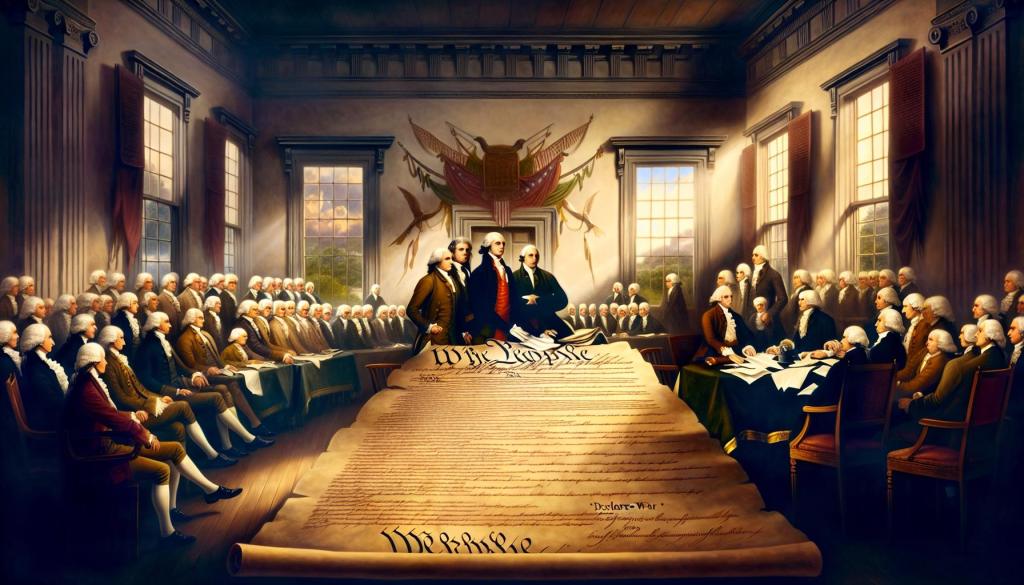
A central cluster of myths surrounds the founding era. Popular narratives celebrate a single, coherent revolutionary moment—often symbolized by 4 July 1776—as the clear “birth” of a united people committed to liberty and democracy. In reality, both independence and the constitutional order emerged from protracted, contested processes. Fighting in the War of Independence predated July 1776 by about a year, the idea of separation from Britain had been circulating for decades, and the actual congressional act declaring independence was the Lee Resolution of 2 July 1776, not the later‑celebrated date of the Declaration’s adoption.[2] Treating Independence Day as a sacred, singular origin conceals the messy debates, regional divisions, and shifting loyalties that made the revolution anything but inevitable.
The Constitution itself is often remembered as a straightforward blueprint for popular self‑rule, drafted by leaders with an unambiguous faith in mass democracy. Yet the framers were wary not only of factions but also of direct popular power. The original design insulated key institutions from voters—for example, by having state legislatures, not citizens, elect U.S. senators—revealing an elite project to filter and constrain democracy rather than fully embrace it.[1] Later generations retrofitted this cautious, exclusionary framework into a story of timeless, egalitarian constitutional wisdom, obscuring the extent to which broad suffrage, direct elections, and civil rights protections were hard‑won, much later additions.
These founding myths are reinforced by broader national narratives that cast the United States as a promised land discovered, settled, and continuously improved by heroic figures. Scholars describe such stories—about discovery, liberty, the frontier, and the Founding Fathers—as “anchors” for discussions of American identity.[5] They function as foundation myths: selective, idealized accounts of origins that legitimize existing institutions and hierarchies by presenting them as the natural outgrowth of a virtuous past.[2][3] In this framework, America appears as a Christian nation destined for freedom, a self‑made society of rugged individuals, and a melting pot that inevitably absorbs differences into equality.
The frontier and “self‑made” myths are especially powerful in shaping how Americans think about inequality and state power. Cultural narratives of the open West and boundless opportunity suggest that individuals rise or fall primarily on merit and effort, not on structural constraints. Abundant land, resources, and relative class fluidity for some groups are remembered as proof of intrinsic national virtue rather than as outcomes of settler colonial expansion and policies that dispossessed Indigenous peoples and excluded many nonwhite populations.[3][4] In this telling, the American Dream—endless mobility in an ever‑expanding economy—becomes not only a hope but an assumed historical norm, making poverty, racial wealth gaps, and environmental damage seem like unfortunate side effects of an otherwise just system.
American exceptionalism condenses these strands into a self‑conscious doctrine: the belief that the United States is not only different but morally exemplary, with a unique mission in the world.[4] By treating U.S. development as singularly free, democratic, and opportunity‑rich, exceptionalist narratives encourage Americans to view domestic injustices as anomalies or temporary deviations rather than as products of long‑standing choices about labor, race, and empire. This cushions public debate from acknowledging the depth of structural inequality or the continuities between past and present forms of domination.
The starkest example of how national myths override evidence lies in public understandings of slavery, the Civil War, and the Confederacy. Despite extensive documentation, many Americans still insist that the Civil War was fought primarily over abstract “states’ rights” rather than slavery, or that large numbers of Black people willingly fought as Confederate soldiers.[1][3][4] In fact, secession commissioners, state conventions, and Confederate leaders were explicit at the time: they left the Union to protect slavery and white supremacy, not general state autonomy.[1][3][4][6] The few Black people present in Confederate armies were overwhelmingly enslaved laborers—cooks, teamsters, body servants—forced to support military operations, not enlisted soldiers in a recognized combat force.[1][3]
These distortions are not accidental misunderstandings but products of a concerted, postwar “Lost Cause” campaign that rebranded the Confederacy as a noble defender of constitutional principle. Lost Cause narratives minimized or sentimentalized slavery, recast enslavers as benevolent guardians, and portrayed Reconstruction as a tragic overreach that victimized the South.[4][6] Southern textbook committees and heritage organizations ensured that generations of students encountered Civil War history as a story of mutual valor and states’ rights, often including images of smiling enslaved people that suggested contentment rather than coercion.[5][6] This propaganda helped legitimate Jim Crow, rationalize Confederate monuments, and embed white supremacist interpretations of the past in school curricula and public spaces.
Across these different contexts—the founding, the frontier, and the Civil War—the same pattern emerges. Myths erase or soften coercion, particularly around race and labor. They obscure how central slavery and racial hierarchy were to the building of U.S. institutions and wealth, marginalize African American resistance, and downplay the ways Black history is intertwined with national development.[4][6][7] By presenting a story in which the nation steadily expands freedom and inclusion on its own, these narratives make present‑day struggles for racial justice seem out of step with, rather than continuous with, the country’s real history.
The endurance of these myths owes much to persistent gaps in historical and civic literacy. Surveys of college graduates show widespread ignorance on basic questions about the Constitution’s structure and core historical events.[1][2] In a complex system where authority is divided among federal, state, and local institutions and courts,[3] such ignorance leaves citizens vulnerable to persuasive but misleading narratives encountered in politics, media, and online spaces. Patriotic lore, exceptionalist tropes, and Lost Cause stories can fill that vacuum precisely because they are simple, morally flattering, and repeatedly reinforced in culture and commemoration.
Yet the same myths that legitimize power can be turned into tools for critique. Scholars note that national myths have a “counter‑presentist” potential: when activists, educators, and artists insist on comparing America’s professed ideals—democracy, equality, opportunity—with the historical record of exclusion and violence, they expose the gap between aspiration and reality.[3] Reexamining July 4th as one step in a long, contested path to independence, or the frontier as a site of dispossession rather than pure opportunity, or the Civil War as a conflict fundamentally about slavery, does more than correct errors. It opens space to question which stories have been treated as synonymous with “who we are,” and to imagine a civic culture grounded less in comforting myth and more in an honest reckoning with the past.
Conclusion
Across these sections, a consistent pattern emerges: the stories most Americans inherit about their past are less careful history than political mythology. Founding‑era lore recasts a conflicted, exclusionary revolution as a timeless birth of liberty. Lost Cause narratives turn a war for slavery into a vague dispute over “states’ rights” and even invent loyal Black Confederates. Frontier and “self‑made” myths reframe conquest, state power, and structural inequality as individual opportunity and national virtue. These myths endure because of weak historical literacy and strong emotional appeal. Unlearning them is not iconoclasm; it is the precondition for honest civic debate and more democratic futures.
Sources
[1] “11 Biggest Myths About American History,” American Council of Trustees and Alumni. https://www.goacta.org/news-item/11_biggest_myths_about_american_history/
[2] Jem Duducu, “American history myths: 7 things people get wrong.” https://www.historyextra.com/period/georgian/american-us-history-historical-myths-things-people-get-wrong/
[3] “Politics of the United States.” https://en.wikipedia.org/wiki/Politics_of_the_United_States
[4] “Confederate States of America.” https://en.wikipedia.org/wiki/Confederate_States_of_America
[5] Heike Paul, The Myths That Made America. https://www.ssoar.info/ssoar/bitstream/document/85859/1/ssoar-2014-paul-The_Myths_That_Made_America.pdf
[6] “Lost Cause of the Confederacy.” https://en.wikipedia.org/wiki/Lost_Cause_of_the_Confederacy
[7] “African-American history.” https://en.wikipedia.org/wiki/African-American_history
[10] https://10millionnames.org/common-myths
[13] “Foundation Myths and Political Legitimization,” Dartmouth master’s thesis (Digital Commons). https://digitalcommons.dartmouth.edu/cgi/viewcontent.cgi?article=1180&context=masters_theses
[14] “American exceptionalism,” Wikipedia. https://en.wikipedia.org/wiki/American_exceptionalism
[15] Jaap Kooijman, Fabricating the Absolute Fake (on the American Dream and star myth), OAPEN. https://library.oapen.org/bitstream/handle/20.500.12657/107753/9781040799963.pdf?sequence=1&isAllowed=y
Written by the Spirit of ’76 AI Research Assistant



 Realizing News
Leave a comment