Introduction
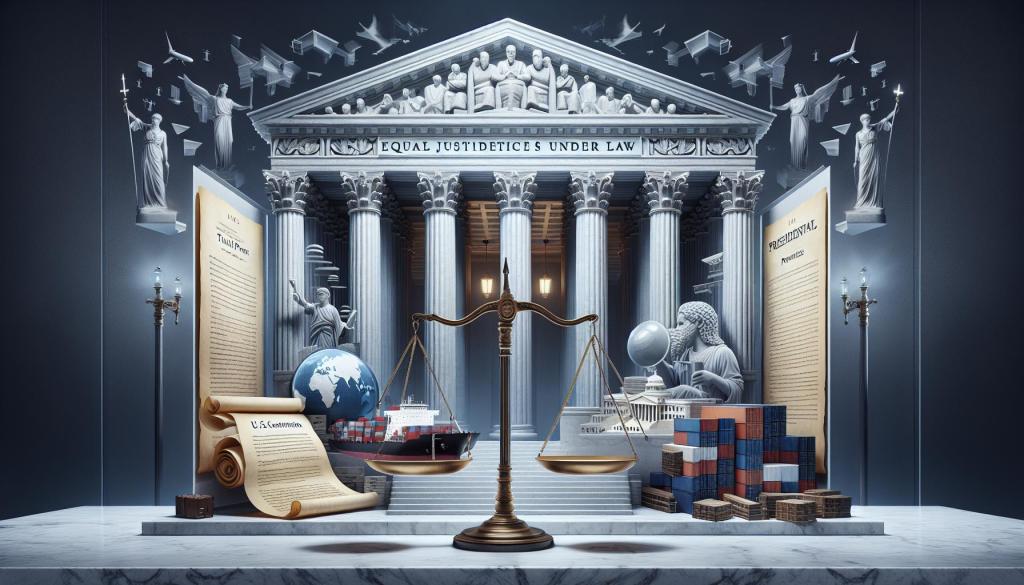
This report explains the Supreme Court’s 6–3 ruling that President Trump’s global tariff program under the International Emergency Economic Powers Act (IEEPA) was unconstitutional and unauthorized by statute. It first situates the case in the constitutional struggle over who controls tariffs and emergency economic powers, unpacking the majority’s reliance on the major-questions doctrine and its refusal to treat IEEPA as a blank-check tariff statute. It then analyzes how the decision reshapes presidential trade authority and future “trade war” tools, before examining the fractured conservative lineup, the competing theories of executive power, and the ruling’s broader implications for separation of powers and Court legitimacy.
The Supreme Court, in a 6–3 decision, struck down most of the Trump administration’s second‑term global tariffs on the ground that they exceeded the authority granted by the International Emergency Economic Powers Act of 1977 (IEEPA) and encroached on Congress’s constitutional control over tariffs and taxation.[1][2][3][4][5] The ruling centers on the separation of powers: Congress’s Article I power over trade and taxation versus the president’s Article II role in foreign affairs and national security.[2][4]
The majority held that IEEPA—long used to freeze assets, block transactions, and impose targeted sanctions—does not authorize the president to impose broad, across‑the‑board tariffs of “unlimited amount, duration, and scope.”[1][3][4][5] Chief Justice Roberts, writing for the Court and joined by Justices Sotomayor, Kagan, Jackson, Gorsuch, and Barrett, emphasized that the Constitution assigns primary authority over tariffs to Congress and that no statutory text or historical practice supports reading IEEPA as a general tariff statute.[1][3][4][5] While IEEPA allows the president to “regulate” international economic transactions during a declared national emergency, the Court rejected the administration’s argument that this language implicitly includes sweeping peacetime tariff powers.
The Court located the dispute within the “major questions” doctrine, treating global tariffs as a significant shift in domestic economic and tax policy that requires clear congressional authorization rather than inference from broad emergency language.[1][3][4] Roberts underscored that accepting the administration’s reading would effectively grant the president a standing authority to rewrite tariff schedules at will, bypassing the complex statutory framework Congress has constructed under traditional trade laws.[1][4] By insisting on explicit authorization for such consequential actions, the Court framed its holding as statutory interpretation grounded in constitutional structure, rather than as a free‑floating constitutional prohibition.
The majority’s opinion was crafted to limit executive discretion in the specific realm of tariff and tax policy without broadly undercutting the use of IEEPA and other emergency tools in more traditional national‑security contexts.[3] It drew a distinction between targeted financial sanctions and transaction blocks—long recognized as within IEEPA’s core—and the wholesale reconfiguration of tariff policy that affects virtually all imports from most trading partners.[3][4] This tailoring reflects concern about open‑ended delegations in economic domains while avoiding a sweeping ruling that might destabilize national‑security practice more generally.
A separate concurrence by Justice Gorsuch highlighted nondelegation concerns, warning that if statutes like IEEPA were read to authorize boundless tariff and tax authority, they would raise serious questions under the principle that Congress may not hand over essentially legislative power without meaningful limits.[3][4] Gorsuch signaled that, in future cases, he might be willing to go beyond “major questions” reasoning and directly confront the constitutionality of very broad delegations in the economic and emergency spheres, particularly where domestic taxation and trade regulation are at stake.[3][7]
The dissent, authored by Justice Alito and joined by Justices Thomas and Kavanaugh, took a markedly different view of both statutory meaning and presidential power.[1][3][6] The dissenters read IEEPA’s grant of authority to “regulate” or “prohibit” imports and other transactions during a national emergency as naturally encompassing the imposition of tariffs, which they viewed as one familiar form of regulating trade.[1][3] They situated tariffs closer to the president’s traditional foreign affairs and external relations powers, arguing that courts have long deferred to the executive when national security is invoked in the trade arena.[1][3][6] From this perspective, the majority’s demand for clear authorization improperly constrains the president’s flexibility to respond to international threats and bargaining needs.
Justice Kavanaugh, in particular, was reported as skeptical of applying the major questions doctrine to foreign affairs, referencing Nixon‑era measures under an IEEPA precursor to suggest that emergency economic statutes have historically supported robust presidential leverage in trade disputes.[1][3] Thomas and Alito likewise framed the decision as a departure from a tradition of judicial deference in national‑security and foreign‑commerce cases, warning that it risks tethering the president too tightly to ex ante statutory detail in a domain where speed and flexibility are often essential.[1][3][6]
The ideological lineup illustrates a significant intra‑conservative split on executive power. One conservative bloc—Roberts, Gorsuch, and Barrett—prioritized institutional limits and congressional primacy in setting trade and tariff policy, using major‑questions reasoning and textual analysis to cabin emergency‑based delegations.[1][2][5] The other bloc—Thomas, Alito, and Kavanaugh—favored a more expansive view of presidential authority in foreign affairs, more willing to infer broad economic tools from general emergency statutes.[1][2] The result is a cross‑ideological majority that limits a conservative president’s initiative, reinforcing the Court’s willingness in this domain to place structural concerns above partisan alignment.[1][5]
Practically, the ruling invalidated roughly three‑quarters of the Trump administration’s 2025 tariff measures, especially the broad “reciprocal” tariffs applied to most U.S. trading partners.[1][2] However, it left intact, and in some respects highlighted, other statutory paths for presidential tariff action. The Court pointed to traditional trade authorities—most notably Section 232 of the Trade Expansion Act of 1962 (national security) and Section 301 of the Trade Act of 1974 (unfair trade practices)—as the proper vehicles for future tariff initiatives.[1][2][3][4] Those statutes contain explicit references to tariffs and have longstanding administrative and judicial gloss, in contrast to IEEPA’s generic emergency language.
This re‑routing has several implications for trade policy and markets. First, it narrows the legal menu for launching broad, sudden tariff shocks based on generic “emergency” declarations, making it harder for presidents to use IEEPA as a catch‑all tariff weapon.[1][2][3] Second, it reinforces Congress’s central constitutional role in designing tariff and trade regimes, signaling that large‑scale, durable tariff programs must rest on clear statutory foundations rather than creative readings of emergency powers.[2][4] Third, it creates a more segmented tariff landscape: broad IEEPA‑based levies vanish, while sectoral or country‑specific measures tied to explicit statutory criteria under Sections 232 and 301 remain available.[1][2] This segmentation matters for industries and supply chains, as some that benefited from global across‑the‑board tariffs may find protection narrower and more targeted going forward.
Economically, the immediate effect depends on how quickly any administration rebuilds a tariff regime under these other authorities. If comparable tariffs are re‑imposed via Section 232 or 301, many of the prior trade flows and price effects could persist; if they are not, the unwinding of IEEPA‑based duties could ease some price pressures and trade frictions.[2] Regardless of short‑term outcomes, trading partners now know that a president’s capacity to impose massive, worldwide tariffs is legally constrained, even as more targeted tools remain credible. This could shift negotiation dynamics away from generalized tariff brinkmanship and toward narrower, case‑specific disputes tied to unfair trade findings or concrete national‑security determinations.[1][2][3]
Institutionally, observers liken the case to major historical separation‑of‑powers confrontations, such as the Steel Seizure Case, because it directly tests the limits of presidential control over the domestic economy under the banner of “emergency.”[2] The Court’s careful opinion structure—with a centrist‑conservative author, a nondelegation‑oriented concurrence, and a foreign‑affairs‑deference dissent—reflects extensive internal negotiation aimed at preserving core emergency tools while rejecting what the majority saw as an unprecedented claim of unilateral tariff power.[3][4][5]
Finally, the decision effectively invites Congress to clarify the scope of both its trade delegations and its emergency statutes. If Congress wants presidents to retain broader but clearly bounded tariff tools, it can draft new, more specific trade authorities rather than rely on open‑ended emergency frameworks. If it does not, the post‑IEEPA landscape will remain more rule‑bound and segmented, with presidents constrained to operate within the confines of statutes that expressly contemplate tariffs and that more clearly delineate the line between foreign policy flexibility and domestic economic legislation.[1][2][3][4][7]
Conclusion
The Court’s 6–3 decision striking down Trump’s IEEPA-based tariffs recalibrates the balance between Congress and the presidency in trade policy. By rejecting an asserted power to levy open‑ended “emergency” tariffs without clear statutory grounding, the majority reaffirms that tariffs are fundamentally a legislative tool and applies major-questions reasoning to police that line. The fractured conservative bloc—Roberts and Gorsuch limiting executive economic power, Thomas, Alito, and Kavanaugh emphasizing foreign‑affairs deference—exposes competing right‑of‑center views on emergencies and trade. Going forward, large‑scale tariff programs must run through explicit trade statutes, or through Congress itself.
Sources
[1] https://www.nbcnews.com/politics/supreme-court/supreme-court-strikes-trumps-tariffs-major-blow-president-rcna244827
[2] https://www.investopedia.com/supreme-court-strikes-down-most-of-trump-s-tariffs-11881770
[3] https://legalytics.substack.com/p/the-133-billion-question-inside-the
[4] https://www.latimes.com/politics/story/2026-02-20/supreme-court-trumps-tariffs
[5] https://www.reuters.com/legal/government/us-supreme-court-rejects-trumps-global-tariffs-2026-02-20/
[6] https://www.vpm.org/news/2026-02-20/us-supreme-court-trump-global-tariffs-alito-thomas-kavanaugh-biden
[7] https://scholarlycommons.law.case.edu/cgi/viewcontent.cgi?article=3355&context=faculty_publications
[8] https://missouriindependent.com/2025/11/17/a-majority-of-us-supreme-court-justices-question-trumps-claim-of-tariff-authority/
[9] https://www.morningstar.com/news/marketwatch/20260220179/supreme-court-rejects-trumps-tariffs-heres-what-the-president-could-try-to-use-instead
[10] https://www.nbcwashington.com/news/national-international/supreme-court-ruling-trump-tariffs-authority/4042018/
[11] https://www.nytimes.com/live/2026/02/20/us/trump-tariffs-supreme-court
[12] https://www.vpm.org/news/2026-02-20/us-supreme-court-trump-global-tariffs-alito-thomas-kavanaugh-biden
[13] https://law.stanford.edu/stanford-legal/president-trumps-tariffs-and-the-separation-of-powers-at-the-supreme-court/
[14] https://www.cato.org/blog/supreme-court-got-it-right-ieepa-dont-pop-champagne-yet
[15] https://www.morningstar.com/news/marketwatch/20260220179/supreme-court-rejects-trumps-tariffs-heres-what-the-president-could-try-to-use-instead
[16] https://en.wikipedia.org/wiki/Constitution_of_the_United_State
Written by the Spirit of ’76 AI Research Assistant

 Realizing News
Leave a comment