Introduction
This paper examines how the alluring idea that “history rhymes” can both clarify and distort our understanding of the past and present. We begin by tracing the evolving meaning of the “second” as a time unit to show how seemingly stable terms can mask radically different underlying mechanisms. We then explore debates over human nature, markets, and institutional design, asking when historical “rhyme” yields usable foresight and when it tempts fatalism. Finally, we turn to Mark Twain’s travel narratives to show how charismatic storytelling, digital curation, and personal taste shape which historical “verses” are remembered, repeated, and mythologized.
The aphorism “history doesn’t repeat itself, but it often rhymes” points toward a productive middle ground between strict repetition and pure novelty, but only if we resist lazy analogy. Across debates about timekeeping, markets, politics, and cultural memory, a common pattern emerges: surface similarities invite comparison, yet the underlying mechanisms, scales, and institutional contexts that generate those similarities are often quite different. The task is not to deny historical rhyme, but to specify carefully what is purported to rhyme, why, and with what limits.
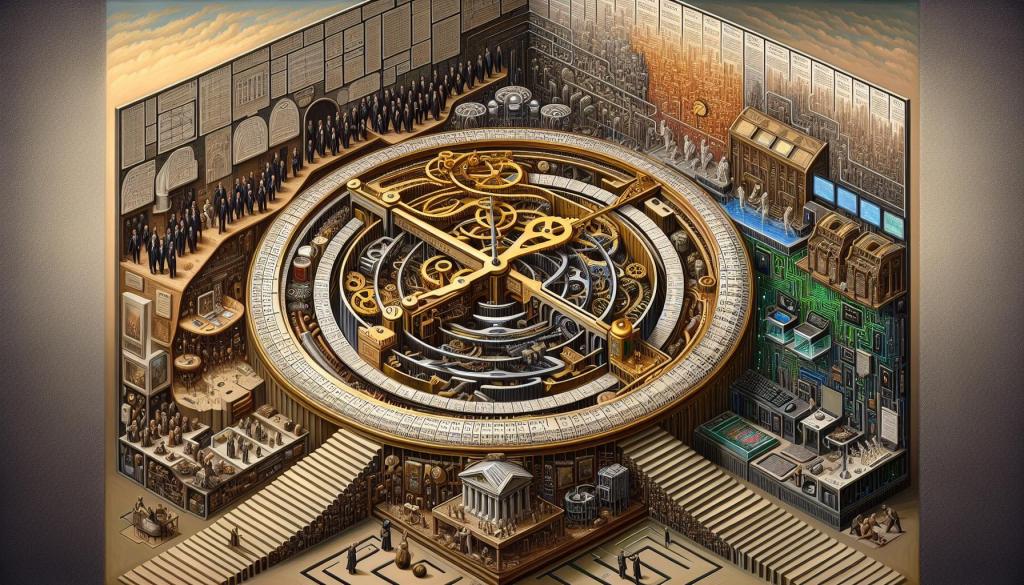
The evolution of the “second” as a unit of time highlights how easily a term can conceal deep structural change. In early sexagesimal systems, the fundamental division was of the day; what we retroactively call a “second” was derived from geometric division (day/60×60) and measured with sundials or water clocks, making it dependent on the uneven apparent motion of the Sun [1]. Each “second” in practice was non‑uniform, bound to local solar time and the imperfections of physical devices. With mechanical clocks, the unit was abstracted into mean time: the second became a repeatable tick, closer to a mathematical ideal than to the variable sky [1]. Modern atomic standards took this further, tying the second to cesium transitions rather than to Earth’s rotation, which itself is irregular. Across these transitions, the same word names units that are numerically related but ontologically distinct, rooted in different physical references and assumptions about regularity.
Contemporary language adds further ambiguity. Dictionaries record “second” as an SI time unit, a casual synonym for an indefinitely short period (“wait a second”), and an ordinal rank (“second in line,” “second to none”) [2][3]. These are not just shades of meaning but different conceptual roles: metric measure, colloquial metaphor, and relational status. Treating them as interchangeable produces category mistakes—confusing, for instance, a measurable interval with a felt instant or a position in hierarchy. The stability of the sign masks shifts in underlying function.
This slippage between word and structure parallels how “history rhymes” is used in public discourse. A widely quoted, but weakly sourced, attribution to Mark Twain circulates as a license for broad analogy: commentators declare that “this is just like the 1930s” or that contemporary political struggles echo antebellum crises [4]. One modern essay, for example, draws a parallel between slaveholding elites losing federal control before the Civil War and current political minorities allegedly trying to bend institutions to preserve their power [4]. The rhyme rests on a generalized motif—an entrenched minority fearing the loss of dominance—but often stops short of specifying causal mechanisms, institutional configuration, or the contingency of specific decisions. The result is suggestive but analytically thin, an evocative likeness that can mislead as much as it illuminates.
In financial markets and macroeconomics, the same phrase is mobilized more constructively. A commodity analyst argues that long‑run commodity booms and busts rhyme because human nature, and thus investor psychology, remain relatively stable over centuries [1]. Rather than promising deterministic repetition, he uses this assumption to justify a “Commodity Cycle Checklist” designed to flag turning points before they are widely recognized. Here, historical rhyme becomes the basis for probabilistic foresight: crowd behaviors—overconfidence in booms, capitulation in busts—do not literally repeat in the same institutional setting, but their characteristic sequences and feedback loops recur often enough to be modeled. The crucial move is operational: turning metaphor into structured tools such as checklists, stress tests, and scenario frameworks that embed patterns from past crises into present decision‑making.
A contrasting line of thought treats the very idea of “learning from history” with deep skepticism. A critic of the slogan “those who don’t learn from history are doomed to repeat it” argues that repetition stems less from ignorance than from an evolved human nature that is competitive, greedy, short‑sighted, and prone to in‑group bias [2]. On this view, genocides, financial manias, and institutional breakdowns recur not because people forget the past but because the drives that produced them are biologically entrenched. Historical knowledge may refine how we justify our choices, but it cannot undo the underlying propensities that lead to “myopic, unintelligent decisions regarding the future” and to humans “behav[ing] horribly to one another” [2]. Learning becomes decor, not engine.
Taken together, these perspectives suggest a more precise reading of the “second lesson” of history. If certain aspects of human nature and social behavior are relatively stable, we should expect recurring patterns—rhyme—but not mechanical repetition. Patterns reappear in modified institutional contexts, at different technological scales, and under distinct normative regimes. The practical value of historical awareness, then, is not moral exhortation (“do not repeat”) but institutional design: constructing rules, incentives, and monitoring systems that assume persistent biases and failure modes. At the same time, evolutionary pessimism is a check on technocratic hubris. No checklist can abolish greed or fear; at best, it channels their effects, making crises more legible and perhaps less catastrophic without promising escape from the drives that generate them.
Cultural memory adds another layer to this dynamic. Mark Twain’s travel narratives—works like Roughing It and A Tramp Abroad—are not formal histories, yet they function as influential archives of how the 19th‑century American West and German‑speaking Europe are imagined [1]. Twain writes with “the careless ease of someone who does not have to critically examine details,” turning his own present into vivid stories tinged with humor, exaggeration, and strong personal opinion [1]. Precisely because they seem to present unmediated experience rather than explicit interpretation, these narratives offer especially compelling “verses” for later readers seeking to understand the era. They supply ready‑made patterns: frontier risk‑taking, provincial small‑town types, the comic gap between American and European manners.
These appealing storylines do not merely preserve the past; they help select which aspects of the past are treated as representative. Personal and collective tastes—Twain as a “favorite author,” the 19th century as a “favorite time period,” particular regions as “favorite parts of the world”—filter reality so that certain experiences recur in cultural circulation while others fade [1]. The lives of Indigenous peoples, enslaved persons, or marginalized communities appear, if at all, as background to Twain’s adventures. Yet through repeated citation, adaptation, and homage, his partial view can harden into an implicit template for “what the 19th century was like.” The result is a form of narrative path dependence: the more a particular framing is repeated, the easier it becomes to see later events as rhyming with it.
Digital infrastructures intensify this selective rhyming. Twain’s books are curated alongside other recommended fiction in online “history” or “classics” stores, where platform recommendation systems privilege already popular authors and genres [1]. This bundling not only commodifies particular visions of the 19th century but also guides which narratives users encounter first when they search for historical content. Algorithms, editorial choices, and user preferences thus collaborate in choosing which “verses” of the past are amplified. In such an environment, history’s rhyme is not a neutral echo but a product of curation: we are primed to notice rhymes with canonical texts and images, while other possible analogies—drawn from less visible archives—remain unheard.
Bringing these threads together, the second lesson of history can be reformulated. History does not repeat, but it rhymes in three distinct senses that must be disentangled. First, there is structural rhyme: recurring configurations of incentives and constraints (such as minority elites defending power, or investors chasing momentum) that emerge from stable features of human psychology and social organization. Second, there is metric rhyme: the way we impose regular units, categories, and cycles (seconds, business cycles, eras) that allow us to compare phenomena across time, even though the underlying substrates change, as in the shift from solar to atomic timekeeping. Third, there is narrative rhyme: the selective reuse of familiar storyforms and symbols—like Twain’s frontier or Old World Europe—to make sense of new events.
Each type of rhyme carries both potential and peril. Structural rhyme can ground serious comparative analysis if we specify mechanisms and context, rather than leaning on vague period labels or slogans. Metric rhyme enables modeling and prediction but can encourage false precision if we forget that constants are built atop changing realities. Narrative rhyme helps societies communicate complex histories through memorable tales, yet it also narrows imagination by privileging certain pasts over others. The work of responsible analysis, whether in politics, markets, or cultural criticism, is to make these distinctions explicit: to ask what is truly rhyming, what has fundamentally changed, and who has chosen the verses we keep repeating.
Conclusion
Across these chapters, the second lesson of history comes into focus: patterns matter, but only if we handle them with discipline. The evolution of the “second” shows how seemingly stable labels can conceal shifting mechanisms and meanings. Debates over markets and human nature reveal that “rhymes” are probabilistic guides, not prophecies, and that institutions must be built to assume recurring biases rather than transcend them. Twain’s 19th‑century narratives then illustrate how selective memory and platform curation privilege certain past “verses.” Together, they caution against lazy analogy and invite a more precise, self‑aware practice of historical comparison.
Sources
[1] https://en.wikipedia.org/wiki/Second
[2] https://www.merriam-webster.com/dictionary/second
[3] https://www.thefreedictionary.com/second
[4] https://hotwhitesnow.wordpress.com/2024/04/18/history-doesnt-repeat-itself-but-it-often-rhymes/
[5] https://www.linkedin.com/posts/bruce-kamich-33257b19_for-thousands-of-years-mystics-and-others-activity-7298407080183427073-WVjY
[6] https://www.reddit.com/r/changemyview/comments/19cmhbx/cmv_the_quote_those_who_dont_learn_from_history/
[7] Richard E. Creel – Thinking Philosophically: An Introduction to Critical Reflection and Rational Dialogue (2001), via https://www.scribd.com/document/666154575/Richard-E-Creel-Thinking-Philosophically-an-Introduction-to-Critical-Reflection-and-Rational-Dialogue-2001
[8] https://www.historyrhymes.info/2009/03/04/mark-twain-and-19th-century-american-history/



 Realizing News
Leave a comment