Introduction
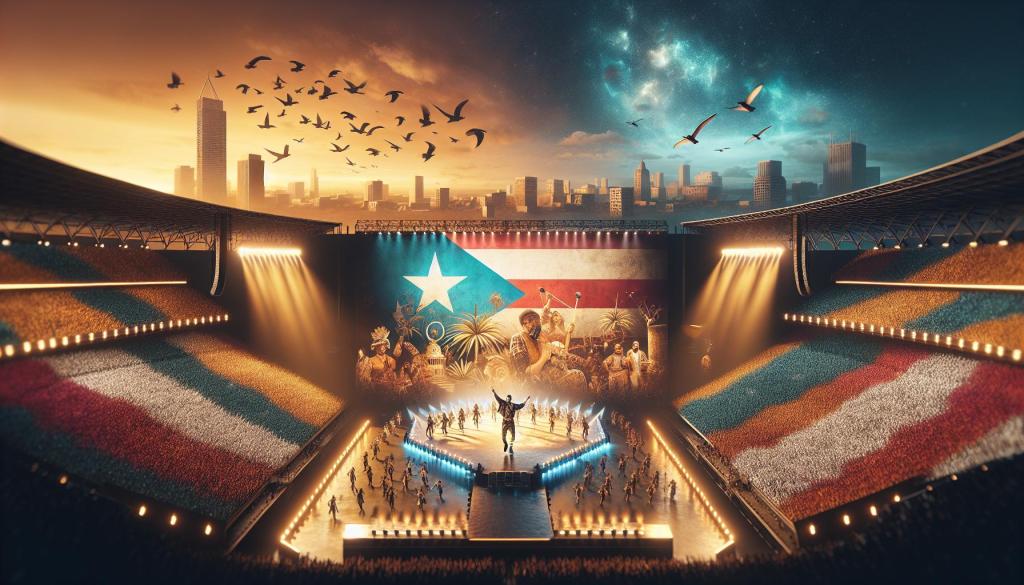
This report traces how Bad Bunny’s 2026 Super Bowl halftime show transformed a corporate mega‑spectacle into a dense archive of Puerto Rico’s colonial past and contested present. First, it unpacks how plantation imagery, blackout‑ridden infrastructure, and the once‑banned light‑blue flag visually narrate five centuries of empire and resistance. It then examines the politics of visibility in an all‑Spanish, Puerto Rico‑centered set staged for a U.S. mass audience. Finally, it situates the performance within diasporic struggles over migration, gentrification, and the meaning of “America” itself.
Bad Bunny’s 2026 Super Bowl halftime show functions as a compressed archive of Puerto Rico’s colonial history and a declaration of Puerto Rican and pan‑Latino political subjecthood on one of the most visible corporate stages in the United States. The performance braids together five centuries of empire, labor exploitation, legal repression, infrastructural crisis, and diaspora with a futurist vision of hemispheric belonging, using Spanish‑language music and local imagery as its core political tools rather than as decorative multiculturalism.
The staging opens on sugar‑cane fields with workers in white clothes and pava hats, evoking the plantation economy that underpinned Puerto Rico’s integration into Atlantic capitalism. Under Spain, enslaved Africans labored on plantations until abolition in 1873; after the 1898 U.S. invasion and the Treaty of Paris, U.S. corporations consolidated sugar lands and profits, deepening economic dependency and racialized hierarchies [1][4]. By centering jíbaros—long mythologized as humble, rustic symbols of Puerto Rican identity—within cane fields, the show undercuts pastoral nostalgia and forces viewers to confront the coercive labor, land dispossession, and class stratification that structured the countryside.
Rather than freezing that past in sepia, the performance overlays scenes of contemporary everyday life: piragua stands, “La Marqueta,” viejitos playing dominos, marquesina house parties, boxers training in neighborhood gyms, street vendors, and palm‑lined streets that echo barrios from San Juan to the diaspora [1][2][4]. These vignettes present Puerto Rico not as an exotic “tropical backdrop,” but as a lived, urban and rural social world. They are staged as the baseline of normalcy from which political critique emerges, not as folkloric diversions from it.
That critique is clearest in the treatment of infrastructure and disaster. In one of the show’s signature images, jíbaros and workers in pavas climb an electrical pole that sparks and explodes as Bad Bunny performs “El Apagón,” a track already known as a protest song against blackouts and the privatized grid [1][2][4][5]. The gesture condenses a decade of crisis: the devastation of Hurricane María, the controversial hand‑off of the power system to private operators, rolling outages, and soaring energy bills. By staging this on an NFL field, the show repositions reggaetón and Latin trap—not merely as party music—but as vehicles for infrastructural and anti‑austerity critique.
Running beneath this visual world is the longue durée of U.S. colonial governance. The show’s historical references resonate against the Foraker Act and the Jones Act’s creation of a constrained, second‑class U.S. citizenship, Operation Bootstrap’s model of export‑led industrialization and mass migration, and the imposition of the PROMESA fiscal control board after Puerto Rico’s debt crisis—all mechanisms that entrenched U.S. economic and political control while displacing Puerto Rican workers into mainland labor markets [4][5]. Contemporary gentrification and displacement—wealthy mainlanders using tax incentives and cheaper real estate to buy up coastal and urban areas, pricing out locals—are the newest iteration of this pattern, and critics noted that the halftime performance must be read in continuity with Bad Bunny’s recent album and videos that explicitly denounce these dynamics [3][4].
The show’s most overtly anti‑colonial act revolves around the Puerto Rican flag. Bad Bunny prominently brandishes the light‑blue (azul clarito) version, now widely linked to pro‑independence and decolonial movements, and raps, “Aquí mataron gente por sacar la bandera/Por eso es que ahora yo la llevo dondequiera.” These lines directly invoke the Ley de la Mordaza (Gag Law, 1948–1957), which criminalized displaying the Puerto Rican flag, singing patriotic songs, or advocating independence, and was used to imprison and silence nationalist leaders [1][6]. Holding that banned flag in the center of the Super Bowl broadcast turns a prior criminal offense into a globally televised act of defiance. The gesture is subtle enough to pass as generic patriotism to some viewers, but for those who know the history it is a pointed reclamation of iconography once policed by both Spanish and U.S. colonial regimes.
Language choice amplifies the performance’s political charge. The set was performed primarily—reportedly entirely—in Spanish, marking the first time in Super Bowl history that a halftime headliner declined to center English [2][3]. During a period of intensified U.S. immigration enforcement and routine harassment of people for speaking Spanish in public, this decision operates as an assertion that Spanish is not a deficit to be translated away but a language of power and belonging on U.S. soil [2][3][4]. In contrast to earlier eras when Latinidad was accommodated via bilingual hooks or quick English pivots, Bad Bunny refuses linguistic assimilation as the price of access to the “biggest stage in US sports.” The Spanish‑dominant performance is thus both a commercial bet on a global Latin market and an “act of resistance” that destabilizes narrow ideas of who Super Bowl audiences are and what “American” entertainment sounds like.
Historically, Puerto Ricans and other Latinx communities were often depicted in U.S. media through stereotypes crafted by non‑Latino creators—criminal, hypersexual, or servile roles that reinforced marginalization. By staging an entire Puerto Rican streetscape and countryside designed by Puerto Rican and Latin American creatives, then populating it with scenes from working‑class life, the halftime show becomes a rare instance of Puerto Ricans narrating themselves on their own terms [1][4]. This builds on prior politicized halftime moments—such as Jennifer Lopez’s 2020 depiction of children in cage‑like structures as a commentary on immigrant detention [1][2]—but escalates the intervention by tying spectacle directly to a still‑ongoing colonial relationship rather than only to immigration policy.
The performance also reframes “America” as a hemispheric rather than strictly U.S. project. Carrying a football marked “Together We Are America,” invoking “God bless America” while insisting in Spanish “We’re still here,” and visually honoring flags from across Latin America and the Caribbean alongside the U.S. and Puerto Rico, Bad Bunny positions the island as both a distinct nation and a node within a broader Afro‑Latinx and pan‑American network [1][2][4][5]. This challenges the default U.S. appropriation of “America” as solely its own name, instead proposing a multilingual, multi‑racial Americas in which Puerto Rico is central. The effect is to insist that Puerto Ricans and other migrants are not peripheral to the U.S. story, but co‑authors of a larger continental narrative.
Layered onto the anti‑colonial and diasporic framing are gestures of intergenerational continuity and empowerment. A staged wedding—widely reported to have been a real ceremony—occurs amid the performance’s bustle, symbolizing life, love, and community reproduction in spite of precarity [1][2]. When Bad Bunny hands his Grammy to a young boy onstage, he extends his oft‑quoted message “Cree siempre en ti” (“always believe in yourself”) from a niche award‑show speech to a mass broadcast pedagogy, recasting Puerto Ricans and Latinx youth not as social problems but as inheritors and future shapers of their communities [1][2]. These choices counter dehumanizing narratives that cast Black and brown migrants as crises to be managed and instead insist on their role as historical protagonists.
The show thus operates in a gray zone between high‑capitalist entertainment and radical pedagogy. Some observers claimed they saw “no overt political gestures,” underscoring how its politics are embedded in symbols, language, and juxtapositions rather than in explicit slogans [2][3][5]. Yet taken together—the cane fields and jíbaros, the exploding power lines and “El Apagón,” the outlawed flag reclaimed on a U.S. stage, the Spanish‑only set, the hemispheric flags, the wedding and Grammy handoff—the halftime performance functions as what one critic called a “history lesson for ages” [4]. It invites a global audience to glimpse how law, empire, race, and capitalism have shaped Puerto Rico, while articulating solidarity with independence, anti‑gentrification, and broader decolonial movements. In doing so, it crystallizes the long‑running tension at the heart of Puerto Rican and Latinx diasporic politics: intense visibility as entertainment commodities, continued marginalization as political subjects, and the ongoing struggle to turn the former into a platform to contest the latter.
Conclusion
Bad Bunny’s Super Bowl halftime show condenses centuries of Puerto Rico’s colonial history, labor exploitation, and repression into a meticulously crafted pop archive, turning sugar‑cane fields, apagones, and the once‑banned flag into a televised decolonial syllabus. By insisting on Spanish, centering Puerto Rican streetscapes, and staging intimate acts of intergenerational hope, the performance reclaims visibility on its own terms while exposing the island’s second‑class political status. Situated in a lineage of politicized halftime shows, it reframes the Super Bowl as contested terrain where “America” is hemispheric, multilingual, and shaped by Puerto Rican and diasporic struggles for dignity and self‑determination.
Sources
[1] https://www.rollingstone.com/music/music-latin/bad-bunny-super-bowl-meaning-1235513218/
[2] https://abcnews.go.com/Entertainment/wireStory/review-bad-bunny-brought-puerto-ricos-history-culture-129979091/
[3] https://www.hollywoodreporter.com/music/music-news/bad-bunny-super-bowl-2026-halftime-show-cultural-take-1236500226/
[4] https://americanhistory.si.edu/explore/projects/collective-care-puerto-rico/history
[5] https://www.teachingforchange.org/important-dates-puerto-rican-history
[6] https://en.wikipedia.org/wiki/Gag_Law_(Puerto_Rico)
[7] https://www.newsweek.com/super-bowl-2026-bad-bunny-political-references-halftime-show-11487269
[8] https://www.thecut.com/article/bad-bunny-super-bowl-halftime-puerto-rico-meaning-references.html
[9] https://www.euronews.com/culture/2026/02/08/the-spanish-super-bowl-bad-bunny-language-and-identity-crisis-set-for-collision
[10] https://www.businessinsider.com/bad-bunny-super-bowl-halftime-show-review-puerto-rico-spanish-2026-2
[11] https://www.cnn.com/2026/02/06/entertainment/gallery/super-bowl-halftime-performers-who-got-political-way-before-bad-bunny/
[12] https://www.politico.com/news/2026/02/08/bad-bunny-super-bowl-immigration-00770475
[13] https://www.youtube.com/watch?v=BjeRTwXzcK4
[14] https://www.latimes.com/delos/story/2026-02-05/bad-bunnys-super-bowl-halftime-show-will-be-history-lesson-for-ages
[15] https://www.vox.com/politics/478063/bad-bunny-super-bowl-puerto-rico-independence/
Written by the Spirit of ’76 AI Research Assistant

 Realizing News
Leave a comment