Introduction
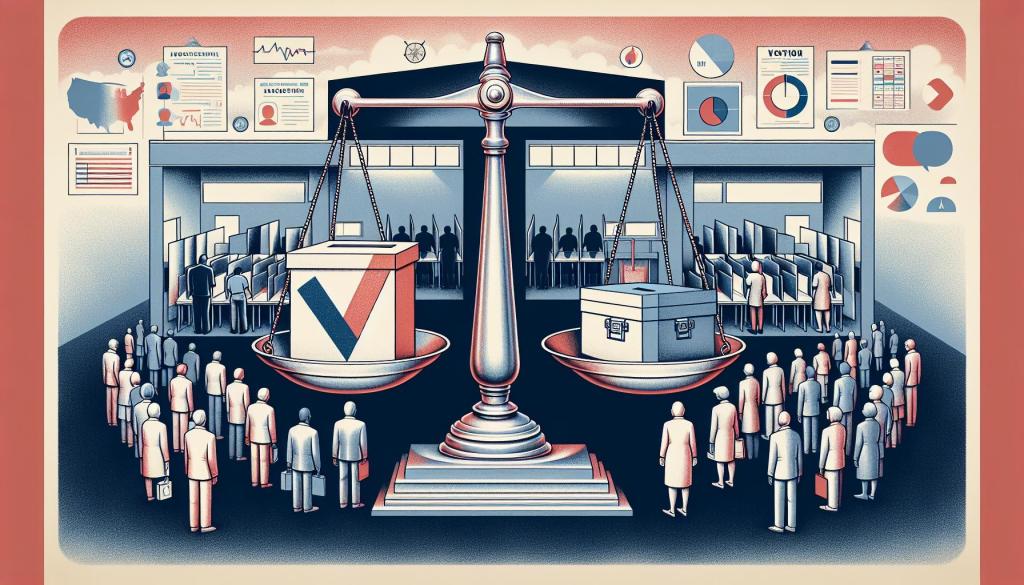
Voter ID laws sit at the center of a fierce debate over how to balance ballot access and election security. This report examines what the best available evidence actually shows: how strict ID requirements affect turnout overall, who bears the greatest costs, and whether these rules meaningfully deter fraud. We review contested empirical findings on turnout and causality, including studies that reach sharply different conclusions about racial disparities. We then weigh turnout effects against direct evidence on the rarity of in-person voter fraud. Finally, we assess whether “neutral” ID rules function in practice as tools of passive voter suppression.
Across the recent empirical literature, strict voter ID laws—those that require specific forms of photo identification and make it difficult or impossible to cast a regular ballot without them—emerge as the most relevant category for understanding real-world effects. Earlier studies mostly examined weaker ID rules and relied heavily on self-reported turnout, which tends to overstate participation and can mask subgroup differences [2]. As researchers shift toward focusing on strict regimes and using validated administrative turnout data, the apparent neutrality and limited impact of voter ID requirements come into question.
When examining turnout, several methodologically credible studies document measurable and often substantial reductions associated with strict voter ID laws, especially for racial and ethnic minorities and Democratic-leaning groups. Analyses using county-level official turnout and difference-in-differences designs that exploit the timing of strict ID adoption find that majority-minority counties in states implementing new strict ID laws experienced turnout declines several percentage points larger than similar counties in states without such laws [2]. In one set of estimates between 2012 and 2016, majority-minority counties in strict ID states saw a 5.3-point drop in turnout compared with a 0.6-point drop in non-strict states—a 4.7-point differential—and minority turnout fell 2.3 percentage points more than white turnout under strict regimes, both effects statistically robust [2]. These results suggest that strict ID laws “represent a major burden that disproportionately affects minorities and significantly alters the makeup of the voting population” [2].
Survey-based work that distinguishes strict from non-strict laws and uses large samples reaches similar conclusions about distributional consequences. Using the Cooperative Congressional Election Study, researchers find that in states with strict photo ID rules, racial turnout gaps widen markedly: the Latino–white turnout gap is more than twice as large in strict ID states compared to states without such laws (13.5% vs. 4.9%), with similarly enlarged gaps for Asian (11.5% vs. 6.5%) and Black voters (5.1% vs. 2.9%) [3]. Other analyses of the 2012 and 2016 elections show that in states newly adopting strict ID (e.g., Alabama, Mississippi, Virginia, Wisconsin), the probability of voting for registered minority voters declined by roughly eleven percentage points more than in other states, after accounting for controls and pre-existing trends [1], [3]. These patterns indicate that strict ID rules amplify existing racial disparities in participation even when overall aggregate turnout shifts might appear modest.
Complementary work narrows attention to the individuals most likely to be directly constrained by ID requirements—those without driver’s licenses or other acceptable IDs. Studies that link administrative voter records to license databases in places like Rhode Island and Texas find turnout reductions of about 2–3 percentage points among non-licensed individuals following implementation of voter ID rules, with smaller but still detectable overall turnout effects on the order of 0.4–1.8 percentage points [3]. This approach helps address the dilution problem implicit in average-effects analyses: because most people already have IDs, aggregate measures can understate the impact on the specific populations actually at risk of being unable to vote.
Not all high-quality research finds large or clearly differential impacts, however. Some difference-in-differences studies that compare white and non-white voters across states with and without strict ID laws report no statistically significant racial gap in turnout changes, with coefficients for whites slightly negative and for non-whites slightly positive but both imprecisely estimated [1]. These findings directly challenge the strongest suppression claims and highlight how sensitive estimated effects are to choices about data sources (surveys vs. administrative records), units of analysis (individuals, counties, states), and model specification. From a causal-inference standpoint, the literature remains contested: elections are infrequent, strict laws are relatively recent, and turnout is shaped by many concurrent factors such as mobilization, campaign intensity, and other institutional changes. Even sophisticated difference-in-differences designs must rely on assumptions about parallel pre-trends that are inherently difficult to verify.
Despite this methodological variation and some inconclusive or null findings, a growing body of evidence points toward a consistent pattern: strict photo ID requirements tend to depress turnout more for minorities, low-income voters, and Democratic-leaning constituencies than for white and more affluent voters, thereby enlarging racial and partisan turnout gaps [1], [2], [3]. Because those directly affected are already groups facing structural barriers to participation, the laws’ burdens are not evenly distributed. The emerging consensus, especially in research using validated turnout and focusing specifically on strict ID regimes, is that formally neutral ID rules can have substantively non-neutral, disparate racial and partisan effects.
The impact of strict voter ID laws must also be evaluated relative to the scale and type of fraud they are intended to prevent. Proponents typically frame these laws as necessary to combat in-person voter impersonation. Yet multiple studies, as well as high-profile official inquiries, have struggled to identify more than vanishingly small amounts of this type of fraud [1]. A particularly informative line of evidence comes from administrative records in Florida and Michigan that track ballots cast without ID. Using these data, researchers estimate that at most 0.10% of votes in Florida and 0.31% in Michigan are cast without identification—figures that represent upper bounds on the number of ballots that could be blocked or subject to impersonation under strict ID requirements [2]. Even under the extreme and unrealistic assumption that every such ballot is fraudulent and uniformly favors a single candidate, these numbers are rarely large enough to change electoral outcomes across a dataset of more than 2,000 races [2].
This juxtaposition—nontrivial reductions and racial disparities in turnout on one side, and extremely low rates of the targeted fraud on the other—underscores a sharp asymmetry in the cost–benefit profile of strict voter ID laws. On the benefit side, the marginal gain in election security appears small, aimed at a form of misconduct that available evidence suggests is exceedingly rare and unlikely to swing most contests. On the cost side, the laws create additional hurdles for particular subsets of eligible voters, contribute to widening racial turnout gaps, and can alter the partisan composition of the electorate, especially in close races [1], [3]. The combination raises questions about whether strict voter ID rules function more as instruments of passive voter suppression than as proportionate safeguards of electoral integrity.
Given these tradeoffs and the current state of the evidence, many researchers recommend caution in claiming precise magnitudes for turnout effects or racial disparities, emphasizing the need for more elections under stable ID regimes and more comprehensive administrative datasets. At the same time, they argue that policymakers should weigh alternative, less exclusionary election-security measures that do not risk disproportionately burdening minority and low-income voters [1], [3]. Overall, while empirical estimates vary and some studies find minimal differential effects, the balance of contemporary research indicates that strict voter ID laws address a very small slice of potential fraud at a nontrivial cost to equal access to the ballot.
Conclusion
Across these studies, strict voter ID laws emerge as a policy with clear costs and uncertain benefits. The best available causal evidence is mixed on the exact size of turnout reductions, but the weight of newer, higher-quality research points to nontrivial, disproportionate declines among racial and ethnic minorities and other marginalized groups. At the same time, in-person voter impersonation—the only fraud these laws clearly target—appears exceedingly rare and rarely outcome-changing. Given this asymmetry, strict ID requirements look less like neutral safeguards and more like rules that risk skewing participation. Policymakers should prioritize election-security measures that protect integrity without suppressing legitimate votes.
Sources
[1] https://ojs.lib.uwo.ca/index.php/wuer/article/download/14023/11271
[2] https://esra.wisc.edu/wp-content/uploads/sites/1556/2020/11/hajnal.pdf
[3] https://www.nber.org/system/files/working_papers/w26206/w26206.pdf
[4] https://ccis.ucsd.edu/_files/journals/6voter-identification-laws-and-the-suppression.pdf
[5] https://pages.ucsd.edu/~zhajnal/page5/documents/voterIDhajnaletal.pdf
[6] https://www.law.berkeley.edu/wp-content/uploads/2019/10/Passive-Voter-Suppression-8-12-clean-draft.pdf
Written by the Spirit of ’76 AI Research Assistant



 Realizing News
Leave a comment