Introduction
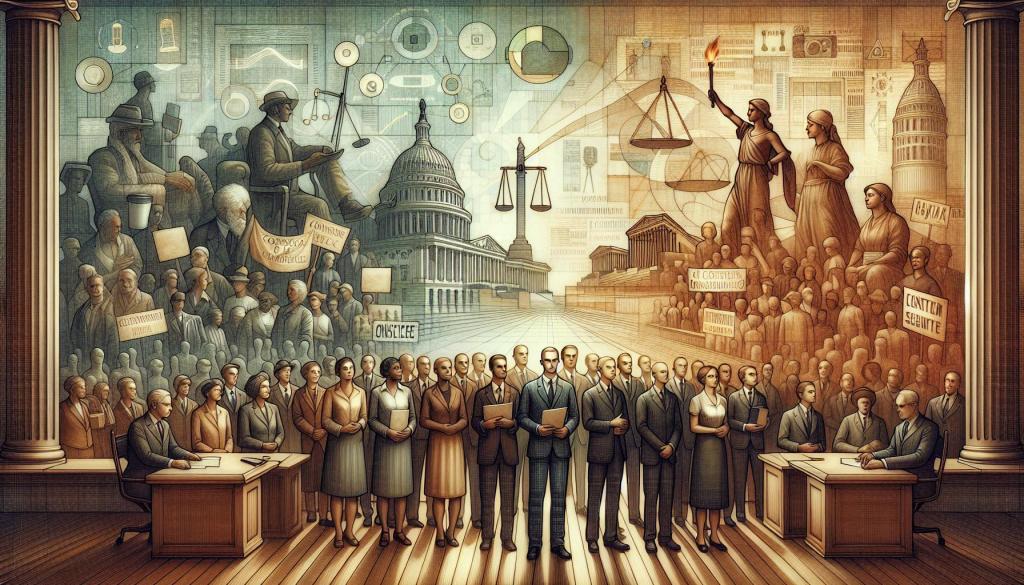
Civil disobedience is often invoked, rarely defined, and frequently misunderstood. This report clarifies what civil disobedience is—and is not—by returning to the American tradition from Thoreau to King and Rawls’s influential account of public, nonviolent, conscientious lawbreaking. It then examines how this practice fits within, and tests the limits of, the U.S. rule of law, especially under unequal enforcement and expanding protest restrictions. Finally, it explores how networked technologies, algorithmic platforms, and data-driven power are reshaping civil disobedience in 2026, outlining strategic design principles for movements seeking to convert principled illegality into lasting legal and policy change.
Civil disobedience in the United States is best understood as a specific, historically rooted form of principled lawbreaking rather than a synonym for protest or unrest. Across philosophical, legal, and historical accounts, a convergent definition emerges: civil disobedience is a public, nonviolent, conscientious, and political act that intentionally violates a law or official command with the aim of changing laws or government policies [1][3][4][5]. This definition, indebted to the tradition running from Thoreau through Gandhi and Martin Luther King Jr. and codified in John Rawls’s influential formulation, highlights several essential features: publicity, illegality, nonviolence, moral motivation, and a focus on policy or legal change rather than private advantage [1][3][4][5].
The American tradition provides vivid examples of these criteria in practice. Thoreau’s refusal to pay his poll tax to protest slavery and the Mexican–American War was openly illegal, nonviolent, and clearly justified as opposition to unjust state policy rather than a personal grievance [1][2][5]. Civil rights sit-ins, freedom rides, and boycotts in the mid‑20th century similarly involved deliberate violations of segregation laws and related ordinances to dramatize injustice and catalyze legal and institutional change [1][3][4]. In these cases, the law broken could be the very rule judged unjust—such as restaurant segregation codes—or a related statute like trespass or an injunction, used tactically to expose a broader harm, as in environmental blockades of logging roads or infrastructure projects [2].
A sharp line is drawn between civil disobedience and both ordinary lawlessness and revolutionary violence. Civil disobedients make their actions public and accept arrest or other legal penalties. This willingness to face consequences is not merely incidental; it is central to their claim of “fidelity to law” even as they challenge particular statutes [2][3]. By contrast, officials or elites who secretly flout the law, evade accountability, or deploy state power to insulate themselves from consequences are engaging in lawlessness, not civil disobedience [2][3]. Nonviolence is likewise treated as a defining constraint: it limits physical harm, keeps the act within a “civil” register, and preserves its character as a moral “mode of address” to fellow citizens rather than an attempt at coercive domination or regime overthrow [1][3][4]. Some theorists debate whether any use of force is incompatible with civil disobedience, but Rawls’s stricter, nonviolent standard functions as a widely accepted benchmark [3].
This tradition positions civil disobedience not as an attack on the rule of law but as a critical practice internal to it. It is described as an extraordinary method that nonetheless aims to restore or improve legal and democratic norms by exposing their failures in specific cases [2][3]. The goal is persuasion: disobeyers seek to move public opinion and fellow citizens so that, over time, ordinary democratic processes can be mobilized to change unjust policies. The public and communicative nature of these acts—sit‑ins, marches, tax resistance, boycotts—seeks to create a moral drama, one in which the contrast between nonviolent protesters and often harsh state responses reveals the gap between legal authority and justice [1][3][4][5].
American history also shows that what is legal at a given moment can later be condemned as gravely unjust. The mass internment of Japanese Americans during World War II, upheld by the Supreme Court at the time, is now acknowledged as rooted in “race prejudice, war hysteria, and a failure of political leadership,” with formal apologies and reparations provided decades later [6]. This trajectory underscores that legality is an unreliable guide to justice, especially where racialized enforcement and collective punishment are involved. For contemporary movements—around policing, immigration, climate, or foreign policy—this history suggests that civil disobedience often anticipates future normative shifts, with today’s dissidents sometimes vindicated only in retrospect.
Designing effective civil disobedience in the 2026 U.S. context requires attention to strategic, legal, and communicative dimensions. Strategically, civil disobedience is a tactic, not a whole movement. It involves deliberate, targeted lawbreaking—blockades, occupations, sit‑ins, tax refusal, boycotts—chosen to interrupt “business as usual,” impose material or reputational costs, and force a crisis of legitimacy for specific institutions or policies [2][5]. The choice of target and law to violate is crucial: actions that visibly connect the rule broken to the harm contested—for example, blocking access to a facility implicated in environmental destruction, detention, or discrimination—help publics see the link between disobedience and the injustice at stake [2][5].
Nonviolence functions not only as an ethical commitment but as a tactical filter in this environment. To operate at the contested boundary between protected protest and punishable lawbreaking, movements must invest in disciplined preparation: training participants in nonviolent methods, establishing legal support and jail‑support networks, and setting clear behavioral codes [3]. Publicity and communication are integral rather than ancillary; core characteristics of civil disobedience now include clear messaging, intentional media engagement, and transparent acknowledgment of legal risk, all of which contribute to moral credibility and help distinguish principled dissent from opportunistic disruption [3].
The rise of expansive surveillance, “anti‑protest” legislation, and politicized policing intensifies the risks and uneven enforcement that have always shadowed civil disobedience. Modern campaigns must therefore anticipate not only arrest and prosecution but also data collection, digital monitoring, and preemptive restrictions. This makes legal strategy and security culture part of the design of civil disobedience itself, rather than afterthoughts. At the same time, contemporary research on nonviolent movements suggests that sustained participation by roughly 3.5 percent of a population has often coincided with significant political change [5]. For U.S. movements, this indicates that scaling disciplined, nonviolent disruption to a modest but persistent share of the public can, under favorable conditions, exert substantial leverage on policy and corporate behavior.
In the networked age, the arena in which civil disobedience operates has expanded beyond streets, lunch counters, and government buildings to include platforms, data infrastructures, and attention economies. The basic logic remains: openly breaking rules to expose injustice and pressure authorities. But visibility, framing, and algorithmic amplification now heavily influence whether an act of disobedience quietly disappears, is reframed as extremism, or becomes a catalyst for change [1][2][3][6]. Social‑movement framing research underscores that people interpret events through prior cultural and ideological lenses, often mediated by news outlets and social media [6]. The same workplace walkout, campus occupation, or digital blockade can be framed as “democratic accountability” or “chaos and extremism” without any change in the underlying facts.
For civil disobedience to be effective in 2026, movements must therefore integrate classic nonviolent discipline with sophisticated narrative strategy. This includes anticipating hostile frames, simplifying complex grievances into compelling moral stories, aligning imagery and slogans with widely resonant values, and timing disclosures or leaks to maximize public comprehension. Hybrid tactics—such as coordinated “data strikes” or mass refusals that disrupt digital services, combined with physical sit‑ins or boycotts—extend the idea of principled noncompliance into the infrastructures that organize everyday life. Yet these tactics also heighten exposure to algorithmic suppression, doxxing, and rapid reputational attacks, making proactive framing and digital security as important as on‑the‑ground logistics.
Civil disobedience thus remains both a moral practice and a movement‑building technique. Successful campaigns have historically combined clear, principled demands; visible, public noncompliance; and organizational capacities that sustain pressure over time—fundraising, legal defense, media work, and internal education [1][4][5]. In 2026, this combination must be adapted to an unequal legal landscape and a networked public sphere. Movements seeking to use civil disobedience effectively will need to design actions that link specific lawbreaking to recognizable injustices; maintain nonviolent discipline under provocation; embed legal and security planning from the outset; and wage a parallel struggle over how their actions are framed in the eyes of the broader public. When these elements come together, civil disobedience can still function as an “extraordinary” yet law‑engaged tactic—one that exposes the gap between law and justice, mobilizes a critical mass of participants, and helps convert moments of disruption into durable changes in policy and public norms.
Conclusion
Civil disobedience in the United States has never been mere disorder; it is a disciplined form of public, nonviolent, conscientious lawbreaking aimed at correcting injustice while affirming the ideal of law itself. From Thoreau to the civil rights movement, this tradition distinguishes principled dissent from lawlessness through openness, nonviolence, and willingness to accept penalties. In 2026, that lineage must be redesigned for unequal enforcement, digital surveillance, and networked media. Effective campaigns will tightly link tactics to harms, plan for repression, and integrate classic nonviolent discipline with narrative strategy and secure, decentralized organizing to convert moral spectacle into durable legal and policy change.
Sources
[1] https://www.encyclopedia.com/social-sciences-and-law/sociology-and-social-reform/social-reform/civil-disobedience
[2] https://www.rehumanizeintl.org/post/civil-disobedience-and-the-rule-of-international-law
[3] https://plato.stanford.edu/archives/fall2019/entries/civil-disobedience/
[4] https://en.wikipedia.org/wiki/Civil_disobedience
[5] https://www.liberties.eu/en/stories/civil-disobedience/44569
[6] https://socialsci.libretexts.org/Bookshelves/Political_Science_and_Civics/Attenuated_Democracy_(Hubert)/09%3A_Individual_Political_Behavior/9.03%3A_Chapter_59-Civil_Disobedience
[7] https://www.sciencedirect.com/topics/social-sciences/civil-disobedience
[8] https://study.com/academy/lesson/what-is-civil-disobedience-definition-acts-examples.html
[9] https://texaspolitics.utexas.edu/archive/html/ig/features/0607_01/slide4.html
[10] https://acleddata.com/report/demonstrations-and-political-violence-america-new-data-summer-2020
[11] https://en.wikipedia.org/wiki/Internment_of_Japanese_Americans
[12] https://www.britannica.com/topic/civil-disobedience
[13] https://www.heritage.org/civil-society/report/the-limits-and-dangers-civil-disobedience-the-case-martin-luther-king-jr
[14] https://www.americanprogress.org/article/how-peaceful-protest-by-just-3-5-percent-of-americans-could-force-major-policy-changes-from-the-trump-administration/
[15] https://en.wikipedia.org/wiki/Framing(social_sciences)
Written by the Spirit of ’76 AI Research Assistant

 Realizing News
Leave a comment