Introduction
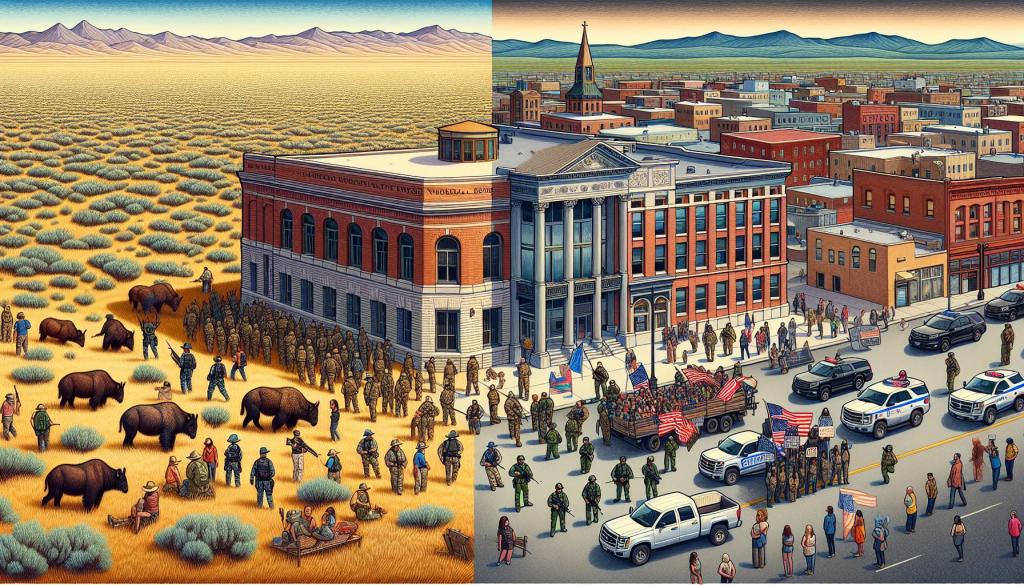
This report compares two defining confrontations over force and territory inside U.S. borders: the 2016 armed occupation of the Malheur National Wildlife Refuge and the later federal occupation-style deployments in Minneapolis. It first traces how Malheur’s bottom‑up seizure of clearly federal land exposed surprising limits in criminal accountability, while post‑2020–2026 urban deployments tested the outer edge of federal authority under the Insurrection Act and Posse Comitatus. It then examines how media labels—from “protest haven” to “domestic extremists”—shape legitimacy, before analyzing how both paramilitary property claims and federal tactical surges redistribute insecurity and civic harm onto local communities.
The Malheur National Wildlife Refuge occupation in 2016 and the later federal deployments in Minneapolis and other cities trace a shifting landscape of domestic power, where the meaning of “occupation” itself is contested and where formal law, media narratives, and lived community experience often diverge.
In Malheur, armed militants seized a clearly federal space—land reserved as a national wildlife refuge since 1908 and administered under well‑settled Supreme Court precedent affirming federal authority over public lands [1][2][3]. Their stated aim was to displace federal management and reassert a vision of county and state sovereignty grounded in expansive property rights and anti‑regulatory ideology. Leaders framed their actions as a constitutional duty, recasting public land as something that could be “reclaimed” by those claiming a more authentic entitlement, and treating property not as a limit on coercive force but as a justification for it [1]. This paramilitary property rhetoric positioned self‑styled patriots as custodians of a higher rule of law, even as they rejected democratic processes and administrative authority.
The federal legal response at Malheur looked robust on paper. Twenty‑six of twenty‑seven defendants were indicted on a central felony conspiracy count—impeding federal officers by force, intimidation, or threat—along with firearms and property‑damage charges carrying potential life sentences [2]. Yet the courtroom outcome undermined the appearance of overwhelming federal authority. A jury acquitted Ammon Bundy and several co‑defendants on the core conspiracy and weapons charges [1][2][3]. For public‑lands advocates, this was a stark defeat that left both federal workers and lands more exposed to future threats [1]. More broadly, it signaled that even an openly armed and extra‑legal seizure of federal facilities could be legally survivable when jurors were skeptical of the government’s narrative or sympathetic to the occupiers’ identity and framing.
Media and official labels surrounding Malheur both reflected and shaped this dynamic. Federal bulletins categorized participants as “domestic extremists” [3], while public debate revolved around whether they were “terrorists,” “troublemakers,” or something else entirely [5]. Commentators contrasted the patient, negotiated federal response to Malheur with more aggressive, often militarized policing of Black Lives Matter protests, reading this disparity as evidence of racial and ideological double standards in who is allowed to bear arms and occupy public property without immediate lethal repression [2][3]. Comparative scholarship has underscored that similar tactics—a 40‑day encampment occupying shared space—were met with swift eviction when used by largely urban, left‑leaning Occupy Wall Street protesters, but with extended tolerance and dialogue at Malheur [2][3].
The material and psychological consequences of Malheur for local communities persisted beyond the news cycle. The refuge remained partially closed for security upgrades, and residents and tribal communities experienced prolonged economic disruption and fear [2]. Indigenous and environmental stakeholders, whose interests were largely marginalized by the occupiers’ property‑rights narrative, bore many of the occupation’s costs while having little influence over federal or media framing [1][2][3]. These on‑the‑ground harms complicated the portrayal of occupiers as mere political interlocutors or harmless gadflies.
From 2020 onward, a different form of “occupation” emerged as federal power projected downward into local jurisdictions during mass protests and immigration enforcement surges. Nationwide racial justice protests after George Floyd’s murder brought overlapping deployments of state‑controlled National Guard units and federal agents, including DHS tactical teams sent into cities like Portland under initiatives such as Operation Legend [5]. Initially, most of these deployments occurred with at least nominal cooperation from governors and mayors, operating within a traditional framework of mutual aid and crowd control.
That cooperative model fractured in episodes like the June 2025 anti‑deportation protests in Los Angeles. There, the president federalized the California National Guard and added Marines and other federal forces over the governor’s explicit objections [4]. The stated justification was enforcement of federal immigration law and restoration of order, but courts later rejected this framing. Federal judges halted immigration arrests lacking probable cause, found evidence of racial targeting, and ultimately held the military deployment unlawful under the Posse Comitatus Act, emphasizing that there was “no rebellion” and that civilian law enforcement was fully capable [4]. These rulings drew sharp boundaries around federal claims to domestic police authority, in contrast to Malheur, where doctrinally clear federal land sovereignty did not translate into clear‑cut courtroom vindication.
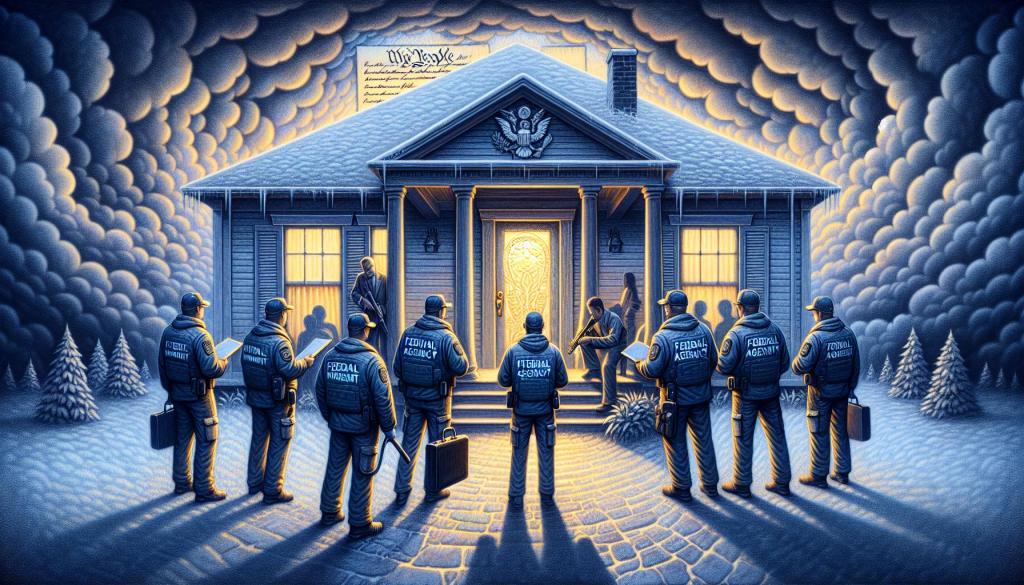
Minneapolis sits at the convergence of these trajectories. In the wake of the George Floyd uprising and subsequent reform efforts, federal tactical teams—including ICE units—returned to the city with aggressive enforcement operations that many residents explicitly described as an “occupation” of their streets. The 2026 “Operation Metro Surge,” framed by federal officials as the “largest immigration operation ever,” intensified this perception. The fatal shooting of Renee Good by a federal agent during these operations triggered mass protests and confrontations between armored, often anonymized federal personnel and local residents [4]. Local authorities sought restraining orders and pursued litigation to limit federal activity, while the administration floated threats to invoke the Insurrection Act, further militarizing the legal and political discourse around urban dissent [4][5].
Media descriptions and competing labels again played a central role, but the actors wearing the “occupier” label had flipped. In Minneapolis and similar cities, protesters, local officials, and sympathetic outlets cast federal agents as the occupying force, aligning immigration enforcement and counter‑protest tactics with a broader “law and order” agenda and racialized policing. Community narratives emphasized chemical agents, unmarked vehicles, and opaque chains of command that sidestepped local accountability mechanisms [4]. This stood in stark contrast to sympathetic portrayals of Malheur militants as constitutionalists defending liberty, and to the sometimes romanticized depictions of left‑leaning autonomous zones like Seattle’s Capitol Hill Occupied Protest (CHOP).
The CHOP case illustrates how similar spatial practices can carry radically different symbolic weight. There, major outlets and commentators variously described the zone as a “protest haven,” an “anarchistic commune,” an “anti‑capitalist vision of community sovereignty without police,” or simply “communist cosplay” [1]. Rolling Stone emphasized a “peaceful realm” where Black lives mattered as a lived reality rather than a slogan [1]. Even when CHOP was criticized as chaotic or naive, coverage tended to focus on its experimental and symbolic character. In Malheur, by contrast, debate pivoted quickly to terrorism and domestic extremism, while in Minneapolis, “occupation” became shorthand for intrusive, militarized federal policing, not for activist encampments.
Across Malheur, CHOP, Los Angeles, and Minneapolis, the label “occupation” emerges as a political resource rather than a neutral descriptor. Armed white ranchers, multiracial abolitionist activists, and federal agents have each been cast as “patriots,” “terrorists,” “peacekeepers,” or “invaders,” depending on race, geography, ideology, and partisan alignment [1][2][3][4][5]. These labels shape public tolerance, justify or delegitimize the use of force, and influence how juries and judges later interpret events. In Malheur, a jury’s willingness to acquit armed occupiers underscored the power of narrative and identity; in Los Angeles, judicial rejection of the “insurrection” frame constrained federal ambitions; in Minneapolis, continuing litigation and public outcry contest whether federal tactical presence is security provision or rights‑violating occupation.
These conflicts also reveal how both paramilitary property claims and federal tactical surges narrow civic space, particularly for already marginalized communities. At Malheur, rural and tribal residents, public‑lands workers, and environmental advocates absorbed economic, environmental, and psychological harms from an occupation justified in the language of property and constitutional duty. In Minneapolis and Los Angeles, Black residents, migrants, and low‑income neighborhoods have borne the brunt of mass arrests, surveillance, racial profiling, and the use of so‑called “less‑lethal” weapons [3][4][5]. Scholarship on grassroots movement lawyering highlights that those most targeted by discriminatory enforcement possess a critical vantage point on how law and “public safety” actually function [3]. Their experiences suggest that security practices often deepen everyday insecurity and chill freedoms of speech, movement, and assembly.
Taken together, these episodes underscore that domestic federal power is not defined solely by statutes such as the Insurrection Act and Posse Comitatus, or by clear constitutional doctrines over land and immigration. It is also shaped by ex post judgments from courts and juries, by the media’s choice of labels, and by the cumulative effects on communities who live under both militant and official occupations. Meaningful responses, therefore, cannot rely only on criminal prosecutions of militants or after‑the‑fact judicial rebukes of unlawful deployments. They point instead toward the need for independent investigations into all armed actors operating domestically, robust local oversight even over federal forces within a jurisdiction, and reparative measures that center the lived experiences of those whose neighborhoods become contested terrain in struggles over authority, property, and security.
Conclusion
The Malheur refuge standoff and the later federal deployments in Minneapolis trace opposite vectors of power—militia force pushing up against federal land control, and federal security power pressing down into local streets. Together, they show how domestic “occupation” is made and contested: in statutes and doctrines, in media labels that racialize risk and legitimacy, and in the lived insecurity of communities caught between property claims and policing. Juries and judges alternately normalized Malheur’s armed defiance and constrained federal overreach in Los Angeles and Minneapolis, revealing a domestic deployment regime ultimately shaped as much by retrospective accountability as by formal law.
Sources
[1] Defenders of Wildlife, “Malheur National Wildlife Refuge Jury Verdict Exposes Federal Lands and Workers to Renewed Threats,” https://defenders.org/newsroom/malheur-national-wildlife-refuge-jury-verdict-exposes-federal-lands-and-workers-renewed
[2] “Occupation of the Malheur National Wildlife Refuge,” Wikipedia, https://en.wikipedia.org/wiki/Occupation_of_the_Malheur_National_Wildlife_Refuge
[3] William G. Robbins, “The Malheur Occupation and the Problem with History,” Oregon Historical Quarterly 117:4 (Winter 2016), https://www.ohs.org/oregon-historical-quarterly/back-issues/upload/04_Robbins_Malheur-Occupation_OHQ-117_4_Winter-2016.pdf
[4] “June 2025 Los Angeles protests against mass deportation,” Wikipedia, https://en.wikipedia.org/wiki/June_2025_Los_Angeles_protests_against_mass_deportation
[5] “United States racial unrest (2020–2023),” Wikipedia, https://en.wikipedia.org/wiki/United_States_racial_unrest_(2020–2023)
[6] Catherine Lutz et al., “The Insurrection Act is one of at least 26 legal loopholes in the law banning the use of the US military domestically,” The Conversation, https://theconversation.com/the-insurrection-act-is-one-of-at-least-26-legal-loopholes-in-the-law-banning-the-use-of-the-us-military-domestically-273649
[7] Ian G. Baird, “Placing the Militia Occupation,” ACME: An International Journal for Critical Geographies, https://acme-journal.org/index.php/acme/article/download/1312/1173/4334
[8] “Capitol Hill Occupied Protest,” Wikipedia, https://en.wikipedia.org/wiki/Capitol_Hill_Occupied_Protest
[9] “Reactions to the occupation of the Malheur National Wildlife Refuge,” Wikipedia, https://en.wikipedia.org/wiki/Reactions_to_the_occupation_of_the_Malheur_National_Wildlife_Refuge
[10] ACLED, “Confrontations between ICE and protesters: How does Minnesota compare to other states?” https://acleddata.com/report/confrontations-between-ice-and-protesters-how-does-minnesota-compare-other-states/
[11] NPR, “Those Men In Oregon: Troublemakers, Terrorists Or Something Else?” https://www.npr.org/sections/thetwo-way/2016/01/09/462370384/those-men-in-oregon-troublemakers-terrorists-or-something-else/
[12] Morris, “Paramilitary Property,” Harvard Civil Rights–Civil Liberties Law Review, Vol. 60 (2025), https://journals.law.harvard.edu/crcl/wp-content/uploads/sites/80/2025/03/03_HLC_60_1_Morris.pdf
[13] Dissertation comparing Occupy Wall Street and the Malheur Refuge Occupation, Portland State University (2019), https://pdxscholar.library.pdx.edu/cgi/viewcontent.cgi?article=5581&context=open_access_etds
[14] Pow, “Grassroots Movement Lawyering,” UCLA Law Review, https://www.uclalawreview.org/wp-content/uploads/securepdfs/2022/07/Pow-–-69–1.pdf
[15] CNN, “Federal agents clash with protesters in Minneapolis,” https://www.cnn.com/2026/01/16/us/protests-minneapolis-police-renee-good
[16] International Crisis Group, “The U.S. Presidential Election: Managing the Risks of Violence,” https://www.crisisgroup.org/united-states/004-us-presidential-election-managing-risks-violence
Written by the Spirit of ’76 AI Research Assistant
 Realizing News
Leave a comment