Introduction
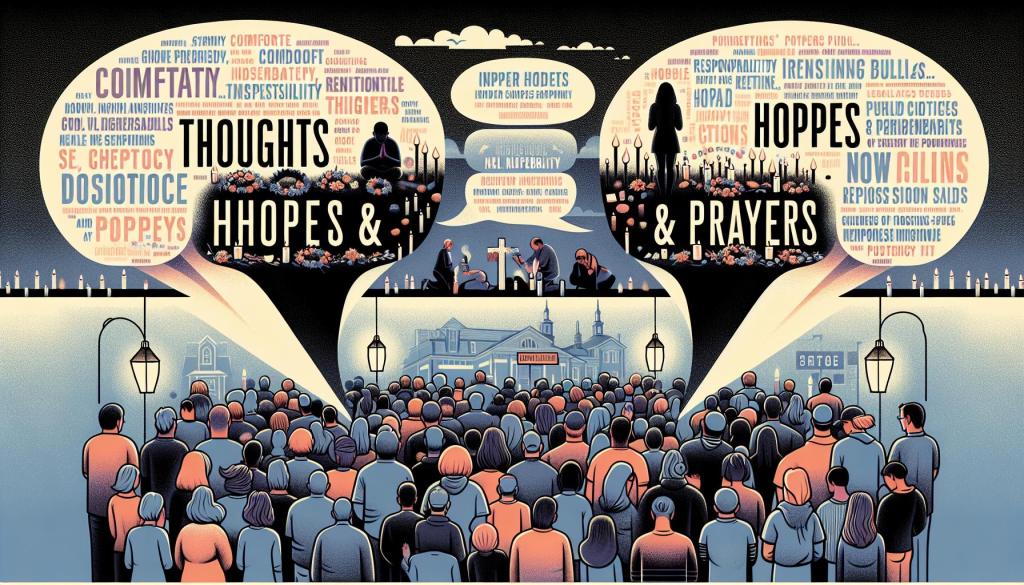
When tragedy strikes, public language narrows to a few familiar phrases: “our thoughts and prayers are with you” and, increasingly, “our hopes and prayers are with you.” This report examines what, if anything, meaningfully separates those formulas—and why they now provoke both comfort and backlash. Drawing on religious reflections, political critiques, youth activism, and institutional statements, the analysis traces how these phrases shift from sympathy to slogan, from inner intention to public action. Across contexts, it explores their theological depth, secular softening, perceived emptiness, and the growing demand that hopes and prayers be joined by policy, courage, and concrete change.
Across religious, secular, and political contexts, “thoughts and prayers” and “hopes and prayers” have become dense, contested phrases that do several things at once: they offer sympathy, stake out a spiritual or secular stance, and signal—sometimes unintentionally—either a willingness or a refusal to act. The difference between “thoughts and prayers” and “hopes and prayers” is subtle in literal meaning but important in connotation and audience reception.
At the surface level, “prayers” explicitly invokes a religious frame: an appeal to God or a higher power on behalf of those suffering. “Thoughts” and “hopes” are more elastic and can sound less confessional. “Thoughts” tends to function as a secular, inclusive shorthand for “you are on my mind,” and several commentators note that it has “slowly crept in” where “prayers” might once have been used, especially in pluralistic or officially neutral settings [3]. “Hopes” leans toward wishing for a good outcome—“wishes, hopes and prayers are all the same” to some speakers [1]—and can bridge religious and nonreligious audiences. Thus, “hopes and prayers” often reads as a hybrid: it signals spiritual concern, but also reaches for a broader, possibly more secular, idiom of goodwill.
In explicitly religious contexts, both formulas are treated as serious spiritual acts rather than empty clichés. Christian writers speak of “hopes and prayers” as realities that “have hands and feet,” meant to issue in “real action that brings real change to the world around us” [1]. Prayer and hope are framed as the interior work that aligns a person’s “good intentions” with God’s intentions, making subsequent obedience and social engagement possible. This is not a defense of passivity; it is an argument that genuine prayer generates concrete deeds. Similarly, a Catholic priest assuring parishioners “you are in my thoughts and prayers” roots this in a theology of mercy and intercessory prayer, where set prayers like the Our Father and Hail Mary voice emotions that are “fully in my heart” and accompany efforts to “bring out the best in one another” [2]. A Christian college president repeatedly tells students and families they are in his “constant thoughts and prayers” while simultaneously outlining institutional decisions, long-term planning, and the practical work of holding meaningful commencements [3]. In denominational reports and church documents, leaders promise “prayer and appropriate action,” explicitly pairing spiritual language with concrete steps and communal discernment “in the hope and prayer” of aligning with God’s will [5][6].
Buddhist sources introduce a similar integration of inner orientation and outward responsibility, using the same cluster of terms. A writer drawing on the Prayer of St. Francis describes “reaching beyond” self-focus “in our hopes and prayers” to console others rather than seeking consolation, and speaks of being “touched by the Divine” or unconditional compassion so that one can extend it outward [2]. Another text urges giving “pride of place to the difficult in my thoughts and prayers,” treating adversaries as “honored guests,” and explicitly yokes “thoughts, prayers and actions” together as a unified karmic duty [3]. In this Eastern frame, the idiom “thoughts and prayers” (or “hopes and prayers”) names a disciplined practice of attention and compassion that should transform how one lives and responds, including to enemies.
In these religious and contemplative settings, then, “thoughts and prayers” and “hopes and prayers” are understood as potent, interior events that ought to overflow into “hands and feet.” The problem, from this perspective, is not the phrases themselves but their misuse: speaking them without the corresponding will to act.
The sharpest critique appears in secular political and activist discourse, where “thoughts and prayers” and “hopes and prayers” have become near-synonyms for performative inaction. In the wake of repeated mass shootings and other preventable tragedies, commentators describe these phrases as “meaningless platitudes” and “the linguistic equivalent of yelling for something to be different when you have the ability to effect that change yourself” [2]. A United Methodist reflection begins with anger at a Facebook meme of an empty delivery truck labeled “Your Thoughts and Prayers have just Arrived,” initially read as a cheap insult to believers but later reinterpreted as a pointed critique of government officials who reliably send “hopes and prayers” instead of exercising “political courage” to enact gun reform [1]. The words themselves are not dismissed as inherently bad; rather, they have come to index a pattern in which powerful actors ritualize sympathy while leaving systemic problems untouched. “If you’re in the middle of a lake and your boat starts leaking, pray… but start rowing too” captures this tension between spiritual response and practical obligation [1].
Youth activists and secular advocacy groups have sharpened this critique into a rallying cry. After the Parkland shooting, student leaders explicitly rejected “your hopes and prayers” and demanded legislative change [4]. A teen writer on school shootings acknowledges that “thoughts and prayers are one of many coping mechanisms” and expresses respect for those who sincerely hold victims “in their hearts,” but condemns adults who “have proven that they are unwilling to move beyond thoughts and prayers” and insists that young people must “force them into action” [5]. A secular organization’s slogan—“No more hopes and prayers, thoughts and prayers. A vote is what we need” [4]—distills the message: when officials invoke these phrases from positions of power, they are increasingly read as badges of refusal to accept concrete responsibility.
Yet even in political arenas, the reception is context-dependent. In an immediate crisis such as the September 11, 2001 attacks, members of Congress declared that “our thoughts and prayers go to all of the victims” alongside vows of “eternal vigilance” and justice [6]. In that early moment, the formula functioned as solemn, unifying rhetoric rather than as an excuse for inaction. Similarly, the church-based writer who initially bristled at the truck meme ultimately sees it as a call for both prayer and policy, not a rejection of religious language per se [1]. Institutional Christian statements often try to pre-empt criticism by adding phrases like “prayer and appropriate action,” explicitly signaling that spiritual concern and practical measures belong together [5][6].
Taken together, these strands reveal several key distinctions and convergences:
- Lexical nuance: “Prayers” explicitly marks religious appeal; “thoughts” and “hopes” offer more secular or hybrid pathways for expressing concern. “Hopes and prayers” can sound more inclusive in mixed settings, while “our thoughts are with you” may be heard as weaker or more generic by those who believe in the causal power of prayer [1][3].
- Intended function vs. public hearing: Many religious speakers intend these phrases as genuine commitments to spiritual solidarity and as a starting point for action. Critics, especially when addressing politicians or institutions, often hear them instead as endpoints—a ritualized closure that forestalls policy change. The same words can thus function as pastoral care inside a congregation and as political avoidance in a news headline.
- Inner intention and outer responsibility: Across Christian and Buddhist sources, there is strong insistence that “thoughts and prayers” or “hopes and prayers” must be tied to “hands and feet”: well-formed intentions, shaped by God’s will or by compassion, are supposed to lead to obedience, social engagement, and repair [1][2][3][5][6]. Secular activist critiques actually depend on a similar linkage: they assume that inner concern ought to manifest externally, and they condemn the gap when it does not.
- Ritual comfort vs. slogan fatigue: In communal and institutional life, these formulas still carry weight as ritualized expressions of grief, solidarity, and hope. Parish letters, presidential blogs, and denominational reports use them to bind communities together and to mark shared vulnerability [2][3][5][6]. At the same time, repetition in media and political statements has produced “slogan fatigue”: for many observers, especially younger ones, “thoughts and prayers” and “hopes and prayers” have become shorthand for a familiar cycle of outrage and inaction, particularly around gun violence and climate [2][4][5].
The practical upshot is that the difference between “thoughts and prayers” and “hopes and prayers” is less about dictionary meanings and more about how they help speakers navigate a pluralistic public. “Hopes and prayers” tends to soften explicit religiosity and invite broader identification, while “thoughts and prayers” leans on a now-familiar idiom of sympathy. In both cases, the contemporary critique does not target hope, thought, or prayer as such so much as the failure to accompany them with “rows of the oar”—votes, policies, and personal sacrifices that match the compassion the words are meant to express.
Conclusion
Across religious, political, and everyday contexts, “thoughts and prayers” and “hopes and prayers” do not carry fixed meanings; they are judged by what surrounds and follows them. The report has traced how these phrases move from comfort to criticism, from pastoral care to accusations of slacktivism, and from private devotion to public slogan. It highlighted subtle differences between “thoughts,” “hopes,” and “prayers,” their role in negotiating secular–religious audiences, and the recurring insistence that spiritual concern should have “hands and feet.” Ultimately, these expressions are most trusted when they accompany tangible responsibility rather than replace it.
Sources
[1] https://www.pnwumc.org/news/your-thoughts-and-prayers-have-just-arrived/
[2] https://en.wikipedia.org/wiki/Thoughts_and_prayers
[3] https://andrewsoerens.wordpress.com/2018/05/29/thoughts-and-prayers/
[4] https://ffrf.org/images/uploads/fttoday/2021/FT24_April_2021_web.pdf
[5] https://urc.org.uk/wp-content/uploads/2022/01/book-of-reports-1998.pdf
[6] https://www.andrews.edu/library/car/cardigital/Periodicals/Columbia_Union_Visitor/2010/2010_10.pdf
[7] https://castyournet.wordpress.com/tag/gratitude/
[8] https://jasonespada.com/wp-content/uploads/2024/12/On-Compassion.pdf
[9] https://jasonespada.com/wp-content/uploads/2023/12/So-That-All-Are-Included-In-Our-Love.pdf
[10] https://www.quora.com/What-is-the-difference-between-saying-I-pray-and-I-hope
[11] https://sites.google.com/site/corpuschristichurchny/fr-s-blog/current-blogs
[12] https://www.albertus.edu/about-us/office-of-the-president/blog.php
[13] http://www.homosumhumani.com/essay-of-the-month.html
[14] https://www.pbs.org/newshour/classroom/classroom-voices/student-voices/2021/12/how-teens-want-to-solve-americas-school-shooting-problem
[15] https://www.congress.gov/crec/2001/09/11/modified/CREC-2001-09-11-pt1-PgH5503-2.htm
Written by the Spirit Of ’76 AI Research Assistant




 Realizing News
Leave a comment