Introduction
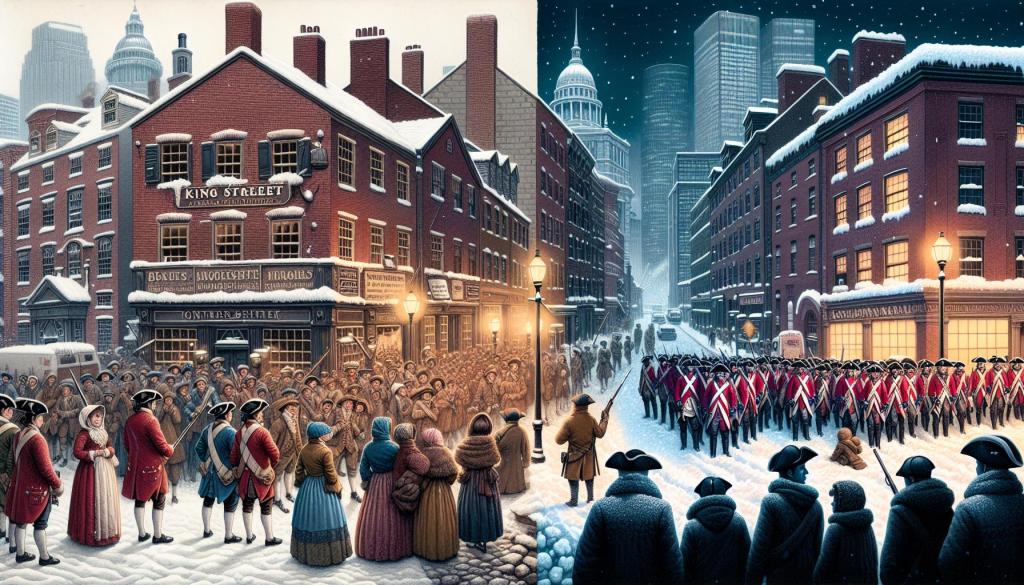
On a winter evening in 1770, musket fire on Boston’s King Street turned a simmering colonial dispute into “The Bloody Massacre.” On a winter afternoon in 2026, gunshots on a Minneapolis block near Karmel Mall turned an ICE raid into a national flashpoint. This report compares these two episodes of state violence across three dimensions: the tense urban worlds that produced sudden crowds under the gun; the legal and political struggles over authority and accountability; and the competing narratives—from “massacre” to “domestic terrorism”—that seek to fix their meaning in public memory.
The Boston Massacre of 1770 and the 1/7/26 ICE shooting in Minneapolis both arise from dense, everyday contact between armed representatives of central authority and populations that already viewed those agents as illegitimate intruders. In late‑colonial Boston, regular troops patrolled a port city steeped in non‑importation campaigns, tax resistance, and radical organizing, where soldiers off duty competed with laborers for work and drank in the same taverns as artisans and sailors [2]. Their presence symbolized “constant surveillance by the British military” and taxation without representation [2]. In Minneapolis, federal immigration officers arrived as part of what officials called the largest immigration “surge” in the region’s history, entering Somali and other immigrant neighborhoods that had built whistle networks, mutual‑aid infrastructures, and local political strategies explicitly to ward off ICE operations [4][6]. City leaders argued that these deployments made communities “less safe” and conflicted with locally defined public‑safety priorities [1][4].
In both settings, an otherwise ordinary urban space rapidly became the stage for lethal state violence. On King Street in Boston, a confrontation began when Private Hugh White struck an apprentice with his musket, drawing an “agitated mob” around the Custom House [1]. People moved through familiar sites—Liberty Tree, Dock Square, Boylston’s Alley—to challenge soldiers, and the crowd grew as apprentices, dockworkers, and other residents left their routines to converge on the commotion [1][2]. When an object struck a soldier and he reportedly cried “Damn you, fire!”, scattered shots turned a tense standoff into a deadly volley that left five colonists dead [1][3].
In south Minneapolis, a weekday streetscape near Karmel Mall similarly shifted into a contested arena after ICE agents confronted Renee Nicole Good in her vehicle [4][5]. Witnesses and initial reports describe residents running toward the scene, shouting, shoving, blowing whistles, and surrounding agents while Good lay prone on the pavement [4][6]. Some residents threw snowballs and absorbed pepper rounds as heavily armed officers formed lines in the street [4]. As in Boston, a sudden escalation unfolded in a space whose everyday geography—apartment blocks, shops, mosque and mall—already encoded political meaning; the sight of federal tactical gear there immediately signaled danger and occupation to locals.
These incidents illuminate recurring patterns in how crowds interact with armed authority. In Boston, working‑class Bostonians and sailors refused to disperse even under threat of musket fire, pressing close enough that some grabbed bayonets and hurled clubs and ice [1][2]. In Minneapolis, residents responded collectively to whistle signals, pressed physically against ICE lines, and insisted on checking on Good as she lay unresponsive, despite being met with “less‑lethal” rounds and force [4][6]. The people on the front lines in both cases—artisans, laborers, Black and Indigenous Bostonians in 1770; Black, immigrant, and working‑class Minneapolitans in 2026—became both the primary targets and the primary authors of resistance tactics, even as others later contested the legitimacy of their actions by labeling them “riots,” “terrorism,” or “mob violence.”
Law and contested authority frame how each event is understood. British regulars in Boston embodied Parliamentary power in a city whose inhabitants lacked direct representation and increasingly questioned the legality of a standing army in peacetime [2][3]. The Massacre intensified debates over soldiers quartered among civilians and whether imperial law could coexist with colonial conceptions of rights. The subsequent trials, in which John Adams defended the soldiers, became tests of whether due process was possible under occupation: could juries fairly weigh individual culpability while the troops themselves personified an illegitimate system [2][3]?
By contrast, the Minneapolis shooting unfolds within a constitutional order that formally guarantees due process, equal protection, and layered jurisdictions. Yet those guarantees are filtered through immigration status, race, and the division of authority between federal agencies and local governments. Minneapolis officials swiftly characterized the shooting as the product of “a federal agent recklessly using power” and insisted that “no one is above the law,” explicitly including federal officers [1][4]. City leaders called for independent investigations and linked the killing to structural critiques of ICE, arguing that large‑scale raids “terrorize” neighborhoods and undermine local safety strategies [1][4][6]. Out‑of‑state officials and advocates highlighted the use of masks and tactical gear by federal officers to argue that such forces exercise “unaccountable power,” and pushed for bans on concealed identities in law enforcement [4][5]. The legal questions now center not only on an individual agent’s liability, but also on how far existing oversight mechanisms can constrain federal enforcement practices that run counter to local democratic preferences.
At the heart of both episodes lies an intense struggle over narrative. The Boston Massacre entered public memory through deliberate patriot framing. Paul Revere’s engraving, published just weeks after the shooting, depicted a rigid firing line of British soldiers calmly mowing down an orderly and defenseless crowd, visually erasing the chaos, shouted insults, and thrown objects that characterized the event [1][3]. The very title, “The Bloody Massacre,” and the circulation of broadsides showing the victims’ coffins fixed the language of atrocity and martyrdom, casting the dead—especially figures like Crispus Attucks—as icons of resistance and imperial oppression [3]. British accounts, which emphasized crowd aggression and the soldiers’ fear, never achieved equal resonance in colonial public culture.
The Minneapolis case is being framed and reframed in real time through a dense media environment that both echoes and transforms eighteenth‑century dynamics. DHS and ICE officials assert that the unnamed officer fired in “self‑defense,” claiming that Good attempted to “weaponise” her car against him and situating the confrontation within a broader narrative of dangerous noncompliance [1][4]. DHS spokespeople describe the operation as a legitimate fraud and immigration enforcement action in Somali communities, while DHS Secretary Kristi Noem has characterized the incident as part of an “act of domestic terrorism” against federal personnel, invoking national security language that places the agent in the role of endangered guardian [4][5].
Local officials and witnesses present a sharply divergent account. Minneapolis Mayor Jacob Frey, after viewing video of the shooting, publicly rejected the federal self‑defense story as a “garbage narrative,” insisting that the visual evidence does not support claims that Good posed a lethal threat at the moment she was shot [2][4]. On‑scene residents say she was pregnant and struggling to breathe as agents kept knees on her body, and that officers delayed or denied aid [4][6]. Community leaders describe the death as “state sanctioned violence,” emphasizing Good’s U.S. citizenship and the disproportionate targeting of Somali neighborhoods in a 2,000‑agent operation advertised as “the largest immigration operation ever” in the area [4][6]. Where DHS invokes “domestic terrorism,” local voices foreground occupation, racialized fear, and the trauma of Black and immigrant communities under militarized policing.
The mechanisms of narrative formation differ across the two eras, but the stakes remain analogous. In 1770, patriots relied on engravings, sermons, funerals, and pamphlets to stabilize the event’s meaning within colonial political culture, eventually allowing John Adams to describe the Massacre as having “laid the foundation of American independence” [3]. In 2026, cell‑phone footage, livestreams, national cable segments, official press releases, and social media posts circulate images and claims within minutes. Competing frames—“Bloody Massacre” versus “necessary order,” “domestic terrorism” versus “federal invasion”—solidify rapidly in partisan and algorithmic echo chambers long before any formal investigative record is complete.
Taken together, the Boston Massacre and the Minneapolis ICE shooting show how confrontations between armed agents of central authority and contested populations are not simply law‑enforcement episodes but inflection points in broader struggles over sovereignty, citizenship, and the legitimacy of state violence. In both cases, everyday urban friction between officials and residents primed a crowd; sudden escalation turned that friction into killing; the law was invoked both to justify and to challenge the use of force; and narrative entrepreneurs—engravers, pamphleteers, federal spokespeople, mayors, activists, and journalists—rushed to fix the meaning of what happened. The echoes across 250 years underscore that the question is rarely only what the agents did, but who gets to decide whether it was order, tragedy, or tyranny.
Conclusion
Placed side by side, the Boston Massacre and the Minneapolis ICE shooting reveal a durable pattern: everyday streets turning into flashpoints where armed agents, marginalized communities, and volatile rumor converge. Across the report, we traced how long-simmering grievances, crowd improvisation, and contested legality shaped both events—from King Street apprentices and Liberty Tree gatherings to Minneapolis whistle networks and street confrontations. We examined how law, citizenship, and federal–local tensions define accountability, and how engravings, broadsides, videos, and press conferences fight to stabilize meaning. Together, these cases show that struggles over state violence are always also struggles over narrative and power.
Sources
[1] https://guides.bpl.org/c.php?g=800717&p=10389852
[2] https://www.nps.gov/articles/000/boston-massacre.htm
[3] https://www.battlefields.org/learn/articles/boston-massacre
[4] https://nypost.com/2026/01/07/us-news/federal-agents-involved-in-minneapolis-shooting-amid-massive-ice-crackdown/
[5] https://www.fox9.com/news/minneapolis-ice-shooting-everything-we-know-so-far-jan-8
[6] https://www.cbsnews.com/minnesota/news/ice-agents-south-minneapolis-clash-protests/
[7] https://www.fox9.com/news/ice-shooting-minnesota-lawmakers-react-jan-2026
[8] https://www.khanacademy.org/humanities/us-history/road-to-revolution/the-american-revolution/a/the-boston-massacre
[9] https://constitutioncenter.org/blog/on-this-day-the-boston-massacre-lights-the-fuse-of-revolution
[10] https://www.minneapolismn.gov/news/2026/january/fatal-shooting-response/
[11] https://louisvilleky.gov/news/councilman-lyninger-releases-statement-shooting-minneapolis
[12] https://www.newsnationnow.com/us-news/immigration/woman-shot-by-ice-officer-as-minneapolis-operation-ramps-up/
[13] https://www.reuters.com/world/us/us-federal-agent-involved-minneapolis-shooting-during-immigration-surge-city-2026-01-07/
[14] https://en.wikipedia.org/wiki/2026_Minneapolis_ICE_shooting
[15] https://www.youtube.com/watch?v=eNeMFbPGikQ
[16] https://www.reuters.com/legal/government/ice-fatal-shooting-minnesota-woman-puts-us-edge-2026-01-08/
Witten by the Spirit of ’76 AI Research Assistant

 Realizing News
Leave a comment