Introduction
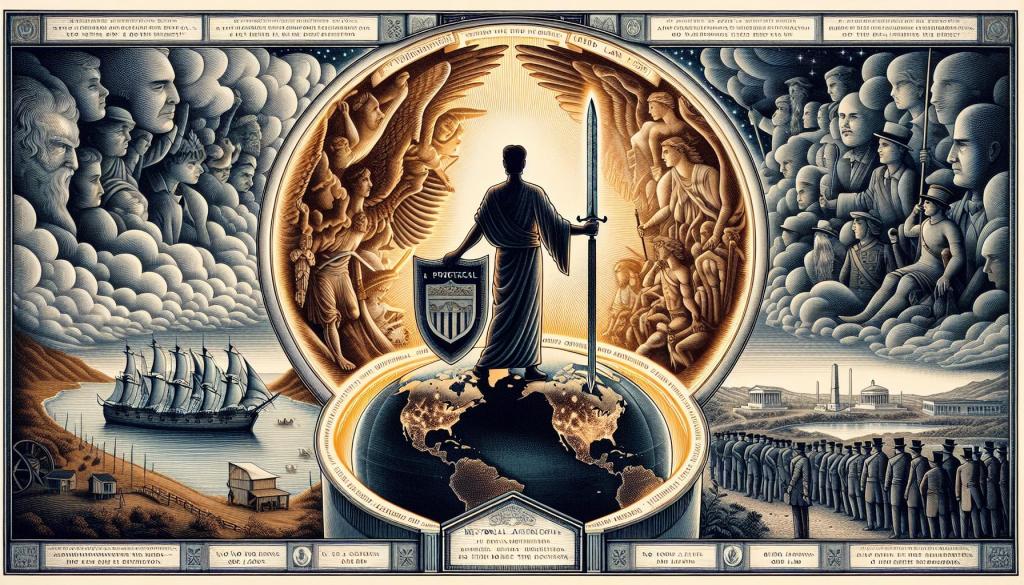
This report reexamines the Monroe Doctrine as both an anticolonial shield and a potential imperial sword. It first situates Monroe’s 1823 message in its immediate context of European great‑power rivalry, Latin American independence, and John Quincy Adams’s effort to separate “Old” and “New” World spheres while preserving U.S. freedom of action. It then turns to Latin American receptions, tracing how early gratitude for a putative protective guarantee hardened into suspicion after episodes such as the Mexican–American War. Finally, it analyzes the Doctrine’s long transformation into a U.S. sphere‑of‑influence claim, underpinning later hemispheric hegemony and intervention.
The Monroe Doctrine grew out of a particular post‑Napoleonic moment in which Latin American independence, European great‑power diplomacy, and U.S. republican self‑definition intersected. By 1823, much of Spanish America had broken away from Madrid, but the new republics remained vulnerable to reconquest or great‑power manipulation. U.S. policymakers, watching the conservative Holy Alliance and rumors of joint intervention to restore Spanish rule, perceived a real risk that European monarchies would reverse the wave of republican revolutions in the Western Hemisphere [1][3][4]. President James Monroe’s annual message that year responded directly to these perceived threats, warning against “new European colonial establishments” and the imposition of monarchies in Latin America, while pledging U.S. non‑interference in European internal affairs and in existing colonies [1][2][3][4].
The intellectual architect behind this stance was Secretary of State John Quincy Adams. He resisted British proposals for a joint Anglo‑American declaration that would deter recolonization but bind Washington to London’s broader imperial agenda [2][3]. Preferring an independent U.S. statement, Adams formulated a vision that sharply divided the world into “Old” and “New” spheres: Europe would manage its affairs without U.S. meddling, and the Western Hemisphere would be insulated from further European colonial expansion [2][3][4]. This framework drew on earlier republican foreign‑policy principles—from Washington’s Farewell Address and the neutral‑rights debates of the War of 1812—emphasizing non‑entanglement in Europe while asserting a distinct American geopolitical space [3][4]. Adams simultaneously negotiated with Russia over North American claims, indicating that Monroe largely entrusted him with shaping U.S. strategy on both hemispheric and northern questions [4].
From the outset, the doctrine’s language combined principle with interest. On its face, it proclaimed solidarity with the newly independent Latin American republics and opposition to monarchical restoration. Underneath, it articulated what later observers describe as a “foreign policy framework addressing America’s security and commercial interests in the Western Hemisphere” [4]. U.S. fears were not only ideological but strategic and economic: European footholds in Latin America might threaten trade routes, markets, and long‑term security, especially as Russian and other European powers tested the limits of expansion in the Pacific Northwest and former Spanish territories [3][4]. By asserting that further European colonization would be treated as a hostile act, the doctrine effectively stated that European powers were “obligated to respect the Western Hemisphere as the United States’ sphere of interest” [2], even as it stopped short of claiming formal supremacy or an explicit right of intervention.
Latin American leaders initially greeted Monroe’s statement with considerable appreciation. Statesmen such as Simón Bolívar, Santander in Colombia, Rivadavia in Argentina, and Victoria in Mexico interpreted the doctrine as an affirmation of their political independence and a barrier to European reconquest [1][2][4]. Yet scholarship underscores that core principles associated with the Monroe Doctrine—non‑colonization, respect for acquired rights, and the political distinctiveness of the Americas—had already been articulated within Latin American political thought before 1823. Republican leaders in Venezuela, the Río de la Plata, Chile, and Central America had advanced doctrines of hemispheric anti‑colonialism grounded in their own revolutionary experiences [2]. In this reading, Monroe’s message echoed, rather than originated, certain Latin American anti‑imperial ideas, complicating U.S.‑centric narratives that present the doctrine as a unilateral American gift of protection.
This shared anti‑colonial vocabulary helped explain why the 1823 message was initially welcomed south of the Rio Grande while eliciting relatively little formal response in Europe, where great powers largely ignored or discounted it at the time [1][3]. For Latin American governments, U.S. recognition and Monroe’s declaration appeared to align Washington with their struggle against European empires. The doctrine thus entered regional politics as a kind of diplomatic guarantee: an informal shield against outside monarchies at a moment of acute vulnerability [2][4][5].
Over time, however, the doctrine’s meaning shifted. Historians increasingly emphasize an “imperial paradox”: the same anti‑colonial posture that repelled European expansion also created conceptual space for the United States to claim a privileged, and ultimately dominant, role in the hemisphere [1][5]. From the early republic, U.S. elites imagined their nation as a rising power in the Americas, and the Monroe Doctrine functioned both as a shield and as a blueprint—excluding European rivals while leaving open, and in some interpretations quietly preparing, the possibility of U.S. expansion and regional primacy [1][5]. Even in 1823, the insistence on a distinct U.S. sphere of interest resembled later great‑power doctrines of informal empire and security orders: it did not demand annexation, but it marked the hemisphere as a special zone in which outside interference would be unacceptable and U.S. concerns would be paramount [2][3][4].
This latent hegemonic dimension became more visible in the mid‑nineteenth century. The Mexican–American War (1846–1848) marked a crucial turning point from Latin American perspectives. While the original doctrine had not explicitly endorsed U.S. territorial aggrandizement, some U.S. leaders invoked “Mr. Monroe’s Doctrine” in debates over expansion and intervention in Mexico [4][5]. President James K. Polk framed U.S. ambitions in terms of both Manifest Destiny and hemispheric security, suggesting that European involvement in a North American conflict could justify preemptive U.S. action [4][5]. After Mexico rejected offers to sell its northern territories, Polk dispatched troops into a disputed border area, provoking clashes that supplied a casus belli. The subsequent Treaty of Guadalupe Hidalgo transferred roughly 525,000 square miles—including future California, New Mexico, and much of Texas—to the United States in exchange for $15 million [4][5]. For many in Latin America, this episode exposed the tension at the heart of the doctrine: a pledge to block European empire that could double as cover for U.S. conquest.
Later in the nineteenth century and into the twentieth, the Monroe Doctrine increasingly served as a flexible justification for U.S. political and military interventions. While early applications included diplomatic and, in the case of support for Benito Juárez against French‑backed Emperor Maximilian in the 1860s, military pressure to expel European forces from Mexico, subsequent reinterpretations expanded its scope [2][4]. By framing European interference anywhere in the hemisphere as a potential threat, the doctrine could be read as authorizing Washington to police regional order. Over decades, this rhetoric undergirded U.S. actions in the Caribbean and Central America and, by the Cold War, was invoked in contexts far removed from the original fear of monarchic restoration: the Cuban Missile Crisis, interventions in Central America, and operations in Panama were all cast, in part, as continuations of the 1823 principle that extra‑hemispheric powers should not establish strategic footholds in the Americas [1][2].
Thus, a statement originally “conceived to meet major concerns of the moment” [2] hardened into a durable framework for U.S. regional hegemony. Its dual character—at once an anti‑colonial shield and an incipient claim to a sphere of influence—illustrates how doctrines can evolve beyond their authors’ immediate intentions. The Monroe Doctrine’s early emphasis on separating Old and New Worlds, supporting republican governments, and deterring European recolonization resonated with Latin American aspirations and long‑standing hemispheric ideas. Yet its assertion that the Western Hemisphere lay within a special U.S. zone of interest, combined with the country’s rising power, enabled later leaders to reinterpret the doctrine as a warrant for expansion, intervention, and informal empire. The historical record and subsequent scholarship suggest that the doctrine was never simply about disinterested protection nor about fully formed imperial design, but about a shifting blend of security concerns, commercial interests, republican ideology, and evolving ambitions for hemispheric primacy [1][2][3][4][5][6].
Conclusion
Across its history, the Monroe Doctrine has functioned less as a fixed rule than as a mutable political language. Originating in 1823 from concrete fears of European recolonization and Adams’s careful separation of Old and New World “spheres,” it initially appeared as a defensive, republican shield. Latin American leaders at first read it that way, even seeing it as echoing their own anti‑colonial principles. Yet the same doctrine soon underwrote U.S. expansion—most starkly in Mexico—and evolved into a wider claim to hemispheric primacy. The Monroe Doctrine thus straddles anticolonialism and empire, revealing how security doctrines can harden into hegemonic projects.
Sources
[1] Weiss, Jo. “The Imperial Paradox of the Monroe Doctrine.” Webster Review of International History 4, no. 2 (2024). https://websterreview.lse.ac.uk/articles/73/files/67a3db13f282c.pdf
[2] “The Monroe Doctrine from the Standpoint of International Law and of International Politics.” Washington University Law Review. https://openscholarship.wustl.edu/cgi/viewcontent.cgi?article=5605&context=law_lawreview
[3] “The Monroe Doctrine, 1823.” Office of the Historian, U.S. Department of State. https://history.state.gov/milestones/1801-1829/monroe
[4] “The Monroe Doctrine, the United States, and Latin American Independence.” U.S. Diplomacy Center / Diplomacy Museum. https://diplomacy.state.gov/stories/the-monroe-doctrine-the-united-states-and-latin-american-independence/
[5] “Manifest Destiny, the Monroe Doctrine, and the Mexican-American War.” Brock University Journal of History. https://journals.library.brocku.ca/index.php/bujh/article/view/4200/3167
[6] Ernest R. May, The Monroe Doctrine, 1823–1826. Text scan. https://archive.org/stream/in.ernet.dli.2015.187613/2015.187613.The-Monroe-Doctrine-1823-1826_djvu.txt
[7] Thesis on Monroe and Adams (includes discussion of Jay Sexton). CORE repository. https://core.ac.uk/download/228820186.pdf
[8] Review of work on U.S. foreign relations and nineteenth‑century United States. https://mdon.library.pfw.edu/digital/api/collection/p16776coll2/id/2870/download
[9] “Monroe Doctrine.” History.com. https://www.history.com/articles/monroe-doctrine
[10] “Monroe Doctrine.” Encyclopedia Britannica. https://www.britannica.com/event/Monroe-Doctrine
[11] “The Monroe Doctrine.” U.S. National Archives, Milestone Documents. https://www.archives.gov/milestone-documents/monroe-doctrine
[12] “Monroe Doctrine.” Wikipedia. https://en.wikipedia.org/wiki/Monroe_Doctrine
[13] “The Monroe Doctrine, the United States, and Latin American Independence.” (Alternate access). https://diplomacy.state.gov/stories/the-monroe-doctrine-the-united-states-and-latin-american-independence/
[14] YouTube lecture on the Monroe Doctrine. https://www.youtube.com/watch?v=EElXGPupRUk
Written by the Spirit of ’76 AI Research Assistant



 Realizing News
Leave a comment