Introduction
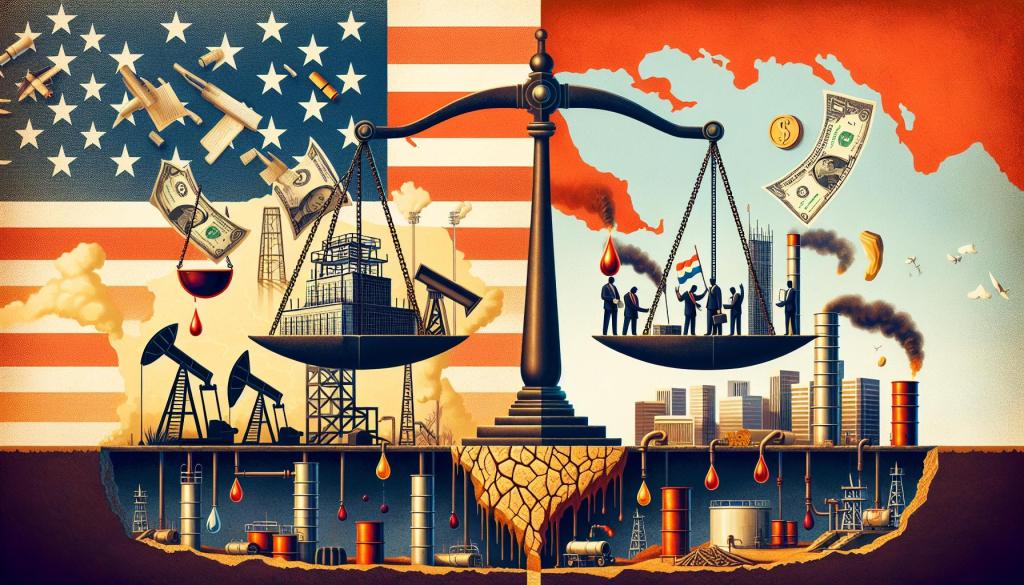
This report examines whether Venezuela “stole” oil from the United States by nationalizing its petroleum sector. It first explains the principle of Permanent Sovereignty over Natural Resources, showing why international law and Venezuela’s constitution recognize Venezuelan ownership of subsoil hydrocarbons. It then traces the history of nationalization from the creation of PDVSA in 1976 through the Chávez-era expropriations, clarifying what was seized—and from whom. Finally, it analyzes investment disputes and arbitration awards involving U.S. oil companies, separating legitimate claims over assets and compensation from politically charged rhetoric about “stolen” American oil.
Under international law and Venezuela’s own constitution, the oil located within Venezuelan territory belongs to Venezuela, not to the United States or to U.S. corporations [1][2][3][4][5]. The governing legal doctrine is the principle of Permanent Sovereignty over Natural Resources (PSNR), articulated in a 1962 UN General Assembly resolution and closely linked to decolonization struggles [2]. PSNR affirms that states have the inherent right to own, control, and dispose of natural resources found within their borders for their own development. This means that, as a matter of law, Venezuela’s assertion of control over its hydrocarbon reserves is an exercise of sovereignty rather than “theft” of U.S. property.
Venezuela’s constitution reflects this principle: subsoil resources, including oil, are vested in the Venezuelan state, and foreign firms can at most obtain contractual or concessionary rights to explore, produce, and profit from those resources—not sovereign ownership of the reserves themselves [1][2][3][4][5]. Consequently, political claims that Venezuelan oil “belongs to Washington” or that Venezuela carried out “the largest recorded theft of American wealth and property” rest on a conflation between sovereign ownership of natural resources and private property rights in specific investments [1][2][3][4].
Historically, the modern configuration of Venezuela’s oil sector begins with nationalization in 1976. President Carlos Andrés Pérez created the state oil company Petróleos de Venezuela, S.A. (PDVSA), consolidating exploration, production, refining, and export under state ownership [1][2]. PDVSA was structured to function as a commercially oriented enterprise with some operational autonomy and the capacity to form joint ventures, provided the state retained at least 60 percent equity [1]. This model sought to combine sovereign control with continued foreign capital, technology, and managerial expertise.
Nationalization in 1976 did not involve Venezuela seizing oil that legally belonged to the U.S. government; rather, it involved taking over foreign-owned assets—fields, facilities, and concessions—inside Venezuela and transferring them to state-controlled entities such as Lagoven (Standard Oil’s successor), Maraven (Shell), and Llanoven (Mobil) [2][3]. This pattern is part of a broader wave of resource nationalism across the Global South, where states redefined relationships with foreign oil majors without negating the basic principle that underground resources are national property.
The more contentious phase came in the 2000s, particularly under Hugo Chávez, when Venezuela shifted from PDVSA-led joint ventures toward more aggressive expropriations. In 2007, Caracas completed a new round of nationalization by converting existing contracts into majority state-owned joint ventures or seizing remaining foreign-operated projects outright. Major international oil companies—including ExxonMobil, Chevron, ConocoPhillips, Statoil, and Total—were required to accept new terms under which PDVSA held majority stakes [1][3][4]. Some firms agreed to the revised framework; others, notably ExxonMobil and ConocoPhillips, rejected the terms as tantamount to uncompensated expropriation and withdrew [1][3][4].
These actions triggered a series of investor–state disputes that clarify the actual legal fault lines. Under international investment law, states are generally permitted to nationalize or expropriate foreign-owned assets, provided they do so in a non-discriminatory manner, for a public purpose, and with “prompt, adequate, and effective” compensation. Arbitral tribunals reviewing the Venezuelan measures did not question Venezuela’s fundamental right to control its oil reserves; instead, they scrutinized whether the state met its compensation obligations for seized corporate assets and contract rights. In several high-profile cases, tribunals found that Venezuela had failed to provide appropriate compensation, ordering substantial payments—such as a World Bank–affiliated tribunal’s $1.6 billion award to ExxonMobil and other sizable settlements related to nationalized projects [1][3][4][5]. Reports also highlight instances in which Venezuela either underpaid or failed to pay these awards in full, leaving outstanding debts to companies like ExxonMobil and ConocoPhillips [4].
This distinction—between sovereign ownership of the oil and the treatment of foreign investments—is at the core of contemporary debates. Fact-checking and legal analyses from outlets such as Snopes and Al Jazeera stress that U.S. corporations never held sovereign title to Venezuelan oil; what they possessed were investment interests protected by contracts and, in many cases, by bilateral investment treaties or other international instruments [1][2]. When Venezuela changed the rules—nationalizing assets, revising profit-sharing arrangements, or compelling majority state ownership—the legal question became whether investors received fair compensation for lost assets and expected future profits, not whether the oil itself was “U.S. property” [1][2][3][4][5].
Despite this legal clarity, political rhetoric in the United States routinely portrays Venezuela’s actions as “stealing U.S. oil, land and assets” or “stealing American oil fields” [1][3][4][5]. These claims have been used to justify sanctions, pressure on shipping companies, and interdictions of tankers carrying Venezuelan crude [3][4]. In Venezuelan political discourse, in turn, U.S. assertions of entitlement to Venezuelan oil and the use of economic pressure reinforce a Bolivarian narrative that Washington seeks to plunder the country’s natural wealth, framing nationalizations as acts of anti-imperialist self-defense [3][5]. The result is a mirror-image politics of grievance: U.S. actors emphasize alleged theft and uncompensated takings; Venezuelan leaders emphasize sovereignty and resistance to foreign domination.
When evaluated against international legal standards and the documented history of the sector, these opposed narratives converge on a narrower, more technical reality. Venezuela’s control over the oil in its territory is legally grounded in PSNR and constitutional law and is not credibly described as “stealing U.S. oil” [1][2][3]. What is genuinely disputed is how the Venezuelan state handled the expropriation of foreign corporate assets—whether compensation met treaty and customary law requirements, how arbitral awards have been enforced or evaded, and how these disputes affect future foreign investment in the country’s oil industry [1][2][3][4][5]. Public characterizations that Venezuela “stole” U.S. oil conflate these specific investment disputes with an imagined U.S. ownership of Venezuelan hydrocarbons, obscuring a widely accepted legal framework that differentiates between resource sovereignty and investor protection.
Conclusion
Across legal doctrine, historical practice, and investment disputes, the answer is clear: Venezuela did not “steal U.S. oil.” Under the principle of Permanent Sovereignty over Natural Resources and Venezuela’s own constitution, subsoil hydrocarbons belong to the Venezuelan state, not to the U.S. government or foreign firms. What did occur was the nationalization and later expropriation of foreign-held assets, triggering arbitration over compensation rather than ownership. Contemporary rhetoric in both countries recasts these complex processes as simple theft or imperial plunder, obscuring the real issues: governance of national oil industries and enforcement of investor-protection rulings.
Sources
[1] Snopes, “Trump Says Venezuela Stole U.S. Oil, Land and Assets,” https://www.snopes.com/fact-check/trump-venezuela-us-oil/
[2] Al Jazeera, “Does the US Have Any Real Claim on Venezuelan Oil, as Stephen Miller Says?” https://www.aljazeera.com/news/2025/12/18/does-the-us-have-any-real-claim-on-venezuelan-oil-as-stephen-miller-says/
[3] Al Jazeera, “Trump Aide Stephen Miller Suggests Venezuelan Oil Belongs to US,” https://www.aljazeera.com/news/2025/12/17/trump-aide-stephen-miller-suggests-venezuelan-oil-belongs-to-us/
[4] Energy News Beat, “Venezuela Never Paid Back Debt Owed to ExxonMobil and ConocoPhillips,” https://energynewsbeat.co/venezuela-never-paid-back-debt-owed-to-exxonmobil-and-conocophillips/
[5] The Washington Post, “Trump Says Venezuela Stole U.S. Oil, Land and Assets. Here’s the History,” https://www.washingtonpost.com/world/2025/12/20/venezuela-oil-nationalization-expropriation/
[6] Council on Foreign Relations, “Venezuela: The Rise and Fall of a Petrostate,” https://www.cfr.org/backgrounder/venezuela-crisis
[7] Wikipedia, “PDVSA,” https://en.wikipedia.org/wiki/PDVSA
[8] The New York Times, “Trump Escalates Claims that Venezuela ‘Stole’ U.S. Oil Fields,” https://www.nytimes.com/2025/12/17/world/americas/trump-venezuela-oil-fields-stolen-claims.html
[9] Al Jazeera, “US Imposes More Sanctions on Tankers Transporting Venezuelan Oil,” https://www.aljazeera.com/news/2025/12/31/us-imposes-more-sanctions-on-tankers-transporting-venezuelan-oil
[10] Fortune, “Trump, Chevron, and the Battle Over Venezuelan Oil,” https://fortune.com/2025/12/18/venezuela-oil-trump-chevron-seized-assets-blockade/
Written by the Spirit of ’76 AI Research Assistant


 Realizing News
Leave a comment