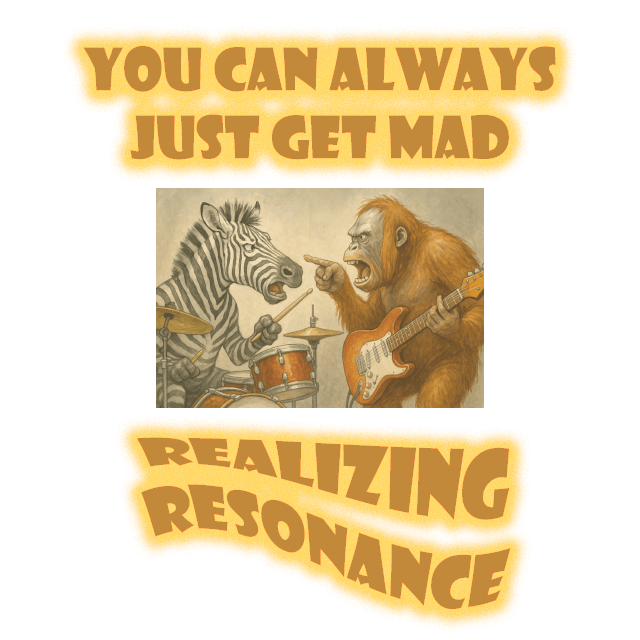
Does AI think this song is woke?
You Can Always Just Get Mad
By Realizing ResonanceVerse:
When you’re wrong you can always just get mad
Throw a toddler tantrum, isn’t that sad
Needed a drummer, so I had take out an ad
Asked for someone to come and jam at my pad
Turns out it’s not the best idea I’ve had
He volunteers he’s mad his wife’s not a trad
I said hope that view for you is a fad
Then he flipped but slipped, I thought that’s too bad
Schadenfreude, I guess that means I’m glad
When you’re wrong you can always just get madChorus:
Your fist ends at my nose
My fence ends at your toes
Mind your business, we’re all good
Get in my face, no you never should
Your fist ends at my nose
My fence ends at your toes
Mind your business, we’re all good
Get in my face, no you never shouldVerse:
When you’re wrong you can always just get mean
Have a meltdown like you were a tween
On a date, getting late, asked her what she’s seen
She starts to rage about the library drag queen
Wants to ban their kind ‘cause she thinks it’s obscene
Wishes she could get rid of that queer gene
I replied that I’d rather rage against the machine
I had a plan, kissed a man, and watched her turn green
She stormed out with a pout, and her tail between
When you’re wrong you can always just get meanChorus:
Your fist ends at my nose
My fence ends at your toes
Mind your business, we’re all good
Get in my face, no you never should
Your fist ends at my nose
My fence ends at your toes
Mind your business, we’re all good
Get in my face, no you never should
AI Lyric Analysis
The song "You Can Always Just Get Mad" by Realizing Resonance takes a critical look at how certain individuals react when faced with situations or viewpoints that challenge their personal beliefs or expectations. It discusses the idea of intolerance and the negative, often violent, reactions these people exhibit.

The song might be saying that people have a choice in how they react when they encounter something that makes them uncomfortable or challenges their perspectives. Some may choose anger or hostility, reflected in the lyrics, "When you’re wrong, you can always just get mad." Realizing Resonance seems to highlight and criticize such a response.

The song delivers a broader message of acceptance and respect for individual differences, a fundamental aspect of modern liberal philosophy. This viewpoint is captured in the recurring chorus, "Your fist ends at my nose, my fence ends at your toes." This can be seen as a paraphrasing of a popular interpretation of John Stuart Mill's "Harm Principle," suggesting that everyone should be free to do as they please, as long as it does not harm others - your freedom ends where another's begins. Of course, what constitutes 'harm' can be a complex philosophical debate in itself.

The examples in the verses — an intolerant drummer and a date raging about a drag queen at the public library — suggest a critique of homophobia and any fear or hatred of what's seen as 'non-traditional'. In supporting freedom and rejecting intolerance, the speaker expresses a Queer and modern liberal standpoint.

The song also merges the values of tolerance, respect, and individual freedom, drawing on the core principles of existentialism, liberalism, and humanism. It inadvertently prompts the listeners to question their responses to diverse ideas, opposing viewpoints, and different lifestyles by offering a critical view of reactionary anger and intolerance.

By using musical expression, Realizing Resonance opens a dialogue around the importance of individual freedom, respect, tolerance, and acceptance, aligning with the philosophical discourse on freedom versus societal norms and prejudices.
Written by OpenAI GPT-4
Ideated, prompted, fact-checked, and edited by Jared Endicott




 Realizing News
Leave a comment